Creating a Consumer Research Report for the Matcha Category
12 mins read - Created on Jul 28, 2026Once rooted primarily in traditional Japanese tea culture, matcha now appears across café-style lattes, smoothies, baked goods, and wellness-focused drinks. This expanding range of products has also created varied expectations around flavor, authenticity, preparation, health benefits, and overall quality.
In this tutorial, we’ll analyze 1,467 customer reviews from across the matcha category and build a consumer research report for the fictional brand Kizuna Matcha. Using selected analytical dimensions, we’ll examine what shapes satisfaction, why consumers choose matcha, who is driving the category, how matcha fits into everyday routines, and which alternatives compete for the same consumer needs.
Let’s start!
Before we begin, download the sample dataset and upload it to your Kimola workspace. We’ll use this dataset throughout the tutorial to build and explore the report step by step.
If you don’t already have a Kimola account, sign up, log in, and navigate to the Dashboard Home page.
Understanding Your Dataset
Before building your report, take a moment to review the dataset you'll be working with. Understanding what information is available will make it easier to interpret your analyses and choose the dimensions that best answer your research questions.
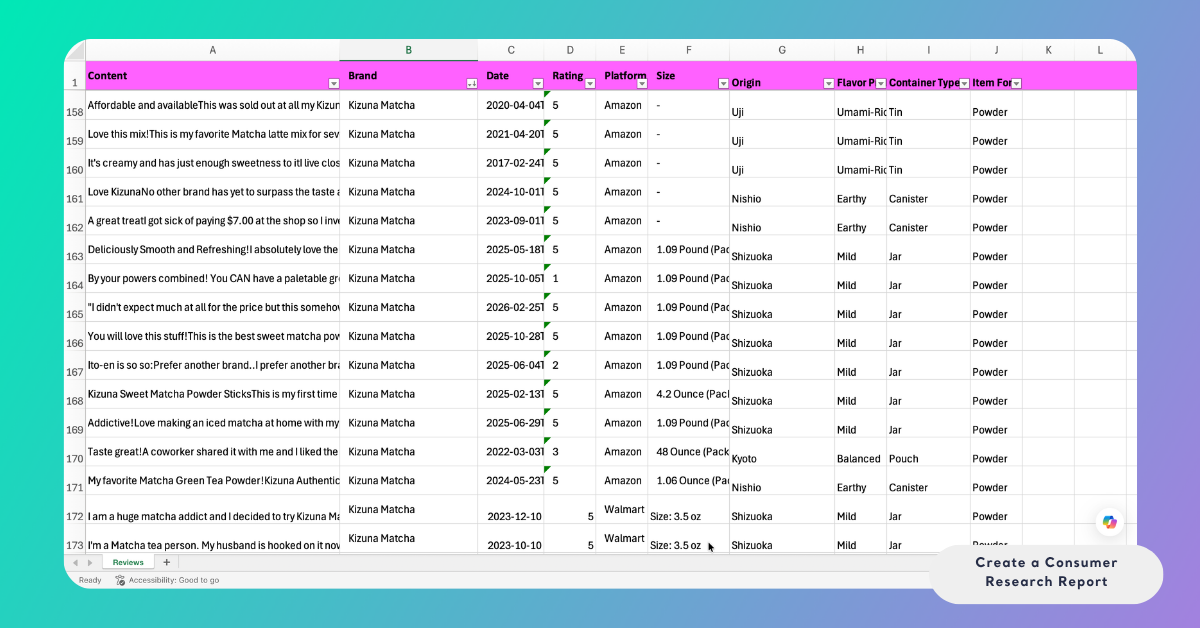
This dataset combines customer review text with structured product information, allowing you to analyze both what consumers are saying and how their opinions vary across different product characteristics.
The Content column provides the foundation for text analysis, while the structured columns add context that can be used to segment, filter, and compare customer feedback. Together, they allow you to explore the category from both qualitative and quantitative perspectives.
Before preparing a dataset, think about the questions you may want to answer later. Adding structured information such as brands, platforms, dates, or product attributes from the beginning makes filtering, comparisons, and deeper analysis much easier.
Creating Your Report
With your dataset prepared, you're ready to create your consumer research report in Kimola.
From the Dashboard Home page, select Upload your custom dataset and upload the sample dataset. Kimola will guide you through a short setup process before generating your report.
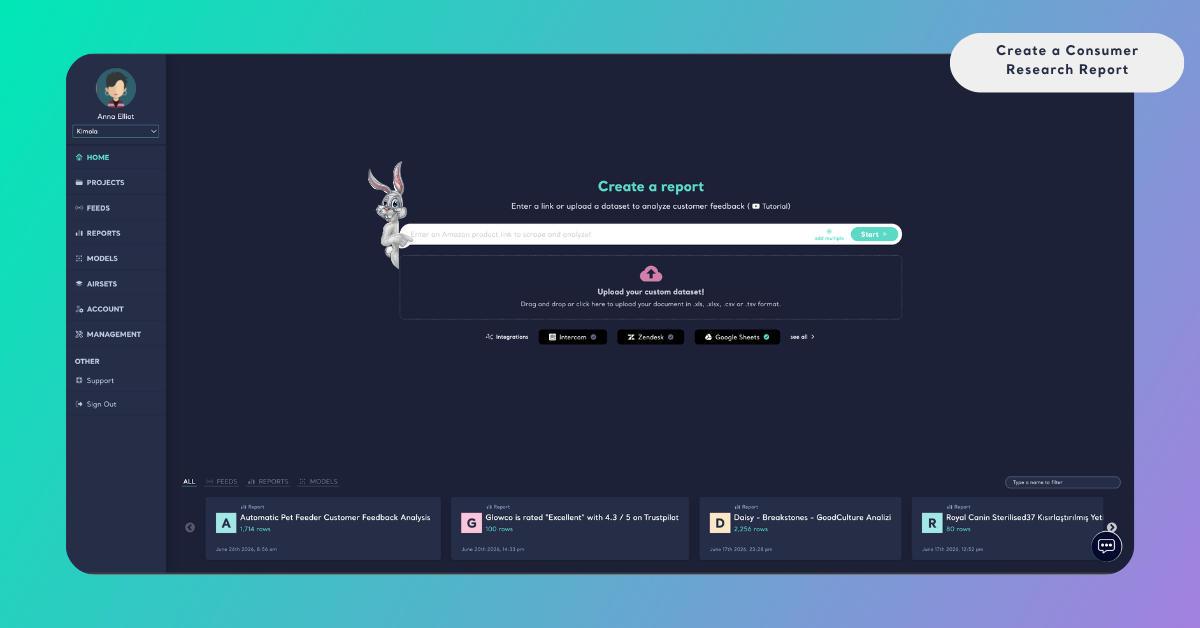
Begin by reviewing your dataset and mapping the required columns. Assign the Content column as the Text Column, as this contains the customer reviews that will be analyzed. You can also map additional structured columns—such as ratings, dates, brands, and product attributes—to enrich your report and provide additional context for your analyses.
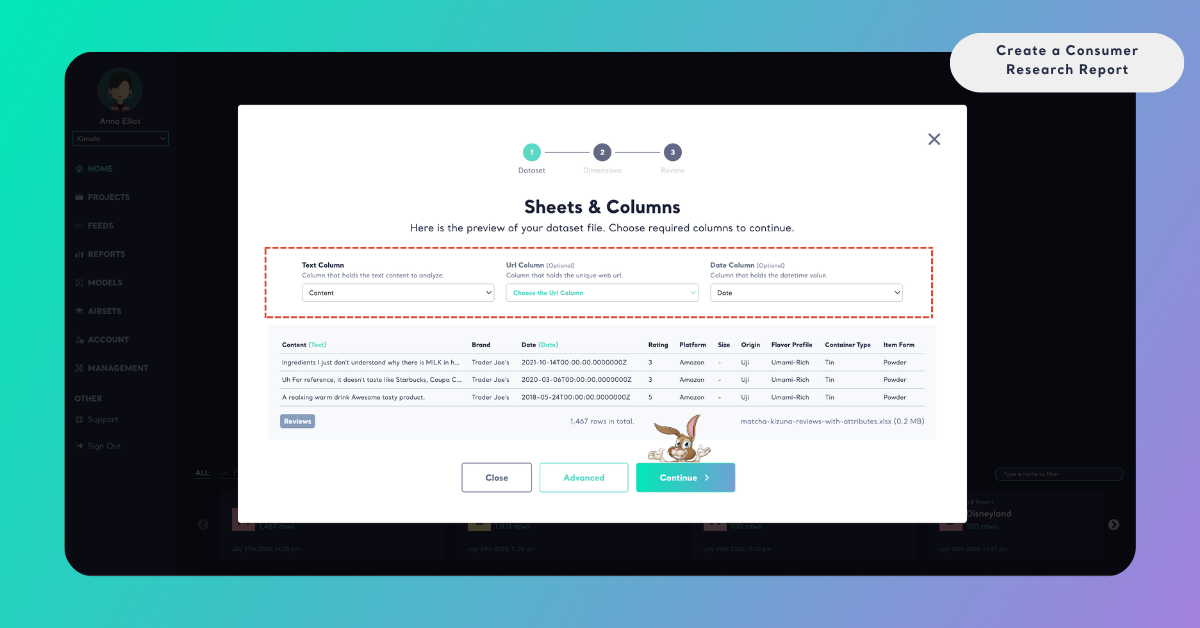
Next, choose the analytical dimensions you want to include in your report. Each dimension examines customer feedback from a different perspective, allowing you to explore topics such as consumer sentiment, purchase motivations, personas, underlying causes, and other aspects of the customer experience.
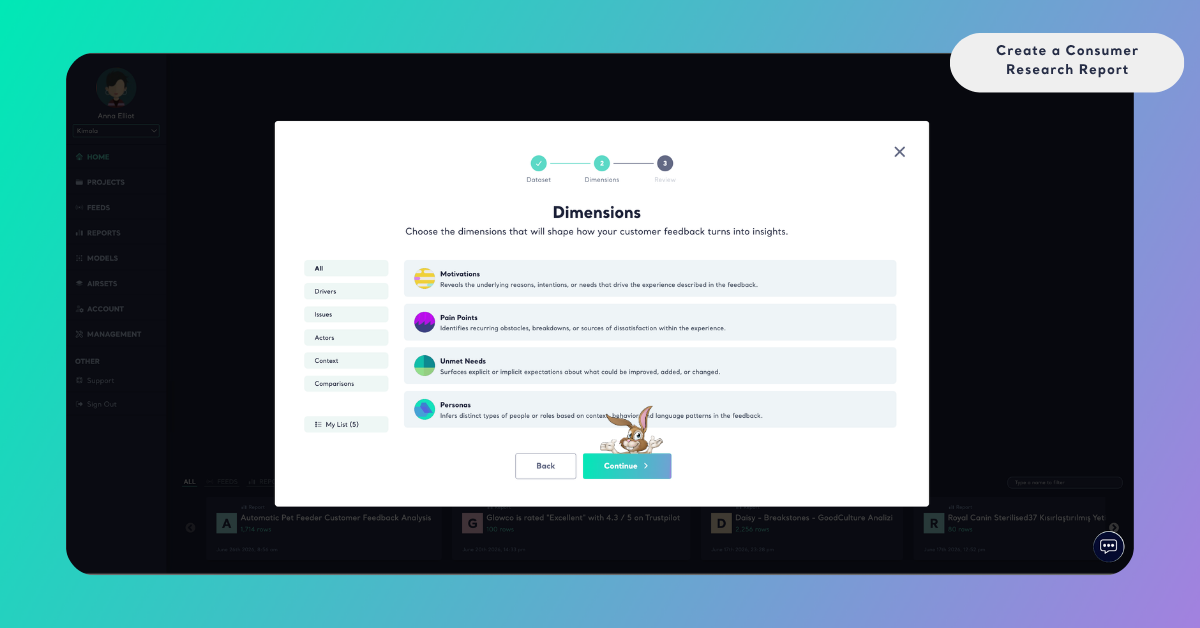
Finally, review your report settings, choose a report name and language, and click Create Report to begin the analysis.
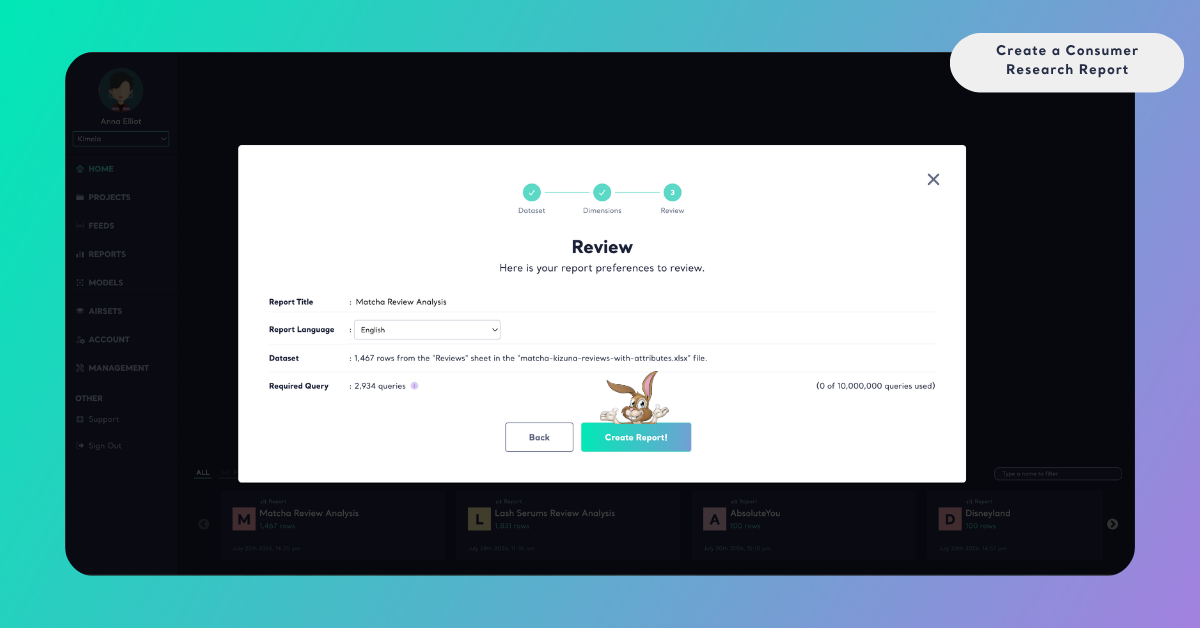
You don't need to include every analytical dimension when creating your report. As your research questions evolve, you can return to the report at any time and add additional dimensions without creating a new report.
Once processing is complete, your report is ready to explore. In the next section, we'll start with the Overview page to get a high-level understanding of the report before diving into individual analyses.
A First Look at Your Report
With your report complete, the Overview page is the best place to begin your analysis. Rather than jumping directly into individual dimensions, it provides a high-level summary of the dataset, helping you quickly understand the most important patterns before exploring them in greater detail.
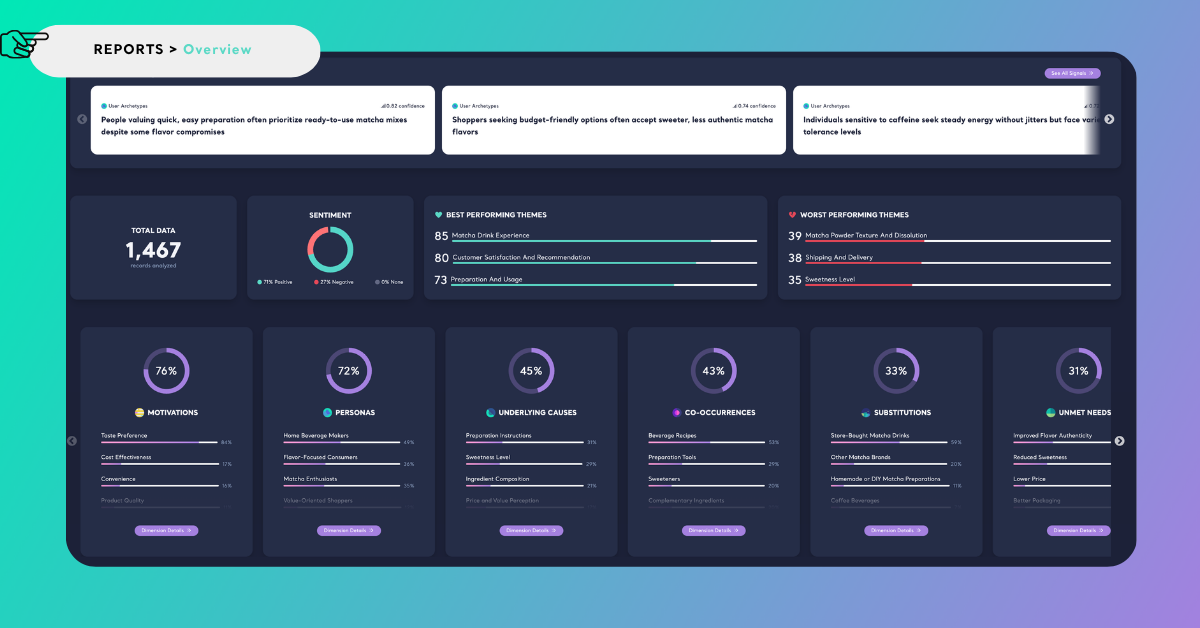
The Overview page brings together your report's key findings in a single place, including Signals, executive summaries, sentiment distribution, theme performance, previews of selected analytical dimensions, and customer reviews enriched with AI-generated classifications such as sentiment and themes. Together, these elements provide a concise snapshot of the category and help you decide where to focus your analysis.
Throughout this tutorial, we'll use the report to answer a series of consumer research questions. Each analytical dimension offers a different perspective on the Matcha category, and together they build a comprehensive understanding of consumer behavior.
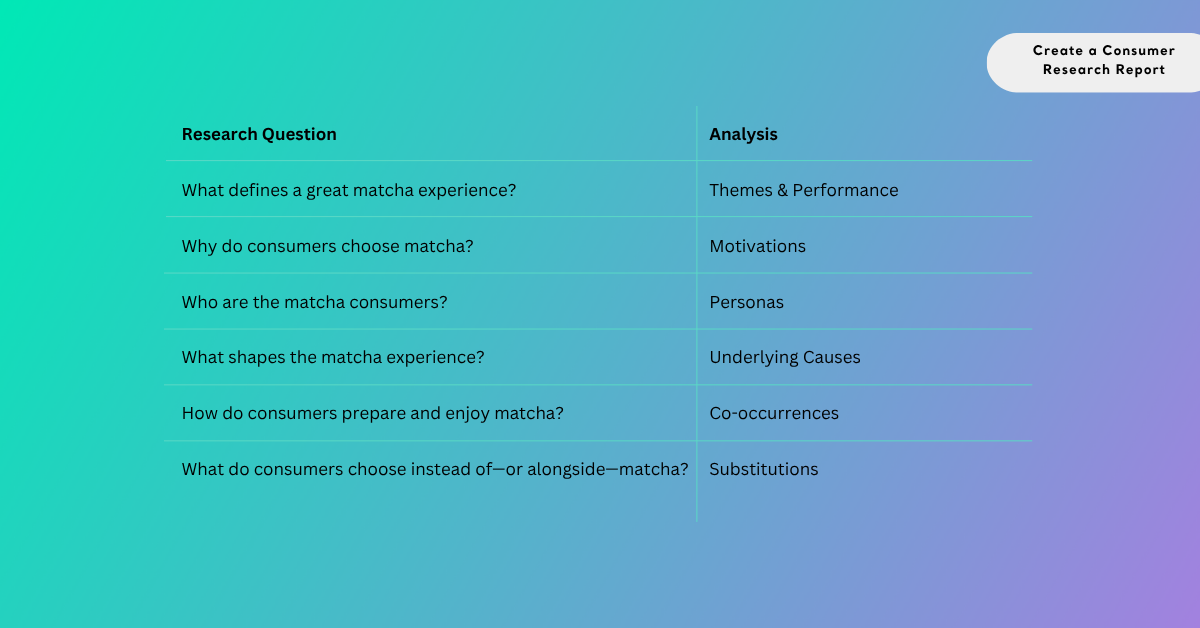
We'll begin with Signals, which provides an initial understanding of the dataset by surfacing the most meaningful patterns before examining the analyses behind them.
What Signals Emerge From Customer Feedback
When exploring a new category, one of the first questions researchers ask is: What are the most important patterns in the data? The Signals dimension helps answer this question by bringing together findings from multiple analyses and highlighting the relationships that stand out across customer feedback. Rather than replacing individual analyses, Signals provide a starting point for deciding which insights deserve deeper investigation.
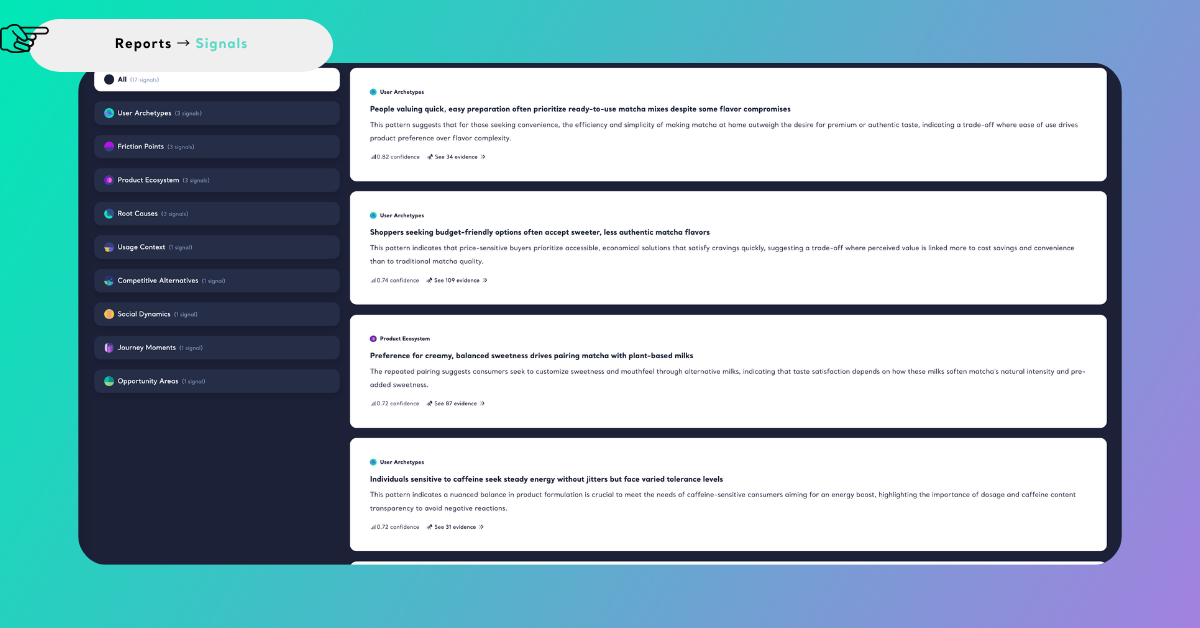
The Signals identified in the Kizuna Matcha report reveal several recurring patterns that shape the category. One of the strongest findings is that consumers associate a positive Matcha experience with authentic flavor, smooth texture, and easy preparation, suggesting that convenience alone is not enough to drive satisfaction. Another Signal highlights the growing role of home preparation, with consumers frequently incorporating Matcha into daily routines, smoothies, and milk-based drinks. The analysis also uncovers a strong connection between ingredient quality, product authenticity, and consumer trust, indicating that purchasing decisions are influenced by more than taste alone.
Together, these Signals provide an initial understanding of the category and help prioritize the topics worth exploring in greater detail. In the following sections, we'll examine the analyses behind these patterns to better understand what drives satisfaction, influences purchasing decisions, and shapes the overall Matcha experience.
Signals are generated automatically when your report includes enough analyses to identify meaningful relationships. If too few dimensions are selected, Signals won't be available.
What Drives Satisfaction in the Matcha Category
The Signals introduced the key patterns emerging from the dataset. The next step is understanding which aspects of the Matcha experience contribute most to consumer satisfaction. By combining the Themes and Performance analyses, you can identify not only what consumers discuss most frequently, but also how successfully each aspect of the experience meets their expectations.
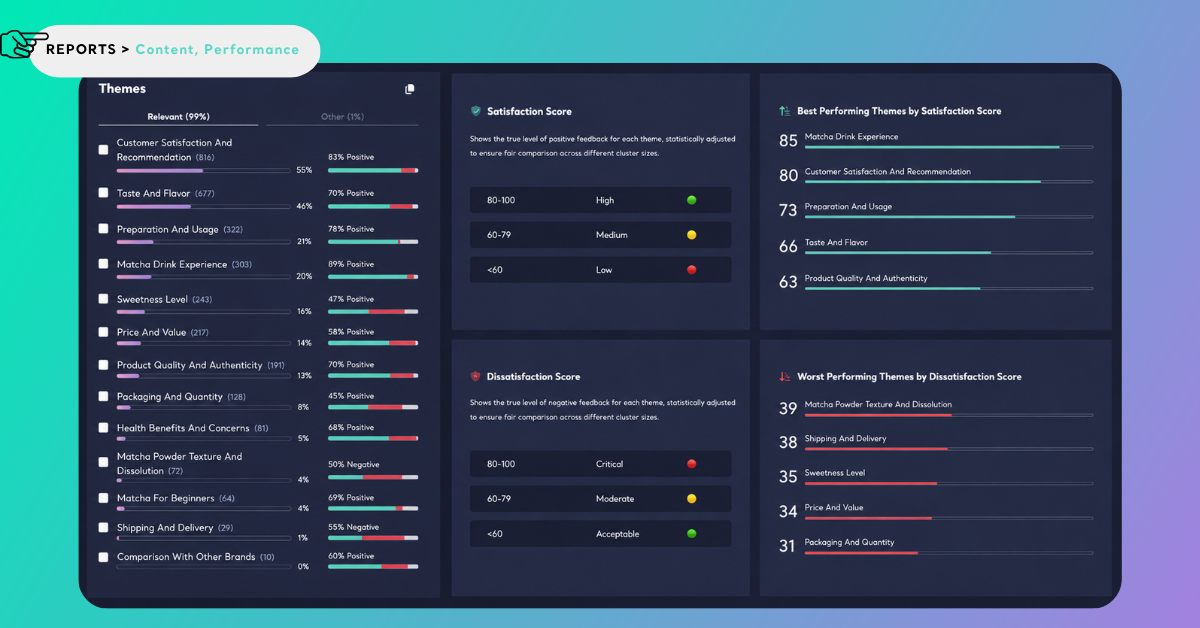
The analysis shows that customer conversations are primarily centered around Customer Satisfaction & Recommendation, Taste & Flavor, Preparation & Usage, and the overall Matcha Drink Experience. Together, these themes suggest that consumers evaluate Matcha as a complete experience—from preparation and flavor to the quality of the final drink and whether it is worth recommending to others.
Looking beyond discussion volume, the Performance analysis reveals which themes create the most satisfying experiences. Matcha Drink Experience, Customer Satisfaction & Recommendation, and Preparation & Usage achieve the highest Satisfaction Scores, indicating that consumers generally value products that are enjoyable to prepare, pleasant to drink, and easy to incorporate into their daily routines.
Not every frequently discussed theme performs equally well, however. Sweetness Level, Price & Value, Packaging & Quantity, Shipping & Delivery, and particularly Matcha Powder Texture & Dissolution receive the lowest Satisfaction Scores. These findings suggest that although consumers appreciate Matcha as a category, formulation, product quality, packaging, and value perception remain important sources of dissatisfaction.
Together, these analyses help distinguish between what consumers talk about most and what has the greatest impact on satisfaction, providing a clear starting point for understanding where the category performs well and where opportunities for improvement remain.
Why Do Consumers Choose Matcha
Understanding why consumers choose a product is just as important as understanding what they think about it. While Themes and Performance explain the experiences consumers have after purchase, the Motivations analysis reveals the needs, expectations, and decision factors that influence purchasing decisions in the first place.
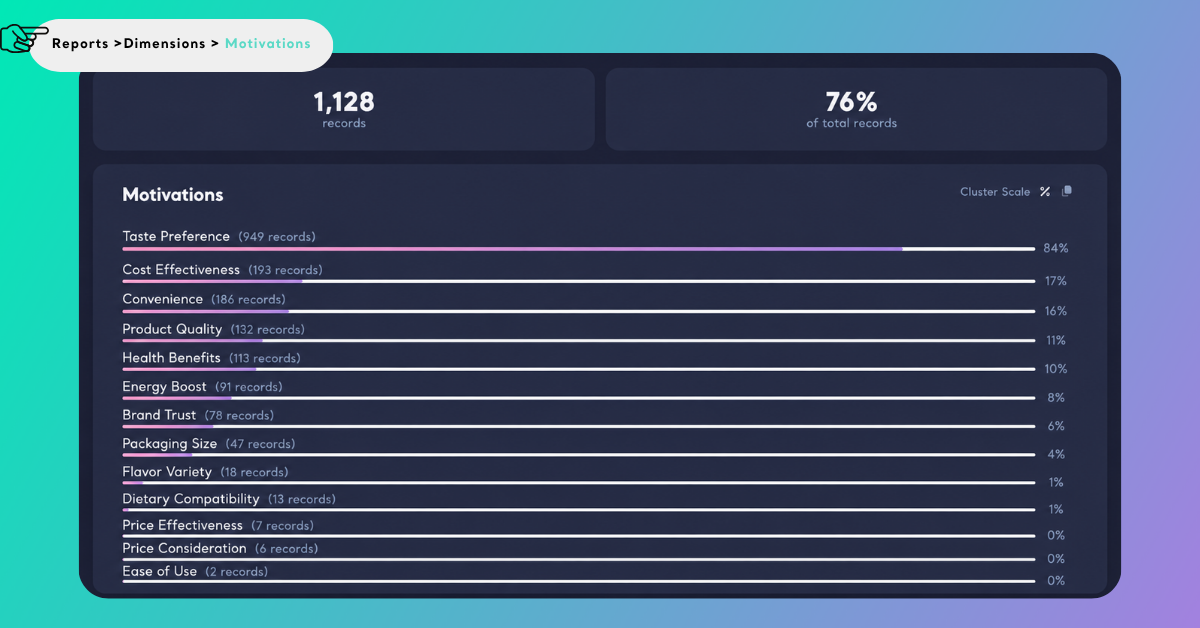
The analysis shows that taste is by far the strongest purchase driver, indicating that consumers primarily seek a balanced and enjoyable Matcha experience. Convenience and affordability follow closely, reflecting a growing preference for products that fit easily into daily routines while offering a café-style experience at home. Health benefits, product quality, and brand trust further strengthen purchase intent, suggesting that consumers evaluate Matcha not only for its flavor but also for its role in supporting healthier lifestyles.
Together, these motivations show that purchasing decisions are rarely driven by a single factor. Instead, consumers look for products that successfully combine enjoyable taste, everyday convenience, perceived health benefits, and good value—revealing the combination of attributes most likely to influence product choice within the category.
Who Is Driving the Matcha Category
Purchase motivations explain why consumers choose Matcha, but they don't reveal whether those motivations are shared by the same type of consumer. The Personas analysis fills this gap by grouping consumers with similar behaviors, preferences, and consumption patterns, making it easier to understand the audiences shaping the category.
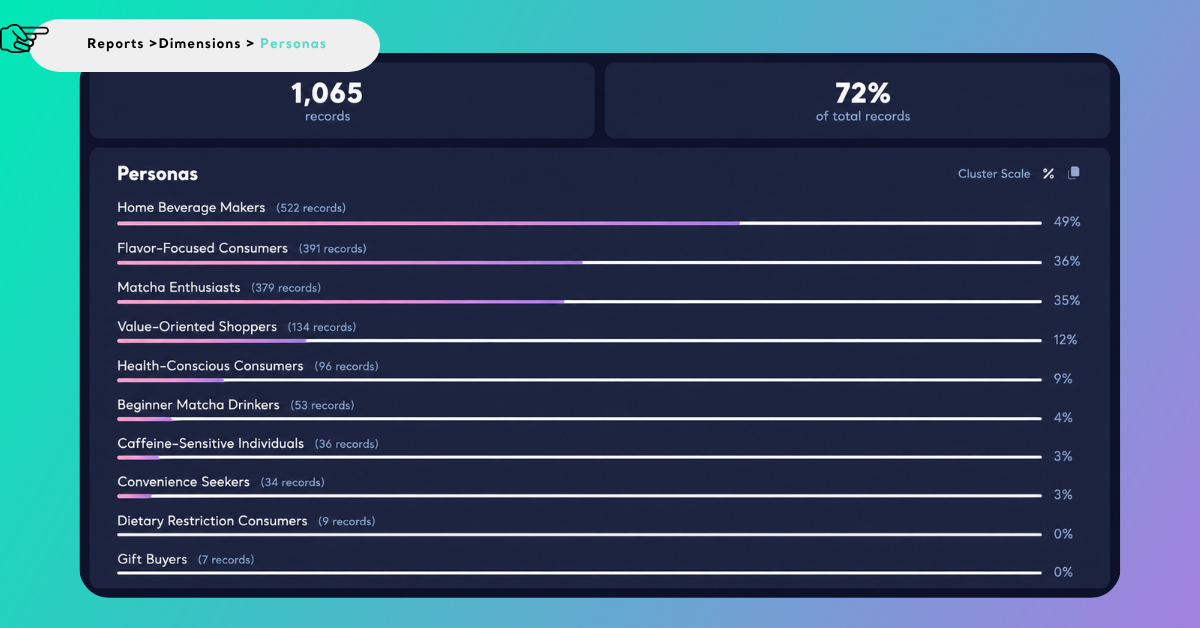
The analysis shows that Home Beverage Makers represent the largest consumer segment, highlighting Matcha's role as an everyday at-home beverage rather than an occasional café purchase. Alongside this core audience, Flavor-Focused Consumers and Matcha Enthusiasts emphasize the importance of authentic taste, preparation quality, and product expertise. Additional personas—including Value-Oriented Shoppers, Health-Conscious Consumers, Beginner Matcha Drinkers, and Convenience Seekers—demonstrate that the category attracts consumers with a wide range of priorities, from affordability and wellness to convenience and accessibility.
Exploring individual personas provides additional context for these findings. For example, the Home Beverage Makers persona frequently describes preparing Matcha as part of everyday routines, recreating café-style beverages at home while balancing convenience, taste, and cost. Similar persona-level insights help explain how different consumer groups experience the category and what they value most.
Together, these findings show that the Matcha category is shaped by multiple consumer segments rather than a single target audience. Recognizing these differences provides valuable context for interpreting the consumer behaviors and experiences explored in the following sections.
What Underlying Factors Shape the Matcha Consumer Experience
Different consumer segments often describe very different experiences with the same product. Understanding the reasons behind these differences is essential for identifying what truly shapes the customer experience. The Underlying Causes analysis moves beyond individual comments to uncover the factors that influence recurring patterns in consumer feedback.
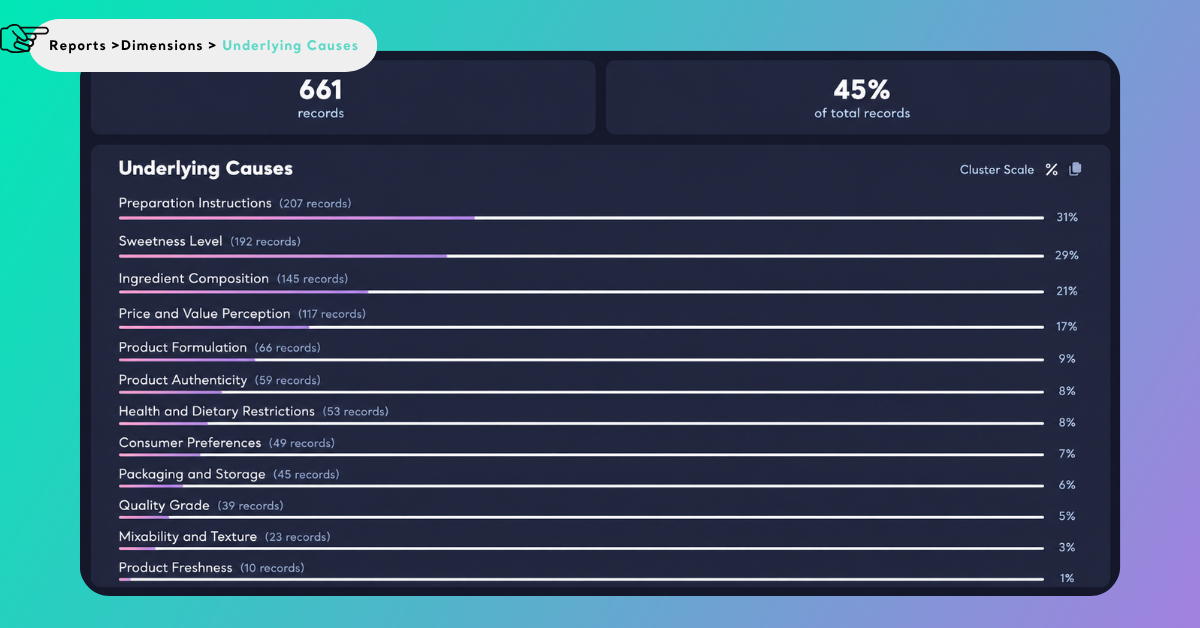
The analysis reveals that Matcha experiences are primarily shaped by the interaction between product formulation, ingredient composition, preparation methods, packaging quality, and individual health needs. Formulation choices—such as the use of added sugars, flavorings, fillers, and different Matcha grades—have a significant influence on flavor authenticity, sweetness, texture, and overall product quality. Preparation instructions, serving recommendations, and powder characteristics further affect ease of use and the final drinking experience, while packaging and storage conditions influence freshness and product integrity throughout the consumer journey.
The findings also show that personal factors—including dietary restrictions, caffeine sensitivity, and expectations for authentic Matcha—help explain why the same product can generate very different reactions among different consumer groups. Rather than being driven by a single issue, consumer experiences emerge from the interaction between product design, formulation decisions, usage conditions, and individual expectations. Understanding these underlying factors provides valuable context for interpreting the behaviors and consumption patterns explored in the next section.
How Do Consumers Prepare and Enjoy Matcha
Customer reviews reveal more than opinions about the product itself. They also describe the ingredients, tools, recipes, and routines that surround Matcha consumption, providing valuable insight into how consumers incorporate the product into their everyday lives. The Co-occurrences analysis brings these relationships together, uncovering the broader consumption ecosystem behind the category.
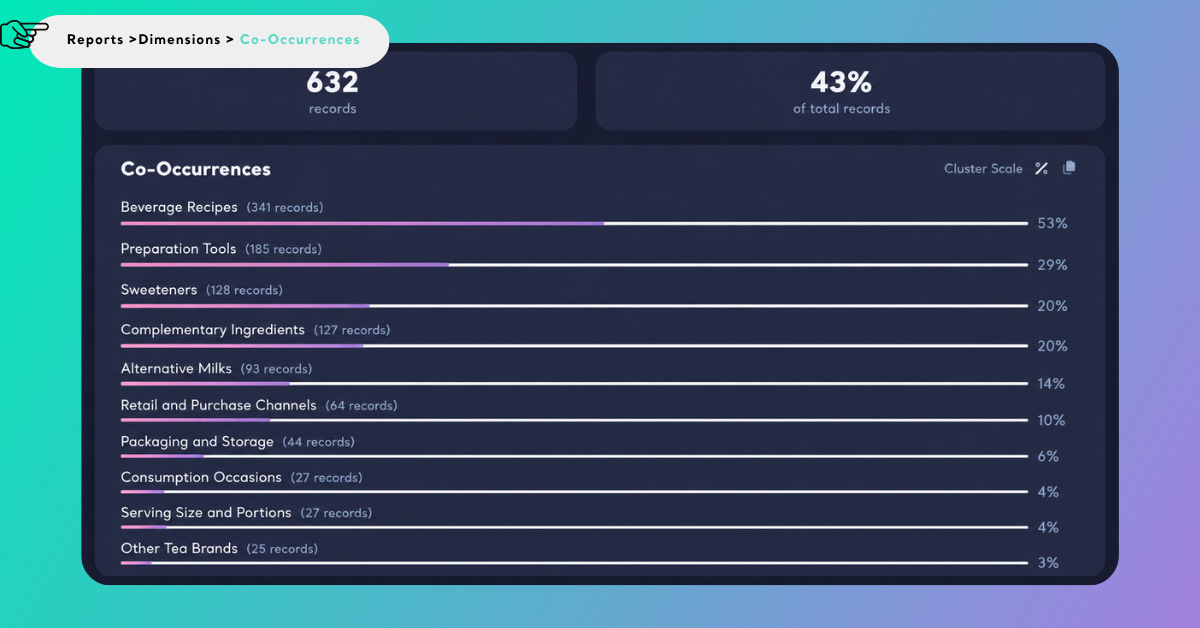
The analysis shows that Matcha is closely associated with a wide range of complementary ingredients, preparation methods, and consumption occasions. Consumers frequently pair Matcha with plant-based milks, sweeteners, flavor enhancers, and functional ingredients while using tools such as bamboo whisks, frothers, and blenders to achieve their preferred texture and flavor. Beyond traditional tea preparation, Matcha commonly appears in lattes, smoothies, protein shakes, baked goods, and other everyday recipes, highlighting its versatility across different usage contexts.
The findings also reveal that consumers actively personalize their Matcha experience by adjusting ingredient combinations, serving sizes, preparation techniques, and storage practices. Together, these recurring relationships show that Matcha is integrated into broader routines, rituals, and lifestyle habits rather than consumed as a standalone beverage. Examining these patterns helps explain how consumers naturally use Matcha in everyday settings and provides valuable context for understanding the category beyond the product itself.
What Do Consumers Replace with Matcha
The way consumers use a product is only part of the story. Their choices also reveal the alternatives they consider and the situations in which they switch from one product to another. The Substitutions analysis uncovers these replacement patterns, providing a broader view of the category's competitive landscape.
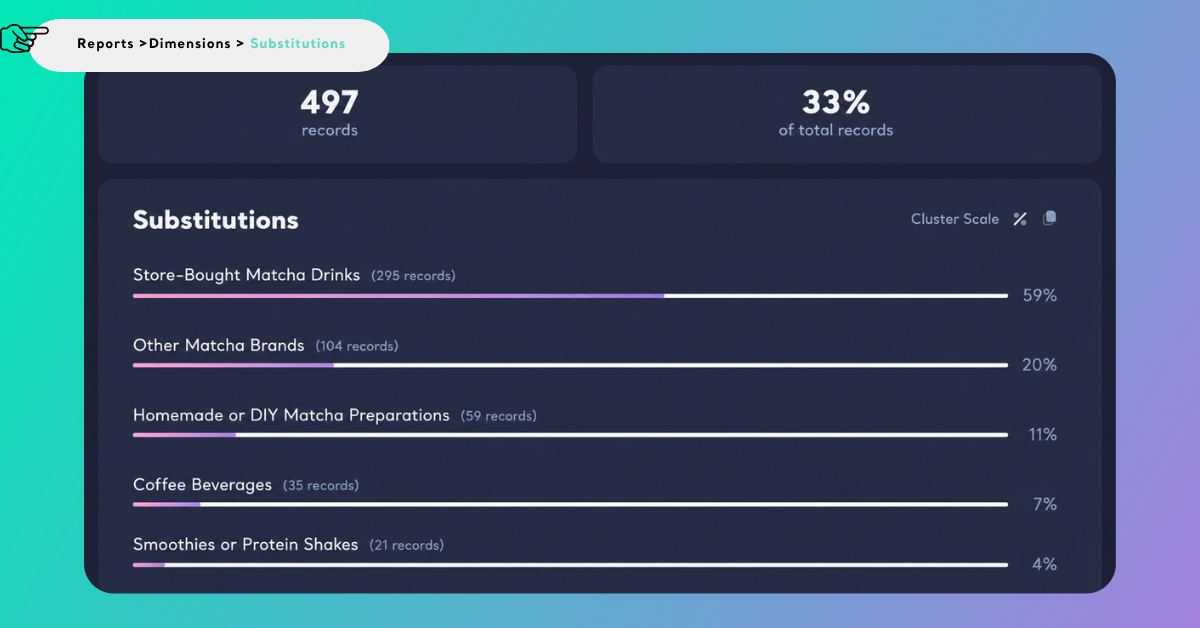
The analysis shows that Matcha competes well beyond the traditional tea category. Consumers frequently replace coffee with Matcha in search of a steadier source of energy, while ready-to-drink Matcha products substitute for café purchases by offering greater convenience and lower cost. Homemade Matcha preparations emerge as customizable alternatives to commercial beverages, allowing consumers to adjust sweetness, ingredients, and preparation methods to suit their own preferences. The findings also reveal Matcha being incorporated into smoothies and protein shakes, demonstrating that many consumers view it as a functional ingredient rather than simply a tea.
Together, these substitution patterns show that Matcha competes across multiple beverage and wellness categories rather than within tea alone. Looking beyond direct competitors reveals the broader needs consumers are trying to satisfy and provides valuable insight into where Matcha fits within their everyday choices.
Conclusion
In this tutorial, we've built a complete consumer research report for the fictional brand Kizuna Matcha, using Kimola's analytical dimensions to transform customer reviews into structured consumer insights. Beginning with high-level Signals and progressing through Themes, Motivations, Personas, Underlying Causes, Co-occurrences, and Substitutions, each analysis contributed a different perspective on the category.
Together, these dimensions demonstrate how consumer feedback can be explored from multiple angles—not only to understand what consumers are saying, but also why they make certain choices, how they use products in everyday life, and what influences their overall experience. By combining these perspectives, individual customer reviews become a comprehensive view of the category, helping researchers uncover actionable insights for product development, positioning, and strategic decision-making.
- Creating a Consumer Research Report for the Automatic Pet Feeder Category
- Creating a Consumer Research Report for the Portable Juice Blender Category
- Creating a Consumer Research Report for the Air Purifier Category
- Creating a Consumer Research Report for the Instant Camera Category
- Creating a Consumer Research Report for the Lash Serum Category