
- Pretrained AI Models
- /
- Classifier
Mobile App Feedback Classifier
This model is created specifically for the Mobile App Industry with 12 main categories and helps app developers to understand mobile app users better.
| Installation & Setup | : Feedback about downloading, installing, updating, or setting up the app for the first time. |
| User Interface & Design | : Mentions of visual design, layout, navigation flow, or overall look and feel. |
| Ease of Use | : Comments on how intuitive, simple, or complicated the app is for daily use. |
| Performance & Speed | : Feedback on responsiveness, loading times, app size, and overall stability. |
| Bugs & Crashes | : Mentions of errors, glitches, app freezes, or unexpected shutdowns. |
| Features & Functionality | : Opinions on available tools and functions, their usefulness, or missing features users expect. |
| Updates & New Versions | : Feedback about the impact of updates, improvements, regressions, or compatibility issues. |
| Privacy & Security | : Concerns about data permissions, account security, authentication, or misuse of personal data. |
| Notifications & Alerts | : Comments on frequency, usefulness, or annoyance of push notifications and reminders. |
| Pricing & Subscriptions | : Feedback on subscription plans, in-app purchases, hidden fees, or overall value for money. |
| Customer Support | : Experiences contacting the developer or support team, including responsiveness and helpfulness. |
| Compatibility | : Mentions of how the app runs on different devices, screen sizes, or operating systems. |
Mobile App Feedback Classifier is a pre-trained AI model designed for mobile app developers, publishers, and product teams. It automatically analyzes user reviews and feedback, categorizing them into 12 app-specific dimensions: Installation & Setup, User Interface & Design, Ease of Use, Performance & Speed, Bugs & Crashes, Features & Functionality, Updates & New Versions, Privacy & Security, Notifications & Alerts, Pricing & Subscriptions, Customer Support, and Compatibility.
The model processes unstructured text from App Store and Google Play reviews, in-app surveys, beta tester notes, support tickets, and social media posts. Each entry is assigned to the most relevant category. If feedback doesn’t match any label, the model outputs “None”—ensuring irrelevant or ambiguous comments don’t distort your analysis. By structuring user feedback, mobile teams can identify friction points, prioritize features, and improve app experiences faster.
Beyond Keywords: Understanding App Reviews
Keywords alone can’t capture the full context of app store feedback. For example:
- “App loads slowly and drains my battery” could be wrongly tagged under Performance only, while it should also include Compatibility.
- “I love the design, but the subscription is too expensive” may get marked under UI & Design while missing Pricing & Subscriptions.
- “Notifications don’t work after the last update” could be flagged under Updates alone, overlooking Notifications & Alerts.
Mobile App Feedback Classifier uses context-aware semantic analysis to understand the nuances of user reviews, tech slang, and multi-issue comments—ensuring no critical detail slips through.
The model can classify reviews in 30+ languages—including English, Spanish, French, German, and Dutch. This makes it a powerful tool for global app publishers with users across different markets, ensuring consistent insights whether feedback comes from San Francisco, Berlin, or São Paulo.
Unlocking Value from Mobile App Feedback
From app stores to beta testing programs, mobile apps attract thousands of reviews each month. Instead of wasting hours sifting through them manually—often with errors—the model categorizes them instantly, empowering teams to:
- Product managers to prioritize new Features & Functionality based on demand,
- Design teams to track feedback on UI & Ease of Use,
- Engineering teams to monitor Bugs, Crashes, Performance, and Compatibility issues,
- Security teams to address concerns around Privacy & Security,
- Business teams to evaluate Pricing models and Subscription value,
- Support teams to measure the quality of Customer Support interactions.
Example Scenario: A fitness app on the App Store receives 10,000 reviews per month. The model automatically classifies “Beautiful design but crashes during workouts” under UI & Design + Bugs & Crashes, and “Update fixed some issues, but subscription costs are too high” under Updates + Pricing & Subscriptions. This helps the product team balance feature improvements with business model adjustments.
Kimola’s Difference
Kimola’s Mobile App Feedback Classifier goes beyond standard text analytics:
- Mobile-specific taxonomy built for app ecosystems,
- Context-aware classification that understands multi-issue user reviews,
- Scalable architecture that processes millions of reviews from App Store & Google Play,
- Multilingual support for global app audiences,
- Actionable insights that guide product, design, engineering, and growth strategies.
By focusing on app-specific feedback, the model transforms scattered user comments into a roadmap for better app experiences and stronger user retention.
Try It Yourself
Use the console above to test the model. Paste a user review from App Store, Google Play, or beta testing feedback, and instantly see how it’s categorized into Performance, UI, Bugs, Pricing, Notifications, Security, or other app-specific categories.
You can also train custom AI models to classify customer feedback with your own labels. Upload your training set, build your model, and start analyzing—all no code!
Get started with ready-to-use AI models to analyze customer feedback with the highest accuracy possible.














Kimola offers a super-clean API documentation with code samples to connect your business process with Kimola.
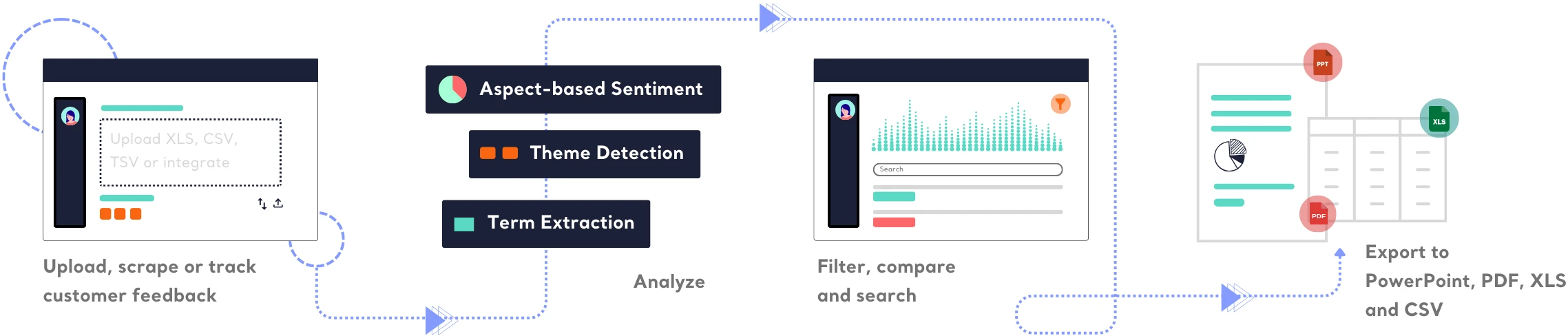
Find out how Kimola can improve your feedback analysis process.
-
![Kimola for Product Feedback Analysis]() Product Feedback Analysis
Product Feedback Analysis
Uncover customer needs, likes, and dislikes from product reviews and feedback.
-
![Kimola for E-commerce Feedback Analysis]() E-commerce Feedback Analysis
E-commerce Feedback Analysis
Analyze customer reviews and ratings to optimize online shopping experiences.
-
![Kimola for Social Feedback Analysis]() Social Feedback Analysis
Social Feedback Analysis
Extract insights from social media conversations and online discussions.



-
![Kimola for Open-ended Survey Analysis]() Open-ended Survey Analysis
Open-ended Survey Analysis
Make sense of free-text survey responses with AI-powered analysis.
-
![Kimola for Conversational Analysis]() Chatbot and Call Center Conversational Analysis
Chatbot and Call Center Conversational Analysis
Understand customer sentiment and concerns from chat and call transcripts.
-
![Kimola for Employee Feedback Analysis]() Employee Feedback Analysis
Employee Feedback Analysis
Identify workplace trends and employee sentiment from internal feedback and reviews.



Frequently Asked Questions
About Mobile App Feedback Classifier
-
What is the Mobile App Feedback Classifier?
It’s a pre-trained AI model that analyzes app store reviews, in-app surveys, beta tester notes, support tickets, and social media comments. Feedback is mapped into 12 categories such as Installation & Setup, User Interface & Design, Performance & Speed, Bugs & Crashes, Privacy & Security, Pricing & Subscriptions, and more.
-
Can it detect bug reports separately from feature requests?
Yes. A review like “Crashes on startup but I’d love a dark mode option” will be tagged under both Bugs & Crashes and Features & Functionality, ensuring no important signal gets lost.
-
Does it support subscription model analysis?
Yes. Mentions of pricing concerns, subscription value, or in-app purchase frustrations are captured under Pricing & Subscriptions, helping growth teams optimize their monetization strategy.
-
How does it help product and design teams?
It clusters feedback into themes like Ease of Use, UI & Design, Notifications, and Updates, allowing teams to spot trends and prioritize improvements based on user sentiment.
-
Does it support multiple languages?
Yes. It classifies reviews in 30+ languages—including English, Spanish, French, German, and Dutch—making it ideal for apps with a global user base.
-
Can it integrate into our analytics workflow?
Yes. API access allows integration with Firebase, Mixpanel, Amplitude, or custom BI dashboards, so classified feedback can sit alongside engagement and retention metrics.
Turn customer feedback into structured market research in 30+ languages—no AI training needed.
Create a Free Account No credit card · No commitment