
- Pretrained AI Models
- /
- Classifier
Online Course Feedback Classifier
This model was created specifically to analyze Online Course User comments on educational course platforms such as Udemy, Coursera etc.
| Content Quality | : Feedback on how well-structured, accurate, and up-to-date the course material is. |
| Instructor Performance | : Mentions of the instructor’s teaching style, clarity, expertise, or engagement. |
| Practical Value | : Comments on the real-world usefulness, applicability, or career relevance of the course. |
| Learning Materials | : Feedback on assignments, exercises, readings, quizzes, and supplemental resources. |
| Video & Audio Quality | : Mentions of production quality — clarity of sound, video resolution, or editing. |
| Platform Experience | : Opinions on browsing, enrolling, and using the learning platform itself. |
| Ease of Understanding | : Comments about how simple, clear, or difficult the course is to follow. |
| Updates & Relevance | : Feedback on whether the course content is current, updated, and aligned with new trends or technologies. |
| Pricing & Value | : Opinions on affordability of the course, discounts, subscriptions, or whether it felt worth the money. |
| Certification & Recognition | : Mentions of certificates, credentials, or whether the course is recognized by employers or institutions. |
| Pacing & Workload | : Feedback on course length, speed of delivery, or workload balance. |
| Community & Interaction | : Comments on discussion forums, peer learning, group projects, or networking opportunities. |
Online Course Feedback Classifier is a pre-trained AI model designed for the e-learning industry. It automatically analyzes learner feedback and classifies it into 12 categories: Content Quality, Instructor Performance, Practical Value, Learning Materials, Video & Audio Quality, Platform Experience, Ease of Understanding, Updates & Relevance, Pricing & Value, Certification & Recognition, Pacing & Workload, and Community & Interaction.
Whether feedback comes from Udemy, Coursera, edX, Skillshare, Khan Academy, university LMS platforms, or internal corporate training programs, the model processes unstructured text and assigns each entry to the most relevant dimension of the learning experience. If a comment doesn’t clearly fit, it returns “None”, ensuring irrelevant or ambiguous feedback is not forced into categories. By structuring student reviews at scale, course providers and EdTech platforms can better understand learner needs, improve content, and optimize engagement.
Beyond Keywords: Capturing the Learning Experience
Generic keyword filters often fail in education settings. For example:
- “The videos are high quality, but the assignments were overwhelming” → might be misclassified under Video Quality when it actually relates to Pacing & Workload.
- “The professor explained clearly, but the course content is outdated” → could be wrongly tagged as Instructor Performance instead of Updates & Relevance.
- “I loved the case studies because they helped me apply the theory” → might be treated as generic praise, but it really belongs under Practical Value.
Online Course Feedback Classifier goes beyond word spotting with context-aware semantic analysis. It understands student language, educational jargon, and even mixed feedback—ensuring accuracy across diverse learning contexts.
Capable of analyzing feedback in more than 30 languages—including English, Spanish, French, German, and Dutch—the model is built for global MOOCs, universities, and EdTech platforms. Its multilingual reach ensures that learner feedback is classified consistently across regions, enabling institutions to benchmark and compare course quality worldwide.
Unlocking Value from Student Feedback
E-learning platforms generate thousands of reviews and course evaluations every semester. Manual review is slow, subjective, and inconsistent. This model automates classification, enabling:
- Instructors to track clarity, pacing, and teaching effectiveness,
- Curriculum designers to evaluate content quality, practical value, and update needs,
- Platform managers to monitor technical performance, video quality, and community engagement,
- Business teams to assess pricing fairness, certification value, and student retention.
Example Scenario: A university launches an online MBA program. Within weeks, students praise the instructor’s clarity, criticize outdated financial datasets, and complain about the heavy workload. The model automatically classifies feedback into Instructor Performance, Updates & Relevance, and Pacing & Workload—giving the university actionable insights to refine content, rebalance assignments, and strengthen the learning experience.
Kimola’s Difference
Kimola’s Online Course Feedback Classifier delivers more than simple tagging:
- Education-specific taxonomy aligned with online learning experiences,
- Semantic understanding that captures nuance in student reviews,
- Scalable performance to analyze thousands of reviews instantly,
- Multilingual reach for international programs and MOOCs,
- Actionable insights that tie feedback directly to course design, platform optimization, and learner success.
By focusing on education-specific needs, the model transforms unstructured student voices into structured insights—helping EdTech companies, universities, and training providers improve teaching quality, strengthen engagement, and grow retention.
Try It Yourself
Use the console above to test the model. Paste a course review, survey comment, or student forum post, and see it categorized instantly into Content, Instructor, Practical Value, Platform, or other learning categories. Testing with your own data shows how the model uncovers the true learning experience behind student feedback.
You can also train custom AI models to classify customer feedback with your own labels. Upload your training set, build your model, and start analyzing—all no code!
Get started with ready-to-use AI models to analyze customer feedback with the highest accuracy possible.














Kimola offers a super-clean API documentation with code samples to connect your business process with Kimola.
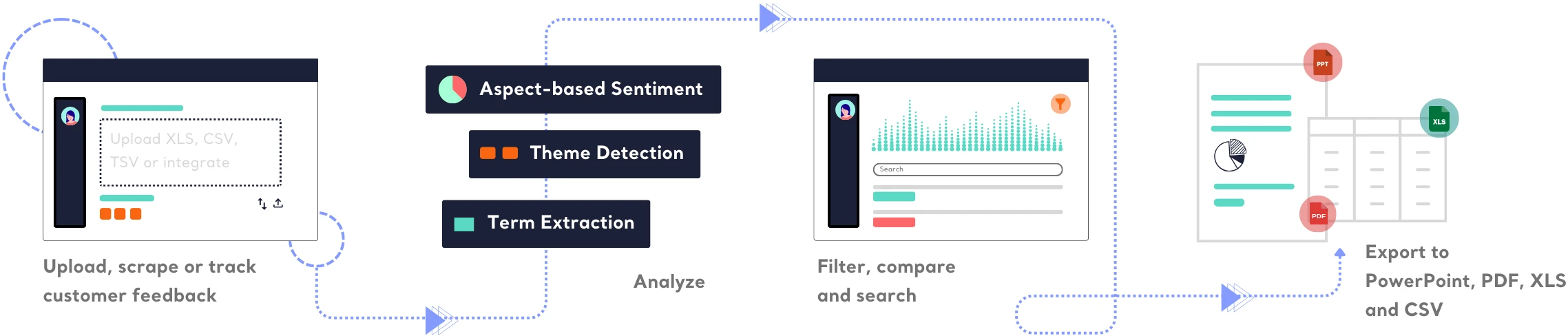
Find out how Kimola can improve your feedback analysis process.
-
![Kimola for Product Feedback Analysis]() Product Feedback Analysis
Product Feedback Analysis
Uncover customer needs, likes, and dislikes from product reviews and feedback.
-
![Kimola for E-commerce Feedback Analysis]() E-commerce Feedback Analysis
E-commerce Feedback Analysis
Analyze customer reviews and ratings to optimize online shopping experiences.
-
![Kimola for Social Feedback Analysis]() Social Feedback Analysis
Social Feedback Analysis
Extract insights from social media conversations and online discussions.



-
![Kimola for Open-ended Survey Analysis]() Open-ended Survey Analysis
Open-ended Survey Analysis
Make sense of free-text survey responses with AI-powered analysis.
-
![Kimola for Conversational Analysis]() Chatbot and Call Center Conversational Analysis
Chatbot and Call Center Conversational Analysis
Understand customer sentiment and concerns from chat and call transcripts.
-
![Kimola for Employee Feedback Analysis]() Employee Feedback Analysis
Employee Feedback Analysis
Identify workplace trends and employee sentiment from internal feedback and reviews.



Frequently Asked Questions
About Online Course Feedback Classifier
-
What is the Online Course Feedback Classifier?
It’s one of Kimola’s industry-specific AI models, trained to analyze learner feedback from online courses. It classifies reviews into 12 categories such as Content Quality, Instructor Performance, Platform Experience, Pacing & Workload, and Certification & Recognition.
-
Who is this model designed for?
he Online Course Feedback Classifier is built for the entire e-learning ecosystem—MOOC platforms such as Udemy, Coursera, edX, Skillshare, and Khan Academy, universities managing their own LMS platforms, and EdTech startups offering online training or certification programs.
-
Do I need technical expertise to use it?
Not at all. The model is pre-trained and ready to use. You can upload reviews or survey data in .xls, .xlsx, .csv, or .tsv formats, or integrate directly via API.
-
Can it classify multi-label reviews?
Yes. A single review mentioning “great instructor but outdated content and heavy workload” will be classified under Instructor Performance, Updates & Relevance, and Pacing & Workload simultaneously.
-
How does it help instructors?
It highlights strengths and weaknesses in teaching clarity, pacing, and interaction, so instructors can improve their delivery.
-
Can it track platform-related issues separately from content?
Yes. The Platform Experience and Video & Audio Quality categories specifically capture technical aspects of the learning environment.
-
Can it integrate with LMS or EdTech dashboards?
Yes. API access enables seamless integration with learning management systems, analytics dashboards, or BI tools.
Turn customer feedback into structured market research in 30+ languages—no AI training needed.
Create a Free Account No credit card · No commitment