
- Pretrained AI Models
- /
- Classifier
Software Feedback Classifier
This model is created specifically for the software products with to help marketing professionals to understand software product users better.
| Ease of Use | : Feedback about how intuitive, simple, or complex the software is for daily work. |
| Features & Capabilities | : Mentions of available tools and functions, how well they work, or gaps compared to needs. |
| Integration & Compatibility | : Comments on how easily the software connects with other systems, apps, or workflows. |
| Performance & Reliability | : Feedback on speed, uptime, bugs, crashes, or overall stability. |
| Setup & Implementation | : Experiences with onboarding, installation, migration, or getting started with the product. |
| Customer Support | : Mentions of responsiveness, expertise, and effectiveness of support teams or account managers. |
| Pricing & Licensing | : Opinions about affordability, contract terms, hidden costs, or value for money. |
| Training & Documentation | : Feedback on manuals, tutorials, help centers, or availability of learning resources. |
| Security & Compliance | : Comments about data protection, privacy, regulatory compliance, or trust in handling sensitive information. |
| Updates & Roadmap | : Feedback on product updates, version improvements, bugs fixed, or future feature promises. |
| Scalability & Flexibility | : Mentions of how well the software adapts to business growth, customization, or changing needs. |
| Return on Investment (ROI) | : Opinions on whether the software delivers measurable value, efficiency gains, or cost savings. |
Software Feedback Classifier is a pre-trained AI model built for SaaS companies, enterprise vendors, and software developers. It automatically analyzes user feedback and classifies it into 12 software-specific categories: Ease of Use, Features & Capabilities, Integration & Compatibility, Performance & Reliability, Setup & Implementation, Customer Support, Pricing & Licensing, Training & Documentation, Security & Compliance, Updates & Roadmap, Scalability & Flexibility, and Return on Investment (ROI).
Whether feedback comes from review platforms like G2, Capterra, TrustRadius, or Gartner Peer Insights, community forums, app stores, or customer surveys, the model processes unstructured text and maps each entry to the most relevant software dimension. If feedback doesn’t fit any label, the model outputs “None”, ensuring ambiguous or irrelevant comments don’t distort insights. By structuring user reviews, SaaS and enterprise vendors can uncover product gaps, monitor satisfaction, and align development priorities with customer needs.
Beyond Keywords: Understanding Software Feedback
Traditional keyword-based systems often fail to capture the nuance in software reviews. For example:
- “The app runs smoothly, but integrations with Salesforce are buggy” → might be misclassified under Performance when it should also map to Integration & Compatibility.
- “Great features, but onboarding was confusing” → could be wrongly tagged as Features instead of Setup & Implementation.
- “Support was quick, but I’m worried about data privacy” → might be labeled as Customer Support only, missing Security & Compliance.
Software Feedback Classifier applies context-aware semantic analysis, understanding software jargon, technical terms, and multi-topic feedback. This ensures accurate classification across the entire software lifecycle—from adoption to scaling.
Your users share feedback in dozens of languages. This model listens in 30+, from English and Spanish to French, German, and Dutch, classifying each comment with the same accuracy. The result: software companies can compare feedback across regions without losing cultural nuance.
Unlocking Value from Software Feedback
Software companies handle thousands of support tickets, reviews, and survey responses daily. Manual classification is slow, inconsistent, and costly. This model automates the process, enabling:
- Product managers to track Features, Roadmap priorities, and ROI,
- Customer success teams to monitor Ease of Use, Support quality, and Training needs,
- Engineering teams to address Performance, Scalability, and Integration issues,
- Security teams to capture concerns around Compliance and data protection,
- Executives to measure feedback on Pricing, Licensing, and business impact.
Example Scenario: A SaaS vendor launches a new collaboration tool. Early feedback includes “easy to use interface”, “integration with Slack doesn’t work properly”, and “pricing is too high for small teams.” The model automatically classifies these into Ease of Use, Integration & Compatibility, and Pricing & Licensing—helping the company refine UX, fix integrations, and adjust its pricing strategy.
Kimola’s Difference
Kimola’s Software Feedback Classifier offers more than automated tagging:
- Software-specific taxonomy that reflects the full customer journey,
- Context-aware analysis to reduce misclassifications in technical reviews,
- Scalable architecture to process millions of tickets and reviews,
- Multilingual reach for international SaaS providers,
- Actionable insights that connect user voices directly to product, engineering, and business teams.
By focusing on the software industry, the model transforms user feedback into business intelligence—helping companies accelerate innovation, improve customer experience, and maximize ROI.
Try It Yourself
Use the console above to test the model. Paste a support ticket, product review, or survey comment, and instantly see how it’s categorized into Ease of Use, Features, Integration, Security, Roadmap, ROI, or other software domains. Testing with your own data shows how the model captures pain points, highlights strengths, and guides product improvement.
You can also train custom AI models to classify customer feedback with your own labels. Upload your training set, build your model, and start analyzing—all no code!
Get started with ready-to-use AI models to analyze customer feedback with the highest accuracy possible.














Kimola offers a super-clean API documentation with code samples to connect your business process with Kimola.
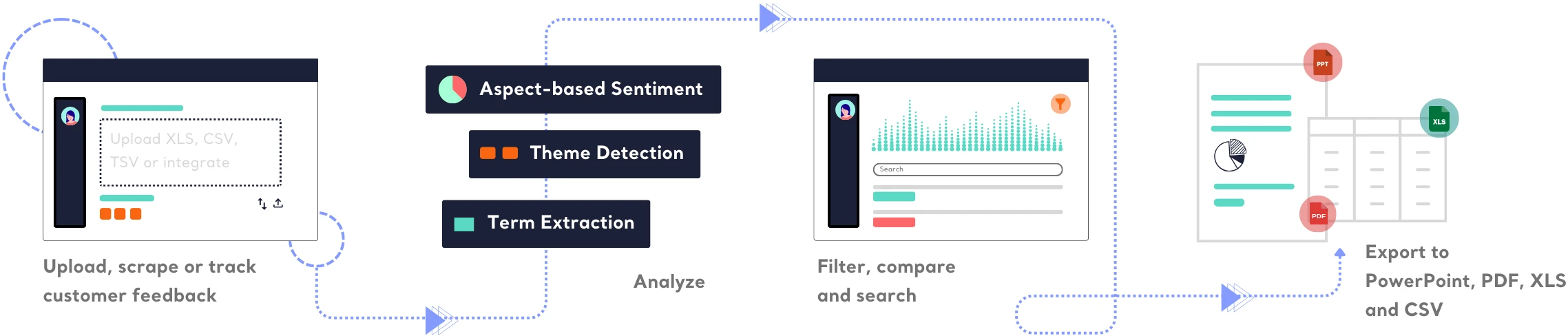
See how teams turn different kinds of feedback into research.






Frequently Asked Questions
About Software Feedback Classifier
-
What is the Software Feedback Classifier?
It’s a pre-trained AI model that analyzes user reviews, support tickets, surveys, and community posts. Feedback is categorized into 12 software-specific themes such as Ease of Use, Features & Capabilities, Integration & Compatibility, Pricing & Licensing, Security & Compliance, and ROI.
-
Can it handle highly technical feedback with jargon?
The model is trained to recognize software-specific terminology, abbreviations, and multi-topic reviews, ensuring accurate classification of even complex technical feedback.
-
How does it deal with feedback that covers multiple issues at once?
If a user says “Great features but poor integration with Slack and confusing onboarding”, the model tags it under Features & Capabilities, Integration & Compatibility, and Setup & Implementation—so no detail gets overlooked.
-
Can it help prioritize product roadmaps?
Yes. By organizing feedback into categories such as Features, Performance, Security, and Roadmap, the model helps product managers uncover recurring patterns and prioritize improvements based on real user needs—turning raw feedback into data-driven strategy.
-
Is onboarding or training required?
No setup headaches. The model is pre-trained and ready to use out of the box—you simply upload your data in formats like .xls, .xlsx, .csv, .tsv or connect via API. Still, Kimola provides guidance and support whenever you need it, ensuring a smooth start and continued success.
-
Does it support global SaaS companies?
Yes. It classifies feedback in 30+ languages—including English, Spanish, French, German, and Dutch—ensuring consistent insights across international markets.
-
Can it integrate with our current tools?
Yes. With API access, it plugs into CRM systems, support platforms (Zendesk, Salesforce, HubSpot), Jira, or BI dashboards, making insights part of your daily workflow.
Turn customer feedback into structured market research in 30+ languages—no AI training needed.
Create a Free Account No credit card · No commitment