
- Pretrained AI Models
- /
- Classifier
E-Commerce Feedback Classifier
This model is created specifically for the E-Commerce Industry with 12 main categories to helps marketers to better understand consumers.
| Website & App Experience | : Feedback on how easy, intuitive, or frustrating the online store or app is to browse, search, and use. |
| Product Information | : Mentions of the accuracy, clarity, or completeness of product descriptions, images, or specifications. |
| Pricing & Discounts | : Opinions on product pricing, affordability, fairness of deals, or satisfaction with promotions and discounts. |
| Checkout & Payment | : Comments about the checkout process, payment methods offered, transaction security, or ease of completing an order. |
| Delivery Speed | : Feedback on how fast products arrive, whether delivery times match expectations, and punctuality of shipments. |
| Packaging & Condition | : Mentions of product packaging quality, protection during shipping, and whether items arrived in good condition. |
| Order Accuracy | : Comments on receiving the correct product, size, or quantity — or problems with missing/wrong items. |
| Returns & Refunds | : Experiences with return policies, ease of returning products, refund timelines, or fairness of the process. |
| Customer Support | : Feedback on contacting the company for help: responsiveness, helpfulness, and resolution of problems. |
| Stock Availability | : Mentions of items being in or out of stock, backorder issues, or regional availability. |
| Loyalty & Rewards | : Opinions about loyalty programs, points systems, or perks for repeat customers. |
| Trust & Security | : Feedback that reflects confidence (or lack of it) in data security, payment protection, or overall platform reliability. |
E-Commerce Feedback Classifier is a pre-trained AI model designed for online retailers and marketplaces. It automatically analyzes customer feedback and maps it to 12 e-commerce–specific categories: Website & App Experience, Product Information, Pricing & Discounts, Checkout & Payment, Delivery Speed, Packaging & Condition, Order Accuracy, Returns & Refunds, Customer Support, Stock Availability, Loyalty & Rewards, and Trust & Security.
Whether the feedback comes from Amazon, eBay, Shopify, Etsy, or any custom e-commerce platform, the model processes unstructured text such as product reviews, customer surveys, live chat transcripts, or social media posts. Each entry is classified into the most relevant category. If a review doesn’t fit any label, it returns “None”—preventing irrelevant or ambiguous feedback from distorting insights. By structuring large volumes of customer comments, e-commerce businesses can track shopper sentiment, identify friction points, and enhance their end-to-end shopping experience.
Beyond Keywords: Understanding Shopper Feedback
Keyword-based filters often misinterpret online shopping experiences. For example:
- “The checkout took forever” might be wrongly classified under Website Experience when it belongs to Checkout & Payment.
- “The shoes looked different from the photos” could be tagged under Order Accuracy instead of Product Information.
- “Delivery was late but the packaging was great” may get labeled as only Delivery Speed, missing the Packaging & Condition aspect.
E-Commerce Feedback Classifier goes beyond keywords with context-aware semantic analysis. It understands e-commerce–specific phrases, abbreviations, and multi-topic reviews, ensuring that every part of the shopper journey is captured accurately.
Beyond Keywords: Understanding Shopper Feedback
Keyword-based filters often misinterpret online shopping experiences. For example:
- “The checkout took forever” might be wrongly classified under Website Experience when it belongs to Checkout & Payment.
- “The shoes looked different from the photos” could be tagged under Order Accuracy instead of Product Information.
- “Delivery was late but the packaging was great” may get labeled as only Delivery Speed, missing the Packaging & Condition aspect.
E-Commerce Feedback Classifier goes beyond keywords with context-aware semantic analysis. It understands e-commerce–specific phrases, abbreviations, and multi-topic reviews, ensuring that every part of the shopper journey is captured accurately.
Supporting feedback in more than 30 languages—including English, Spanish, French, German, and Dutch—the model is built for international retailers and global marketplaces. Its multilingual reach ensures that customer voices are classified consistently across regions, enabling truly comparable insights worldwide.
Unlocking Value from E-Commerce Feedback
Online retailers handle thousands of reviews, survey responses, and support tickets daily. Manual classification is slow, inconsistent, and error-prone. This model automates the process, enabling:
- UX teams to improve Website & App Experience and streamline Checkout & Payment,
- Product teams to monitor Product Information accuracy and track Order Accuracy,
- Operations teams to evaluate Delivery Speed, Packaging, Returns, and Refunds,
- Customer support leaders to measure service responsiveness and efficiency,
- Marketing teams to track Pricing, Discounts, Loyalty programs, and customer trust.
Example Scenario: An online fashion retailer receives thousands of daily reviews. The model classifies “checkout was confusing” under Checkout & Payment, “dress didn’t match the size chart” under Order Accuracy, and “delivery was fast but box was damaged” under Delivery Speed + Packaging & Condition. This helps the retailer pinpoint exactly where improvements are needed.
Kimola’s Difference
Kimola’s E-Commerce Feedback Classifier offers more than automated tagging:
- E-commerce–specific taxonomy covering 12 critical shopping categories,
- Semantic analysis that distinguishes between multi-topic customer reviews,
- Scalable architecture capable of processing millions of reviews daily,
- Multilingual reach for global e-commerce players,
- Actionable insights that link feedback directly to operations, UX, and marketing strategies.
By focusing on the entire online shopping journey, the model turns raw customer opinions into structured insights—helping retailers boost conversion rates, strengthen loyalty, and improve overall shopper satisfaction.
Try It Yourself
Use the console above to test the model. Paste a customer review, support ticket, or app store comment, and instantly see how it’s categorized into Delivery, Checkout, Pricing, Customer Support, Loyalty, or other e-commerce categories. Testing with your own data reveals how the model interprets shopper feedback and highlights opportunities for optimization.
You can also train custom AI models to classify customer feedback with your own labels. Upload your training set, build your model, and start analyzing—all no code!
Get started with ready-to-use AI models to analyze customer feedback with the highest accuracy possible.














Kimola offers a super-clean API documentation with code samples to connect your business process with Kimola.
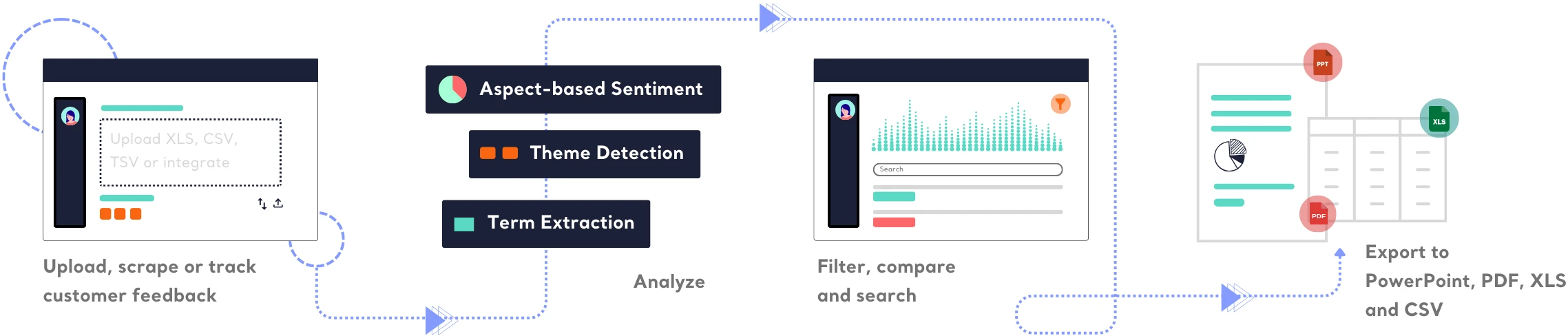
Find out how Kimola can improve your feedback analysis process.
-
![Kimola for Product Feedback Analysis]() Product Feedback Analysis
Product Feedback Analysis
Uncover customer needs, likes, and dislikes from product reviews and feedback.
-
![Kimola for E-commerce Feedback Analysis]() E-commerce Feedback Analysis
E-commerce Feedback Analysis
Analyze customer reviews and ratings to optimize online shopping experiences.
-
![Kimola for Social Feedback Analysis]() Social Feedback Analysis
Social Feedback Analysis
Extract insights from social media conversations and online discussions.



-
![Kimola for Open-ended Survey Analysis]() Open-ended Survey Analysis
Open-ended Survey Analysis
Make sense of free-text survey responses with AI-powered analysis.
-
![Kimola for Conversational Analysis]() Chatbot and Call Center Conversational Analysis
Chatbot and Call Center Conversational Analysis
Understand customer sentiment and concerns from chat and call transcripts.
-
![Kimola for Employee Feedback Analysis]() Employee Feedback Analysis
Employee Feedback Analysis
Identify workplace trends and employee sentiment from internal feedback and reviews.



Frequently Asked Questions
About E-Commerce Feedback Classifier
-
What is the E-Commerce Feedback Classifier?
It’s one of Kimola’s pre-trained AI models, designed to analyze and categorize customer feedback for online retailers and marketplaces. It classifies reviews into 12 e-commerce–specific categories such as Website & App Experience, Delivery Speed, Returns & Refunds, Packaging & Condition, and Customer Support.
-
Which types of e-commerce players can benefit?
From global marketplaces like Amazon, eBay, and Etsy to regional champions such as Trendyol or Hepsiburada, and even independent Shopify stores—any retailer dealing with customer feedback at scale can leverage it.
-
Do I need a data science team to get started?
No. The model is plug-and-play. You can upload reviews in familiar formats like .xls, .xlsx, .csv, or .tsv, or connect directly through our API.
-
Can the model tell apart product quality complaints from delivery frustrations?
Yes. A review like “Shoes arrived late and in the wrong size” gets tagged under Delivery Speed and Order Accuracy simultaneously.
-
How does this help sellers stand out on marketplaces?
By surfacing issues that impact ratings—like missing product details, poor packaging, or refund delays—so sellers can fix them before they hurt visibility.
-
Can it track how customers react to discounts or loyalty programs?
Yes. Mentions of coupons, vouchers, or loyalty points are automatically grouped under Pricing & Discounts or Loyalty & Rewards.
Turn customer feedback into structured market research in 30+ languages—no AI training needed.
Create a Free Account No credit card · No commitment