
- Pretrained AI Models
- /
- Classifier
Consumer Feedback Classifier
This model is created with the intent of classifying consumer conversation around a product, service or a brand in general.
| Quality | : Feedback that highlights how durable, reliable, or well-made the product or service feels in real use. |
| Features & Functionality | : Mentions of what the product can or cannot do — specific features, how well they work, or missing functions customers expect. |
| Ease of Use | : Comments describing how simple, intuitive, or difficult it is to set up and use the product on a daily basis. |
| Pricing & Value | : Opinions on whether the cost feels fair, affordable, or worth the money, including mentions of discounts and offers. |
| Customer Service | : Experiences with staff or support channels — from responsiveness and friendliness to problem-solving effectiveness. |
| Purchase Experience | : Feedback on the act of buying itself: checkout process, payment methods, or how smooth the in-store or online transaction felt. |
| Delivery & Logistics | : Mentions of shipping and packaging: speed, accuracy, courier quality, or condition of the product when it arrives. |
| Availability & Stock | : Conversations about whether the product is easy to find, frequently out of stock, or accessible in a given region. |
| Brand Perception | : Feedback that goes beyond the product, touching on the company’s overall reputation, trustworthiness, or emotional image. |
| Marketing & Communication | : Reactions to how the company promotes itself — ads, campaigns, promotions, or how information is communicated. |
| Competitor Comparison | : Customer references to rival products or services, often framed as direct comparisons or alternatives. |
| Sustainability & Ethics | : Mentions of eco-friendliness, fair practices, environmental impact, or the company’s role in social responsibility. |
Consumer Feedback Classifier is a pre-trained AI model designed for brands, retailers, and consumer research teams. It automatically analyzes customer feedback and classifies it into 12 consumer-specific categories: Quality, Features & Functionality, Ease of Use, Pricing & Value, Customer Service, Purchase Experience, Delivery & Logistics, Availability & Stock, Brand Perception, Marketing & Communication, Competitor Comparison, and Sustainability & Ethics.
The model processes unstructured feedback from customer surveys, e-commerce reviews, social media posts, support tickets, and focus group transcripts. Each entry is categorized into the most relevant dimension of consumer experience. If feedback doesn’t fit any category, the model outputs “None”, ensuring irrelevant or ambiguous comments don’t distort analysis. By structuring this data, businesses can uncover patterns, monitor sentiment, and align decisions with real consumer expectations.
Beyond Keywords: Truly Understanding Consumer Feedback
Consumer feedback is rarely simple. A single review can touch on product quality, delivery, price, and even a competitor comparison—all in one sentence. Traditional keyword-based filters reduce this complexity to a handful of tags, often stripping away the real meaning behind a customer’s words.
Take these examples:
- “The product works fine, but the packaging was terrible” might be recorded only under Quality, even though the frustration clearly lies in Delivery & Logistics.
- “Great value, but customer support took forever” could be seen as positive Pricing & Value, while the deeper issue in Customer Service goes unnoticed.
- “I like the features, but the competitor’s version is cheaper” might land in Features, missing the crucial Competitor Comparison insight that highlights market threats.
This is where Consumer Feedback Classifier makes a difference. Instead of skimming for keywords, it applies context-aware semantic analysis that interprets meaning in full. It understands when multiple issues appear in a single review, distinguishes praise from criticism, and connects comments to the right business dimensions.
By doing so, the model doesn’t just categorize feedback—it reveals the true intent behind consumer voices. This allows brands to avoid blind spots, act on the right problems, and capture richer insights that drive product improvements, stronger customer relationships, and competitive advantage.
The model supports over 30 languages, including English, Spanish, French, German, and Dutch. This makes it ideal for global consumer brands and retailers, ensuring consistent insights whether feedback comes from New York, Berlin, or São Paulo.
Unlocking Value from Consumer Feedback
For today’s brands and retailers, consumer feedback flows in from everywhere—Amazon reviews, e-commerce platforms, app stores, social media conversations, customer surveys, and even call center transcripts. The sheer volume of data can easily overwhelm teams, and manually reviewing it is not only inefficient but also prone to human error and subjective interpretation.
Consumer Feedback Classifier changes this by automatically transforming scattered consumer voices into structured, actionable insights. It helps each team focus on the signals that matter most:
- Product teams can monitor Quality, Features, and Ease of Use, identifying what delights customers and what frustrates them in day-to-day product interactions.
- Marketing teams can track Brand Perception, Campaign messaging, and Competitor positioning, spotting how consumers compare their brand against rivals and whether marketing resonates.
- Customer service leaders can surface recurring issues in Service experiences and Purchase journeys, using feedback loops to reduce churn and strengthen loyalty.
- Operations teams can evaluate Delivery, Logistics, and Stock Availability, aligning supply chain performance with customer expectations.
- Sustainability and CSR managers can capture mentions of Ethics, Packaging, and Environmental Impact, ensuring that consumer values around responsibility and sustainability are not overlooked.
Example Scenario:
A global consumer electronics brand receives tens of thousands of reviews each month across Amazon, Best Buy, and social media. Using this model:
- “The phone is great, but delivery was delayed” is classified under Quality + Delivery & Logistics, highlighting a supply chain issue rather than a product flaw.
- “Good features, but the competitor offers better pricing” falls under Features + Competitor Comparison, signaling both product satisfaction and a pricing risk.
These structured insights allow the brand to pinpoint weak spots in logistics, strengthen partnerships with delivery providers, and at the same time reconsider pricing strategies to remain competitive.
Kimola’s Difference
Kimola’s Consumer Feedback Classifier is built specifically for consumer industries:
- Consumer-focused taxonomy across 12 key dimensions of purchase and usage,
- Context-aware classification that recognizes multi-topic reviews,
- Scalable design for processing millions of reviews and survey responses,
- Multilingual support for global brands,
- Actionable insights that connect feedback to product, marketing, service, and sustainability strategies.
By translating raw consumer voices into structured insights, the model helps brands refine their products, improve service quality, strengthen brand trust, and stay competitive.
Try It Yourself
Use the console above to test the model. Paste a review, survey comment, or social media mention, and instantly see how it’s categorized into Quality, Features, Pricing, Customer Service, Brand Perception, Competitor Comparison, or other consumer-specific categories.
You can also train custom AI models to classify customer feedback with your own labels. Upload your training set, build your model, and start analyzing—all no code!
Get started with ready-to-use AI models to analyze customer feedback with the highest accuracy possible.














Kimola offers a super-clean API documentation with code samples to connect your business process with Kimola.
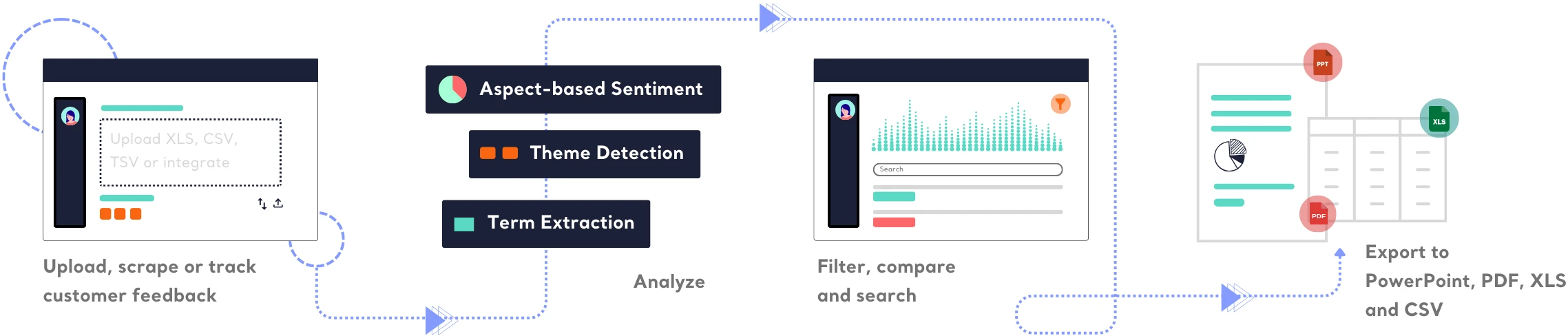
Find out how Kimola can improve your feedback analysis process.
-
![Kimola for Product Feedback Analysis]() Product Feedback Analysis
Product Feedback Analysis
Uncover customer needs, likes, and dislikes from product reviews and feedback.
-
![Kimola for E-commerce Feedback Analysis]() E-commerce Feedback Analysis
E-commerce Feedback Analysis
Analyze customer reviews and ratings to optimize online shopping experiences.
-
![Kimola for Social Feedback Analysis]() Social Feedback Analysis
Social Feedback Analysis
Extract insights from social media conversations and online discussions.



-
![Kimola for Open-ended Survey Analysis]() Open-ended Survey Analysis
Open-ended Survey Analysis
Make sense of free-text survey responses with AI-powered analysis.
-
![Kimola for Conversational Analysis]() Chatbot and Call Center Conversational Analysis
Chatbot and Call Center Conversational Analysis
Understand customer sentiment and concerns from chat and call transcripts.
-
![Kimola for Employee Feedback Analysis]() Employee Feedback Analysis
Employee Feedback Analysis
Identify workplace trends and employee sentiment from internal feedback and reviews.



Frequently Asked Questions
About Consumer Feedback Classifier
-
What is the Consumer Feedback Classifier?
It’s a pre-trained AI model that analyzes customer feedback from surveys, e-commerce reviews, social media, and support tickets. It classifies each comment into 12 consumer-specific categories such as Quality, Pricing & Value, Customer Service, Delivery & Logistics, Competitor Comparison, and Sustainability & Ethics.
-
Can it distinguish between product issues and service issues?
Yes. A review like “The laptop works fine, but delivery was late” is tagged under both Quality and Delivery & Logistics, ensuring you see the full picture.
-
Can it highlight competitor references in reviews?
Yes. If a customer says “This detergent works well, but Brand X is cheaper”, the model flags it under Competitor Comparison, giving you insights into how your brand stacks up against rivals.
-
How does it help marketing teams?
By classifying feedback into areas like Brand Perception, Marketing & Communication, and Pricing & Value, marketing teams can quickly identify what messages resonate and what drives dissatisfaction.
-
Is it useful only for retailers?
No. Any consumer-facing business—whether in FMCG, electronics, apparel, or services—can use it to structure customer feedback and improve decision-making.
-
Can the model analyze feedback from multiple sources at once?
Yes. You can combine reviews from Amazon, e-commerce platforms, social media, and surveys into a single dataset. The model processes all inputs consistently, giving you a unified view of consumer sentiment.
-
How does the model handle multi-issue feedback?
If a customer writes “Great product, but delivery was late and the packaging wasn’t eco-friendly”, the model will classify it into Quality, Delivery & Logistics, and Sustainability & Ethics simultaneously—ensuring every concern is captured.
Turn customer feedback into structured market research in 30+ languages—no AI training needed.
Create a Free Account No credit card · No commitment