
- Pretrained AI Models
- /
- Classifier
Automotive Feedback Classifier
This model is created specifically for the Automotive Industry with 13 main categories to helps marketers to understand automotive consumers better.
| Performance & Power | : Feedback on engine strength, acceleration, handling, braking, or overall driving performance. |
| Comfort & Interior | : Mentions of seating, cabin space, ergonomics, noise levels, or ride comfort. |
| Design & Style | : Opinions on the vehicle’s exterior design, interior aesthetics, or overall appearance. |
| Technology & Features | : Comments on onboard systems such as infotainment, connectivity, driver-assist, or navigation. |
| Fuel Efficiency & Range | : Feedback about fuel consumption, hybrid performance, electric range, or charging efficiency. |
| Safety | : Mentions of safety features, crash ratings, reliability of airbags, or driver-assist technologies. |
| Maintenance & Repairs | : Experiences with servicing, spare parts, repair costs, and long-term reliability. |
| Purchase Experience | : Feedback on buying a car — dealership experience, sales staff, or financing process. |
| After-Sales Service | : Experiences with warranty coverage, dealer support, or post-purchase services. |
| Pricing & Value | : Opinions about vehicle cost, financing options, affordability, or value for money. |
| Resale & Depreciation | : Comments on second-hand value, depreciation, or ease of reselling the car. |
| Brand Perception | : Mentions of the automaker’s reputation, trustworthiness, or brand loyalty. |
| Environmental Impact | : Feedback about emissions, eco-friendliness, sustainability efforts, or compliance with green standards. |
Automotive Feedback Classifier is a pre-trained AI model designed specifically for the automotive industry. It automatically analyzes consumer feedback and classifies it into 13 key categories: Performance & Power, Comfort & Interior, Design & Style, Technology & Features, Fuel Efficiency & Range, Safety, Maintenance & Repairs, Purchase Experience, After-Sales Service, Pricing & Value, Resale & Depreciation, Brand Perception, and Environmental Impact.
Trained on large datasets of automotive-related feedback, the model processes text from dealership surveys, service center reviews, online forums, or social media posts. Each entry is automatically mapped to the most relevant category. If feedback does not clearly fit any label, the model outputs “None”, ensuring ambiguous or irrelevant comments are filtered rather than misclassified. By transforming unstructured reviews into structured insights, automotive companies can understand consumer perceptions at scale and respond with data-driven strategies.
Beyond Keywords: Understanding Automotive Feedback
Traditional keyword-based methods often misinterpret complex automotive feedback. For example:
- “The car consumes too much fuel” could be misclassified under Pricing when it actually relates to Fuel Efficiency & Range.
- “The dealership gave me a great financing plan” might be mistaken for Customer Service instead of Purchase Experience.
- “I love the quiet ride” could be wrongly tagged as Design, when it’s actually Comfort & Interior.
Automotive Feedback Classifier goes beyond keywords with context-aware semantic analysis. It recognizes industry-specific terminology, abbreviations, and multi-topic sentences, ensuring accurate categorization across the 13 automotive labels.
The model supports more than 30 languages—including English, Spanish, German, French, and Dutch. This enables international manufacturers and dealerships to unify customer insights across regions while preserving local nuances. Multilingual capability makes it a powerful tool for global feedback monitoring and trend analysis.
Unlocking Value from Automotive Feedback
Every day, the automotive industry generates thousands of reviews and survey responses. Sorting them manually is slow, inconsistent, and prone to mistakes. This model streamlines the process by automating classification, making it faster and more reliable.
- Product teams to evaluate Performance, Safety, and Technology feedback,
- Design teams to track trends in Style, Comfort, and Environmental Impact,
- Sales teams to measure Purchase Experience, Pricing & Value, and Brand Perception,
- Service teams to monitor After-Sales Service, Maintenance & Repairs, and Resale & Depreciation.
Example Scenario: After launching a new EV, an automaker receives thousands of reviews. The model identifies positive sentiment around Design & Style and Technology & Features, but recurring concerns about Charging Range and After-Sales Service delays. This enables the company to highlight its strengths in marketing campaigns while prioritizing improvements in weak areas.
Kimola’s Difference
Kimola’s Automotive Feedback Classifier offers more than automated tagging:
- Automotive-specific taxonomy that captures 13 real-world feedback categories,
- Context-aware semantic analysis to avoid keyword-based misclassifications,
- Scalable architecture capable of processing millions of reviews,
- Multilingual support for global brands and dealerships,
- Business-ready insights that connect consumer feedback directly to R&D, design, and sales strategies.
By focusing on automotive-specific language and concerns, the model converts raw consumer opinions into actionable intelligence—helping automakers improve vehicles, enhance dealership experiences, and strengthen brand loyalty.
Try It Yourself
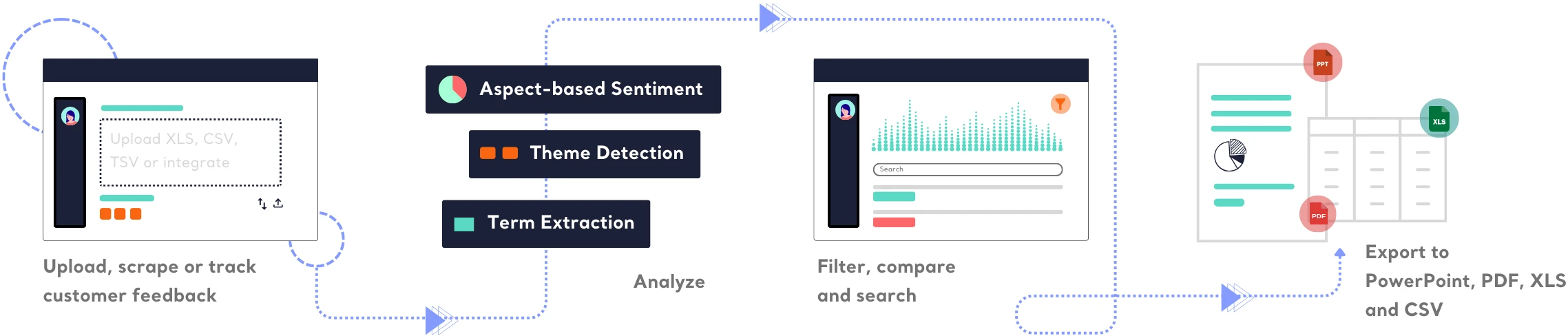
Use the console above to test the model. Paste a dealership review, social media post, or survey response, and instantly see how it is categorized into one of the 13 automotive labels. Testing with your own data shows how the model interprets nuanced automotive feedback and highlights areas for operational or product improvements.
You can also train custom AI models to classify customer feedback with your own labels. Upload your training set, build your model, and start analyzing—all no code!
Get started with ready-to-use AI models to analyze customer feedback with the highest accuracy possible.














Kimola offers a super-clean API documentation with code samples to connect your business process with Kimola.
Find out how Kimola can improve your feedback analysis process.
-
![Kimola for Product Feedback Analysis]() Product Feedback Analysis
Product Feedback Analysis
Uncover customer needs, likes, and dislikes from product reviews and feedback.
-
![Kimola for E-commerce Feedback Analysis]() E-commerce Feedback Analysis
E-commerce Feedback Analysis
Analyze customer reviews and ratings to optimize online shopping experiences.
-
![Kimola for Social Feedback Analysis]() Social Feedback Analysis
Social Feedback Analysis
Extract insights from social media conversations and online discussions.



-
![Kimola for Open-ended Survey Analysis]() Open-ended Survey Analysis
Open-ended Survey Analysis
Make sense of free-text survey responses with AI-powered analysis.
-
![Kimola for Conversational Analysis]() Chatbot and Call Center Conversational Analysis
Chatbot and Call Center Conversational Analysis
Understand customer sentiment and concerns from chat and call transcripts.
-
![Kimola for Employee Feedback Analysis]() Employee Feedback Analysis
Employee Feedback Analysis
Identify workplace trends and employee sentiment from internal feedback and reviews.



Frequently Asked Questions
About Automotive Feedback Classifier
-
What is Automotive Feedback Classifier?
Automotive Feedback Classifier is one of Kimola’s industry-specific AI models. It is a pre-trained solution that automatically analyzes and classifies consumer feedback in the automotive industry across 13 categories, including Performance, Safety, Comfort, Technology, and After-Sales Service.
-
Who can use this model?
Automotive manufacturers, dealerships, R&D teams, marketing teams, and after-sales service providers who want to better understand consumer opinions at scale.
-
Do I need technical expertise to use it?
No. Automotive Feedback Classifier is ready to use without any technical setup. You simply upload your feedback data, and the model handles the classification automatically. Supported file formats include .xls, .xlsx, .csv, and .tsv, ensuring seamless integration with your existing workflows.
-
What happens if feedback doesn’t fit into any category?
The model outputs “None”, ensuring ambiguous or irrelevant feedback isn’t misclassified.
-
How does it help product development?
By classifying performance, safety, and technology feedback, R&D teams can prioritize improvements that matter most to consumers.
-
How many feedback items can it process?
The number of feedback items you can process depends on the plan and query limit included in your subscription. Each plan comes with a defined query quota, and within that limit, the model can scale to handle thousands of feedback entries seamlessly.
Turn customer feedback into structured market research in 30+ languages—no AI training needed.
Create a Free Account No credit card · No commitment