
- Pretrained AI Models
- /
- Classifier
Sentiment Classifier
This model is created with the intent of classifying positive or negative sentiment in any consumer conversation.
| Positive | : Indicates a favorable consumer experience, such as satisfaction, appreciation, or delight with a product or service. |
| Negative | : Indicates an unfavorable consumer experience, such as frustration, disappointment, or dissatisfaction with a product or service. |
Sentiment Classifier is a pre-trained AI model that helps brands truly understand how customers feel. It automatically classifies text into two categories: Positive or Negative.
This model has been trained on extensive datasets of customer feedback collected from multiple industries—ranging from retail and e-commerce to telecom, SaaS, and consumer services. It processes unstructured text such as reviews, survey responses, app store ratings, or social media comments, and assigns each entry a sentiment classification.
Instead of forcing every piece of text into a binary outcome, the model introduces a third label: “None.” This is used for neutral, ambiguous, or irrelevant feedback—ensuring that noise is filtered out rather than misclassified. By doing so, businesses gain cleaner, more reliable insights that reflect the real voice of the customer.
Beyond Keywords: Uncovering the Customer’s True Feelings
Consumer feedback is rarely straightforward. People use sarcasm, comparisons, and subtle phrasing to express how they feel, often blending multiple opinions in a single comment. Traditional keyword-based sentiment tools fail to grasp this nuance, reducing complex emotions into misleading labels.
Take these examples:
- “The product is cheap, but feels cheap too” might be tagged as Positive because of the word cheap, while the actual sentiment is clearly Negative.
- “I didn’t expect it to be this good” could be mistaken for Negative due to the phrase didn’t expect, even though it’s a strong Positive.
- “It’s fine, nothing special” doesn’t lean strongly in either direction, yet most systems force it into Positive or Negative. Sentiment Classifier accurately marks it as None, preventing neutral statements from skewing results.
What makes this model stand out is its context-aware semantic analysis—it doesn’t just scan for keywords, it interprets meaning. It recognizes irony, negations, and even layered tones within a single review, capturing what customers truly mean.
And because consumers express themselves in many languages, this capability extends across borders. With support for 30+ languages—including English, Spanish, French, German, and Dutch— the model ensures that a German app store review, a Spanish Facebook comment, or an English survey response are all analyzed with the same accuracy. This makes it an invaluable tool for global brands seeking consistent sentiment insights across regions and platforms.
Unlocking Value from Sentiment Analysis
Every day, thousands of customer opinions are shared online—far too many to track manually. Sentiment Classifier automates this process, enabling:
- Marketing teams to measure brand reputation and campaign impact in real time,
- Customer service managers to spot negative experiences early and improve response times,
- Product teams to identify enthusiasm for new features or detect dissatisfaction,
- Executives to track satisfaction levels across products, regions, or time periods.
Example Scenario: A retail brand launches a new product. Within days, the classifier processes thousands of comments:
- “Love the design, super sleek” → Positive
- “Support team kept me on hold forever” → Negative
- “It’s okay, nothing special” → None
This allows the brand to celebrate wins, act fast on problems, and avoid overreacting to neutral feedback.
Kimola’s Difference
Kimola’s Sentiment Classifier isn’t just another polarity tool:
- Context-aware classification that handles sarcasm, negations, and ambiguity,
- A None category to filter irrelevant or neutral data,
- Scalable architecture to handle millions of feedback items daily,
- Multilingual capability for seamless global analysis,
- Actionable insights that can be connected directly to product roadmaps, marketing strategies, and customer care initiatives.
By transforming scattered consumer opinions into clear sentiment signals, the model helps brands protect their reputation, improve customer experience, and make smarter decisions with confidence.
Try It Yourself
Use the console above to test the model. Paste a review, tweet, or survey comment, and instantly see whether it’s classified as Positive, Negative, or None.
You can also train custom AI models to classify customer feedback with your own labels. Upload your training set, build your model, and start analyzing—all no code!
Get started with ready-to-use AI models to analyze customer feedback with the highest accuracy possible.














Kimola offers a super-clean API documentation with code samples to connect your business process with Kimola.
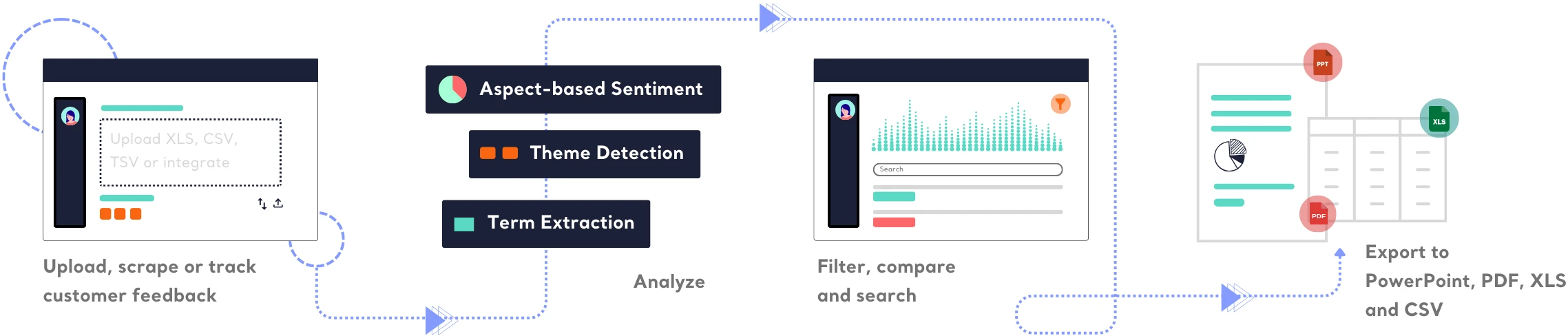
See how teams turn different kinds of feedback into research.






Frequently Asked Questions
About Sentiment Classifier
-
What is sentiment analysis?
Sentiment analysis is the process of detecting the emotional tone behind text data—whether a customer’s feedback is positive, negative, or neutral. It helps businesses measure satisfaction, track brand reputation, and understand consumer emotions at scale. Sentiment Classifier automates this task with higher accuracy than traditional keyword-based methods.
-
How is this different from simple star ratings?
Star ratings show a general score, but they don’t capture the reasoning behind a customer’s opinion. Sentiment Classifier reveals why a user is satisfied or dissatisfied by analyzing the actual words in reviews.
-
Can it handle sarcasm or indirect expressions?
Yes. Unlike keyword-based tools, the model uses context-aware semantic analysis, allowing it to understand sarcasm, negations, and subtle tone differences (e.g., “Great, another crash 🙄” → Negative).
-
What happens to neutral or unclear reviews?
Instead of forcing them into Positive or Negative, the model assigns them as None, preventing neutral content from distorting analysis.
-
Does it require technical expertise to use?
No. You can upload data in .xls, .xlsx, .csv, .tsv formats or integrate via API. The model is pre-trained and ready to use immediately.
-
Can it be integrated with my existing dashboards?
Can it be integrated with my existing dashboards?
-
Does it require retraining for my industry?
The model is pre-trained on diverse industries (retail, SaaS, telecom, consumer services), but it can be fine-tuned with your own data if needed.
Turn customer feedback into structured market research in 30+ languages—no AI training needed.
Create a Free Account No credit card · No commitment