
- Pretrained AI Models
- /
- Classifier
Mobile Game Feedback Classifier
The model has 12 main categories and helps marketing professionals to understand mobile gamer better.
| Gameplay & Mechanics | : Feedback about how the game plays — controls, mechanics, balance, or difficulty curve. |
| Graphics & Visuals | : Mentions of art style, animations, effects, and overall visual appeal. |
| Sound & Music | : Comments on background music, sound effects, voice-overs, or audio quality. |
| Story & Characters | : Feedback on plot, dialogue, world-building, or how engaging the characters are. |
| Performance & Stability | : Mentions of lags, loading times, frame rates, crashes, or device compatibility. |
| Updates & New Content | : Opinions on new levels, events, patches, expansions, or seasonal content. |
| Progression & Rewards | : Feedback about leveling systems, achievements, unlocks, or fairness of rewards. |
| Multiplayer & Community | : Comments on online play, matchmaking, chat, or interactions with other players. |
| Fairness & Balance | : Feedback on whether gameplay feels fair — avoiding pay-to-win or overpowered elements. |
| Ads & Monetization | : Mentions of in-app purchases, ads frequency, pricing of items, or value of microtransactions. |
| Fun & Engagement | : Overall impressions of how enjoyable, addictive, or boring the game feels. |
| Customer Support | : Feedback about contacting developers for help, bug reports, or account recovery. |
Mobile Game Feedback Classifier is a pre-trained AI model tailored for the gaming industry. It automatically analyzes player feedback and categorizes it into 12 game-specific dimensions: Gameplay & Mechanics, Graphics & Visuals, Sound & Music, Story & Characters, Performance & Stability, Updates & New Content, Progression & Rewards, Multiplayer & Community, Fairness & Balance, Ads & Monetization, Fun & Engagement, and Customer Support.
The model processes unstructured feedback from App Store & Google Play reviews, Discord & Reddit communities, in-game surveys, support tickets, and social media mentions. Each comment is classified into the most relevant category. If feedback doesn’t match any label, the model outputs “None”, ensuring irrelevant or vague remarks don’t dilute insights. By structuring player reviews, studios can track sentiment, balance gameplay, and improve player retention.
Beyond Keywords: Understanding Gamer Feedback
Keyword-based filters often fail in gaming contexts, where player comments are layered with slang, abbreviations, and sarcasm. For example:
- “The game is pay-to-win” might be misclassified as Progression instead of Ads & Monetization.
- “Great graphics but constant lag kills the fun” could be tagged under Graphics only, missing Performance & Stability.
- “Love the co-op mode, but matchmaking is unfair” may get marked under Multiplayer while ignoring Fairness & Balance.
Mobile Game Feedback Classifier applies context-aware semantic analysis that understands gamer language, mixed reviews, and multi-topic comments, ensuring accurate categorization of what truly matters to players.
The model works across 30+ languages—including English, Spanish, French, German, and Dutch. This makes it suitable for global game publishers, ensuring consistent insights whether feedback comes from Tokyo, São Paulo, or Los Angeles.
Unlocking Value from Game Feedback
Mobile games attract thousands of reviews, tweets, and forum posts every month. Manually sorting them is slow, biased, and error-prone. This model automates the process, enabling:
- Game designers to refine Gameplay, Story, and Balance,
- Developers to monitor Performance, Stability, and Updates,
- Monetization teams to track Ads & Subscriptions complaints,
- Community managers to gauge sentiment in Multiplayer & Community feedback,
- Producers to evaluate Fun, Engagement, and Player Retention.
Example Scenario: A battle royale game receives thousands of reviews after a new season update. The model automatically classifies “love the new map but too many bugs in ranked mode” under Updates + Performance, and “game is fun but matchmaking is unfair for free players” under Fun & Engagement + Fairness & Balance. This helps studios act fast, balancing gameplay and optimizing retention strategies.
Kimola’s Difference
Kimola’s Mobile Game Feedback Classifier offers more than keyword tagging:
- Game-specific taxonomy across 12 critical player experience areas,
- Context-aware semantic analysis that understands gamer slang & sarcasm,
- Scalable architecture to process millions of reviews across app stores & communities,
- Multilingual support for global publishers,
- Actionable insights that connect directly to design, development, monetization, and community strategies.
By focusing on player experience, the model transforms raw gamer feedback into data-driven insights—helping studios deliver smoother gameplay, fairer balance, and more engaging content.
Try It Yourself
Use the console above to test the model. Paste a review from App Store, Google Play, or gamer forums like Reddit/Discord, and instantly see how it’s categorized into Gameplay, Performance, Balance, Monetization, Engagement, or other game-specific categories.
You can also train custom AI models to classify customer feedback with your own labels. Upload your training set, build your model, and start analyzing—all no code!
Get started with ready-to-use AI models to analyze customer feedback with the highest accuracy possible.














Kimola offers a super-clean API documentation with code samples to connect your business process with Kimola.
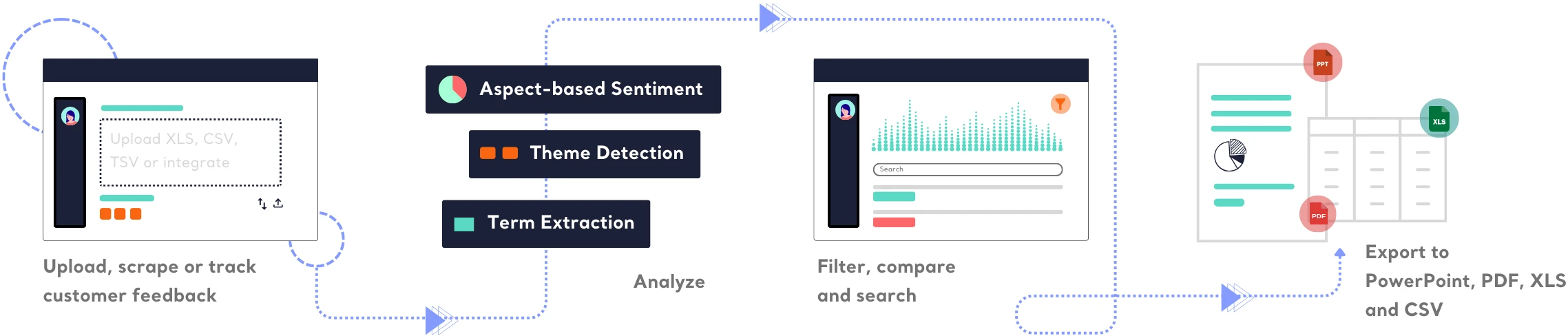
Find out how Kimola can improve your feedback analysis process.
-
![Kimola for Product Feedback Analysis]() Product Feedback Analysis
Product Feedback Analysis
Uncover customer needs, likes, and dislikes from product reviews and feedback.
-
![Kimola for E-commerce Feedback Analysis]() E-commerce Feedback Analysis
E-commerce Feedback Analysis
Analyze customer reviews and ratings to optimize online shopping experiences.
-
![Kimola for Social Feedback Analysis]() Social Feedback Analysis
Social Feedback Analysis
Extract insights from social media conversations and online discussions.



-
![Kimola for Open-ended Survey Analysis]() Open-ended Survey Analysis
Open-ended Survey Analysis
Make sense of free-text survey responses with AI-powered analysis.
-
![Kimola for Conversational Analysis]() Chatbot and Call Center Conversational Analysis
Chatbot and Call Center Conversational Analysis
Understand customer sentiment and concerns from chat and call transcripts.
-
![Kimola for Employee Feedback Analysis]() Employee Feedback Analysis
Employee Feedback Analysis
Identify workplace trends and employee sentiment from internal feedback and reviews.



Frequently Asked Questions
About Mobile Game Feedback Classifier
-
What is the Mobile Game Feedback Classifier?
It’s a pre-trained AI model that analyzes player reviews, surveys, community posts, and support tickets. Feedback is automatically categorized into 12 game-specific areas like Gameplay & Mechanics, Performance & Stability, Ads & Monetization, Fairness & Balance, and Fun & Engagement.
-
Can it understand gamer slang and abbreviations?
Yes. The model is trained to recognize gaming-specific terms like “pay-to-win,” “OP,” “nerf,” or “GG,” so even informal or sarcastic reviews are correctly classified.
-
Does it distinguish between performance issues and game design complaints?
Yes. A review like “Graphics are amazing but the game keeps crashing” will be tagged under both Graphics & Visuals and Performance & Stability, while “The boss fight is unfair” would fall under Gameplay & Mechanics and Fairness & Balance.
-
Does it support global player communities?
Yes. With support for 30+ languages—including English, Spanish, German, French, and Dutch, the model ensures consistent insights across regions, making it ideal for international publishers.
-
Can it separate feedback about fun from technical complaints?
Yes. If a player says “The gameplay is addictive but the app keeps freezing”, the model tags it under both Fun & Engagement and Performance & Stability.
-
Can it recognize that players are frustrated with ads?
Yes. Comments such as “Ads are too frequent and ruin the experience” are automatically classified under Ads & Monetization, giving teams clear signals to adjust ad strategies.
Turn customer feedback into structured market research in 30+ languages—no AI training needed.
Create a Free Account No credit card · No commitment