
- Pretrained AI Models
- /
- Classifier
Hate Speech Detector
This model is prepared to identify hate speech towards a specific ethnicity, nationality, religion, sexuality, disability, or class.
| Hate Speech | : This label shows the texts that contain hate speech. |
| Not Hate Speech | : This label indicates conversations that do not contain hate speech. |
Hate Speech Detector is a pre-trained AI model that automatically identifies and classifies hate speech in text. It is designed to detect harmful content such as racism, sexism, homophobia, xenophobia, religious intolerance, and offensive slurs.
The model is trained on large, diverse datasets of online discussions, social media posts, and forum comments. It processes unstructured text—whether a short comment, a tweet, or a conversation snippet—and determines whether it contains hate speech. If the text does not clearly fit, the model outputs “None”, ensuring neutral or irrelevant content is not mislabeled. By filtering harmful language at scale, organizations can create safer communities and protect brand integrity.
Beyond Keywords: Understanding Harmful Content
Relying on keywords alone makes it easy to overlook context and subtle meaning. For example:
- “You people don’t belong here” may not contain an explicit slur, but it is a form of xenophobia.
- “That was sick!” might be flagged incorrectly as offensive when it actually conveys positive slang.
Hate Speech Detector goes beyond keywords with context-aware semantic analysis. It understands slang, sarcasm, multi-topic sentences, and cultural nuance—reducing false positives while catching hidden hate speech.
Covering 30+ languages such as English, Spanish, French, German, and Dutch, the model empowers organizations to maintain consistent content moderation across diverse regions and audiences.
Unlocking Value from Hate Speech Detection
With millions of comments generated daily, manual moderation is both costly and inconsistent. Hate Speech Detector automates this process, enabling:
- Social media platforms to reduce toxic behavior and protect users,
- Gaming companies to moderate in-game chat environments,
- News sites & forums to maintain civil discussions,
- Brands to safeguard their reputation from harmful content,
- NGOs & public institutions to track hate speech trends and prevent escalation.
Example Scenario: An online forum receives thousands of daily comments. Hate Speech Detector identifies racist slurs, subtle xenophobic remarks, and sexist comments in real time, while ignoring neutral or positive posts. This ensures moderators focus only on harmful content, saving time and resources.
Kimola’s Difference
Kimola’s Hate Speech Detector offers more than automated flagging:
- Context-aware classification that reduces false positives,
- Comprehensive taxonomy covering racism, sexism, homophobia, xenophobia, and more,
- Multilingual support for global communities,
- Scalable architecture for processing millions of comments,
- Actionable insights for moderation dashboards and reporting.
By focusing on both accuracy and context, the model transforms raw user comments into safe, structured insights, empowering platforms to foster healthier digital environments.
Try It Yourself
Use the console above to test the model. Paste a social media post, chat message, or forum comment, and instantly see if it’s flagged as hate speech. Testing with your own data shows how the model interprets different expressions, distinguishes harmful content from harmless slang, and helps create safer communities.
You can also train custom AI models to classify customer feedback with your own labels. Upload your training set, build your model, and start analyzing—all no code!
Get started with ready-to-use AI models to analyze customer feedback with the highest accuracy possible.














Kimola offers a super-clean API documentation with code samples to connect your business process with Kimola.
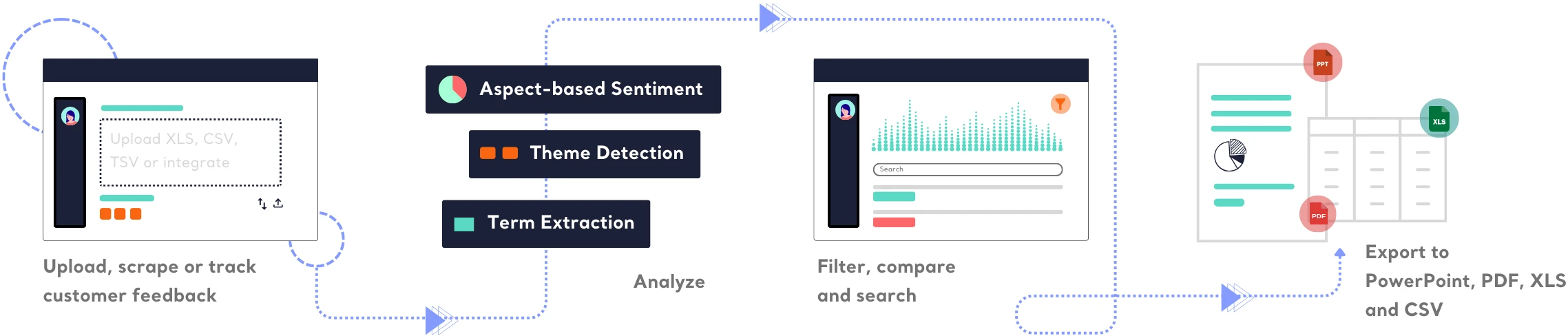
Find out how Kimola can improve your feedback analysis process.
-
![Kimola for Product Feedback Analysis]() Product Feedback Analysis
Product Feedback Analysis
Uncover customer needs, likes, and dislikes from product reviews and feedback.
-
![Kimola for E-commerce Feedback Analysis]() E-commerce Feedback Analysis
E-commerce Feedback Analysis
Analyze customer reviews and ratings to optimize online shopping experiences.
-
![Kimola for Social Feedback Analysis]() Social Feedback Analysis
Social Feedback Analysis
Extract insights from social media conversations and online discussions.



-
![Kimola for Open-ended Survey Analysis]() Open-ended Survey Analysis
Open-ended Survey Analysis
Make sense of free-text survey responses with AI-powered analysis.
-
![Kimola for Conversational Analysis]() Chatbot and Call Center Conversational Analysis
Chatbot and Call Center Conversational Analysis
Understand customer sentiment and concerns from chat and call transcripts.
-
![Kimola for Employee Feedback Analysis]() Employee Feedback Analysis
Employee Feedback Analysis
Identify workplace trends and employee sentiment from internal feedback and reviews.



Frequently Asked Questions
About Hate Speech Detector
-
What is the Hate Speech Detector?
It’s one of Kimola’s pre-trained AI models designed to identify and classify hate speech in text. The model uses two labels: Hate Speech (content that is offensive, discriminatory, or harmful) and Not Hate Speech (neutral or safe content).
-
Who can use this model?
Any organization that needs to monitor, moderate, or research online conversations—such as social media platforms, gaming companies, forums, news websites, NGOs, and brands concerned with digital safety.
-
Do I need technical expertise to use it?
No. The model is ready to use. You only need to upload your data or connect via API. Supported file formats include .xls, .xlsx, .csv, and .tsv for seamless integration into your workflow.
-
Does the model recognize sarcasm or irony?
Yes. The model is designed to handle nuanced expressions. For example, sarcastic remarks that mask offensive intent can still be flagged as hate speech when context indicates harmful meaning.
-
How does it support global communities?
With multilingual capability across 30+ languages, it ensures that hate speech is consistently identified in different cultural and linguistic contexts, enabling global platforms to apply uniform moderation policies.
-
Is it useful for brand safety?
Absolutely. Brands can use it to monitor harmful content that may affect their reputation or customer community.
Turn customer feedback into structured market research in 30+ languages—no AI training needed.
Create a Free Account No credit card · No commitment