Creating a Consumer Research Report for the Portable Juice Blender Category
14 mins read - Updated on Jul 14, 2026Portable juice blenders have transformed blending from a kitchen activity into an everyday habit. Designed for busy lifestyles, these compact devices allow consumers to prepare smoothies, protein shakes, and fresh drinks wherever they are—at home, at work, at the gym, or while traveling. As the category has grown, so have consumer expectations. What makes a portable blender truly convenient? Which features matter most? And what separates products that become part of daily routines from those that quickly disappoint?
In this tutorial, you'll learn how to answer questions like these by building a complete consumer research report in Kimola. To make the process practical, we'll work with a sample dataset created for AuraVibe, a fictional portable juice blender brand, and use it to explore the category from multiple perspectives.
As you follow along, you'll learn a repeatable workflow for preparing data, understanding your report, interpreting individual analyses, and connecting insights to answer real business questions.
Before we begin, download the sample dataset and upload it to your Kimola workspace. We'll use this dataset throughout the tutorial to build a complete consumer research report and explore each analysis step by step.
If you don't already have a Kimola account, sign up first, then sign in and navigate to the Dashboard Home page to get started.
Understanding Your Dataset
Before exploring the analyses, let's take a closer look at the dataset we'll use throughout this tutorial.
Our sample dataset contains 3,402 e-commerce reviews collected across AuraVibe and several competing portable juice blender brands. Although fictional, it reflects the type of customer feedback organizations commonly collect from e-commerce platforms, customer surveys, support channels, and online communities.
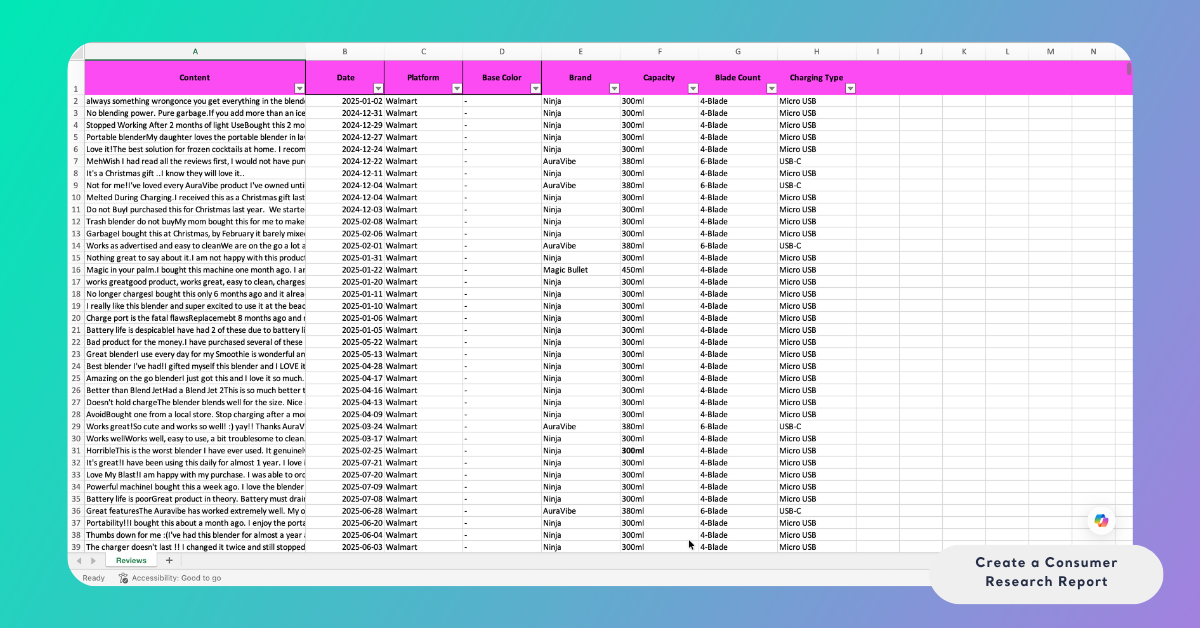
At the center of the dataset is the Content column, which contains the customer reviews Kimola analyzes to identify recurring patterns, behaviors, and consumer insights.
Alongside the reviews, the dataset includes structured columns such as Date, Platform, Brand, Base Color, Capacity, Blade Count, and Charging Type. These attributes provide valuable context for every conversation, making it possible to compare products, investigate how different product configurations influence customer experiences, and answer more targeted research questions.
Think about the questions you want to answer before building your dataset. Including relevant product attributes alongside customer feedback makes it easier to compare product variations, uncover meaningful patterns, and answer more specific business questions throughout your research.
Creating Your Report
Now that your dataset is ready, it's time to create your report in Kimola.
From the Dashboard Home page, upload the sample dataset using the Upload your custom dataset section.
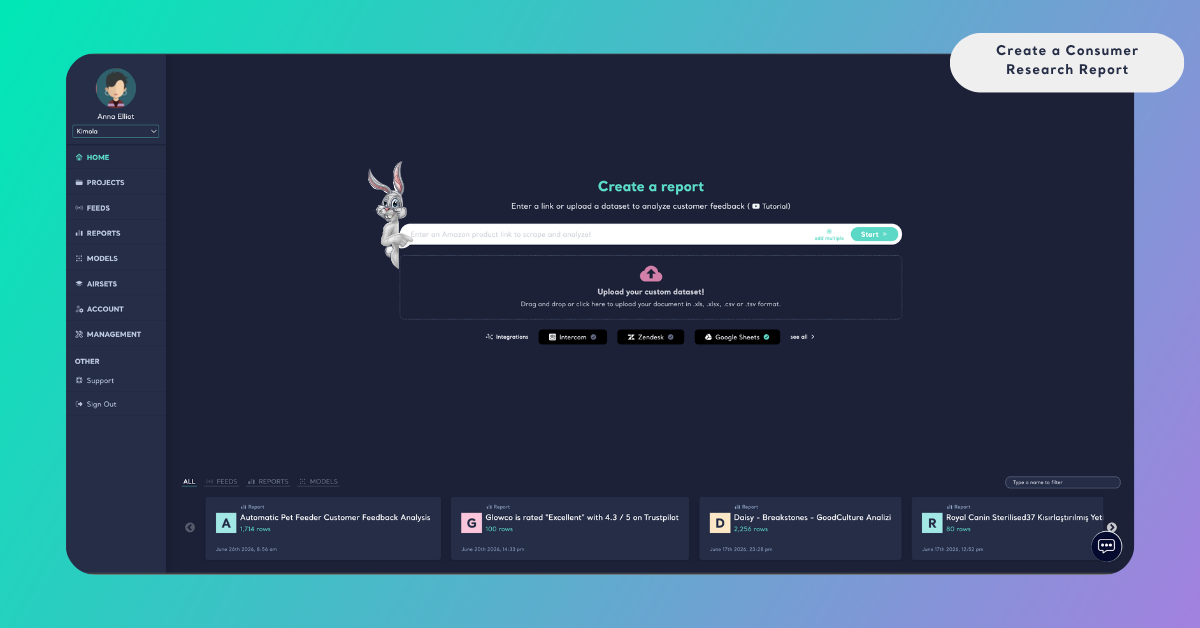
Once the upload is complete, Kimola guides you through a short setup process.
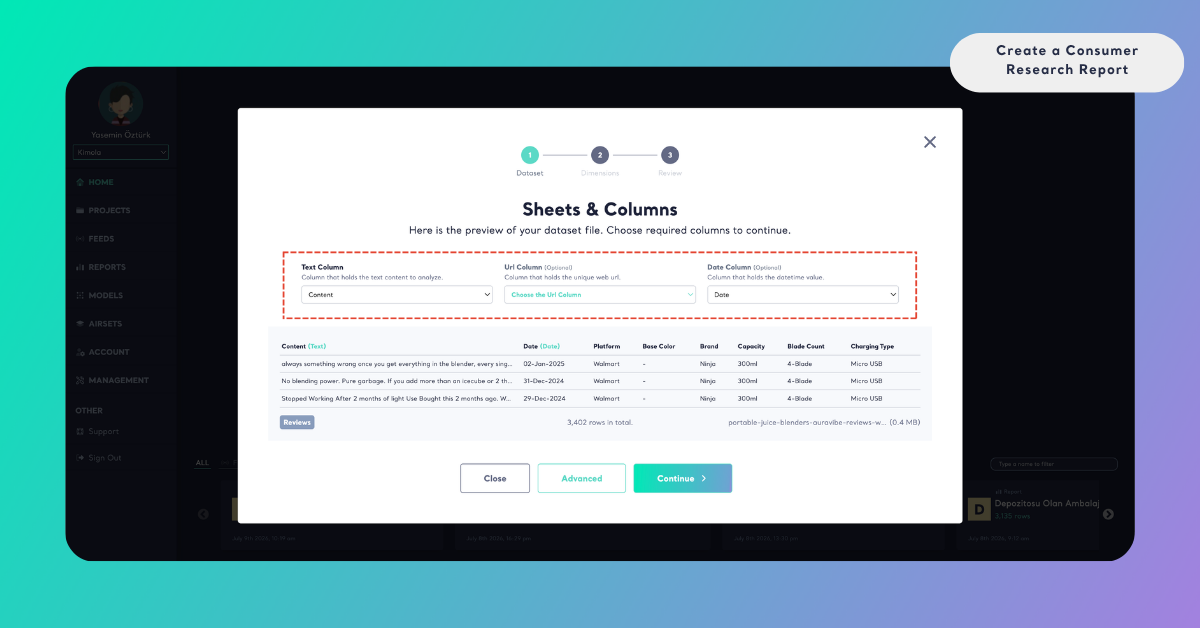
Begin by reviewing your dataset and mapping the required columns. Assign the Content column as the Text Column so Kimola knows which field contains the customer feedback to analyze. If your dataset includes additional fields such as dates or URLs, you can map those as well.
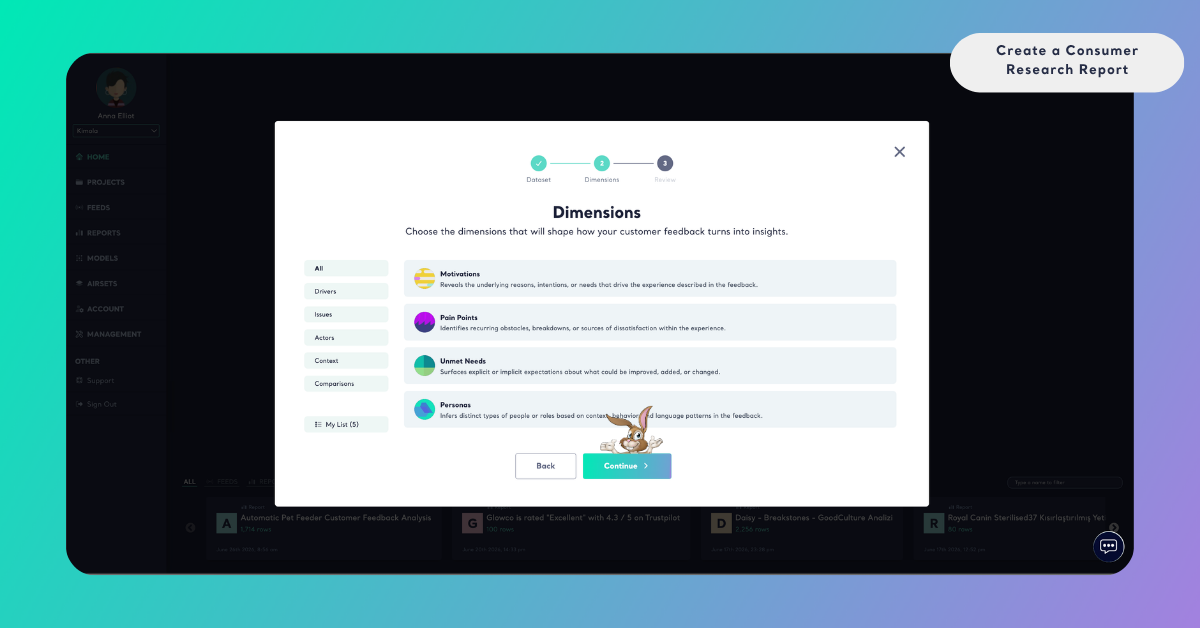
Next, choose the dimensions you want to include in your report. Each dimension examines the same customer feedback from a different perspective, helping answer different types of consumer research questions.
Finally, review your report settings, enter a report name, choose the report language, and click Create Report.
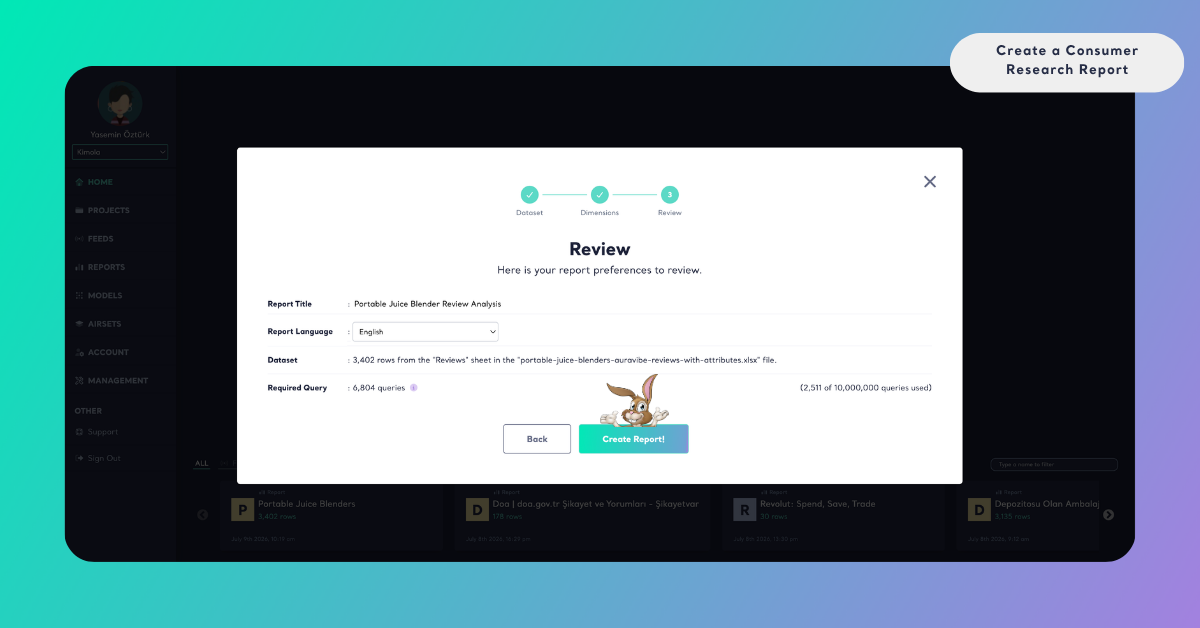
You don't have to select every dimension at the beginning. As your research evolves, you can return to your report and add additional dimensions without creating a new one.
Kimola will process your dataset and generate the selected analyses automatically. Once processing is complete, you'll be ready to explore your report.
A First Look at Your Report
Your report is now ready, and all selected analyses have been generated.
The Overview page brings together the key findings from across your report, providing a quick snapshot of your dataset before you begin exploring individual analyses. It highlights overall sentiment, the strongest and weakest-performing themes, and summarizes the most prominent findings from each selected dimension.
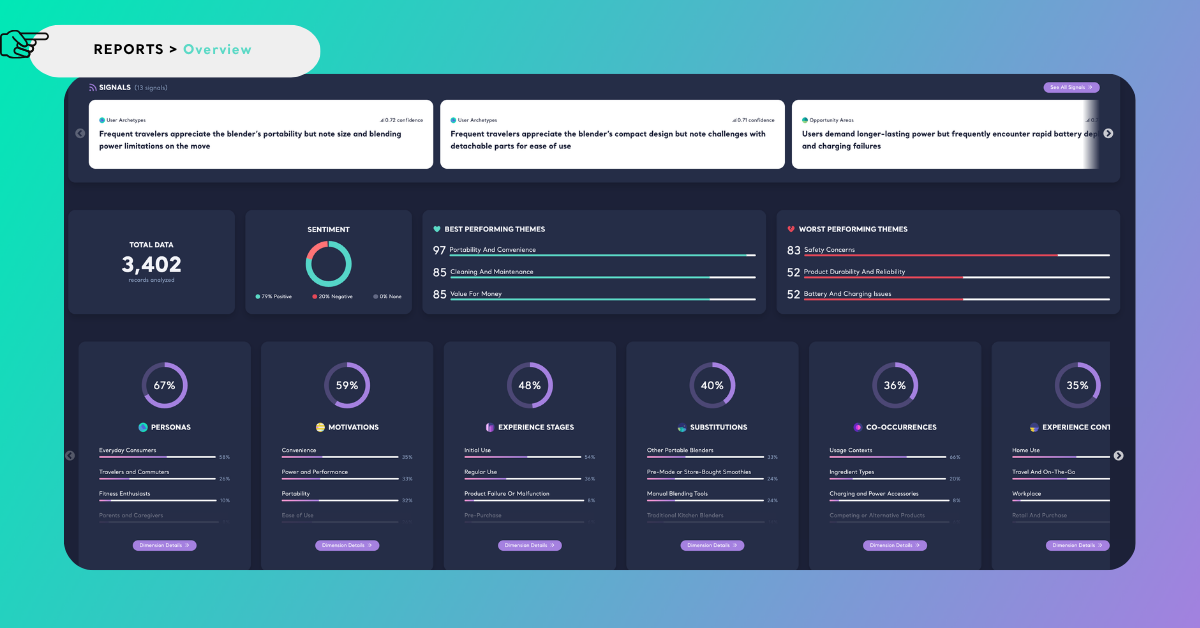
Throughout this tutorial, we'll use different analyses to answer the following questions about the portable juice blender category.
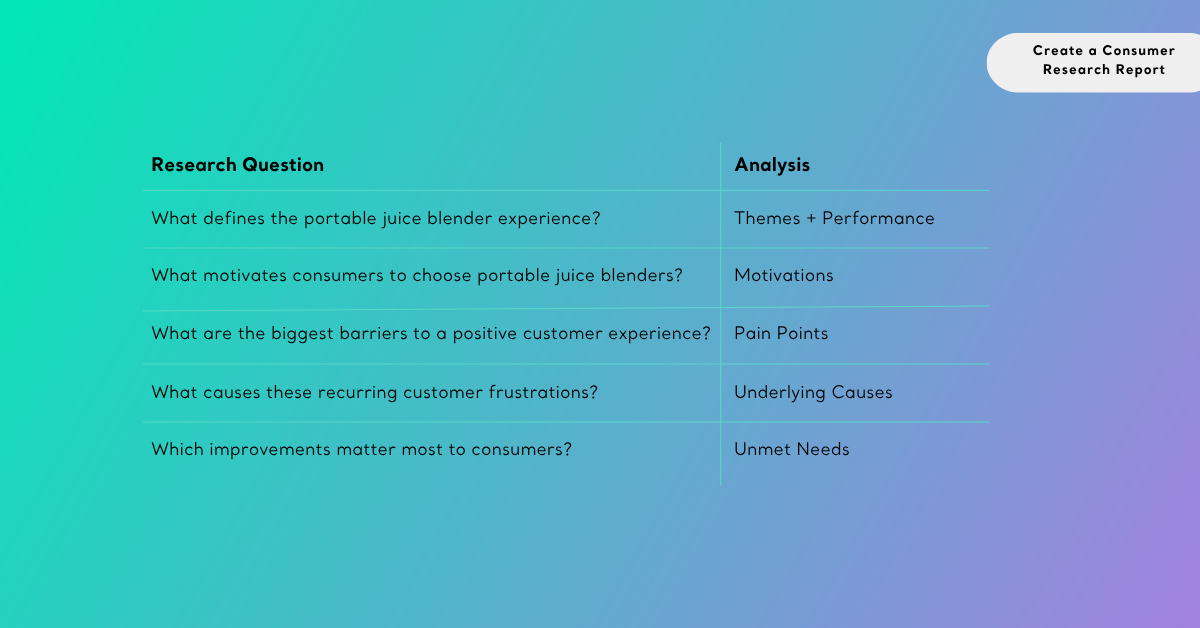
We'll begin with Signals. By connecting findings across multiple analyses, they provide a high-level view of the recurring patterns emerging throughout the report before we explore each analysis in more detail.
Seeing the Bigger Picture with Signals
A single analysis can answer an important question, but consumer behavior is rarely explained from one perspective alone. Signals connect findings across your report, helping reveal the broader patterns that emerge when multiple analyses reinforce one another.
Rather than introducing new information, Signals identify meaningful relationships between different analyses, making it easier to understand how customer motivations, behaviors, challenges, and opportunities are connected.
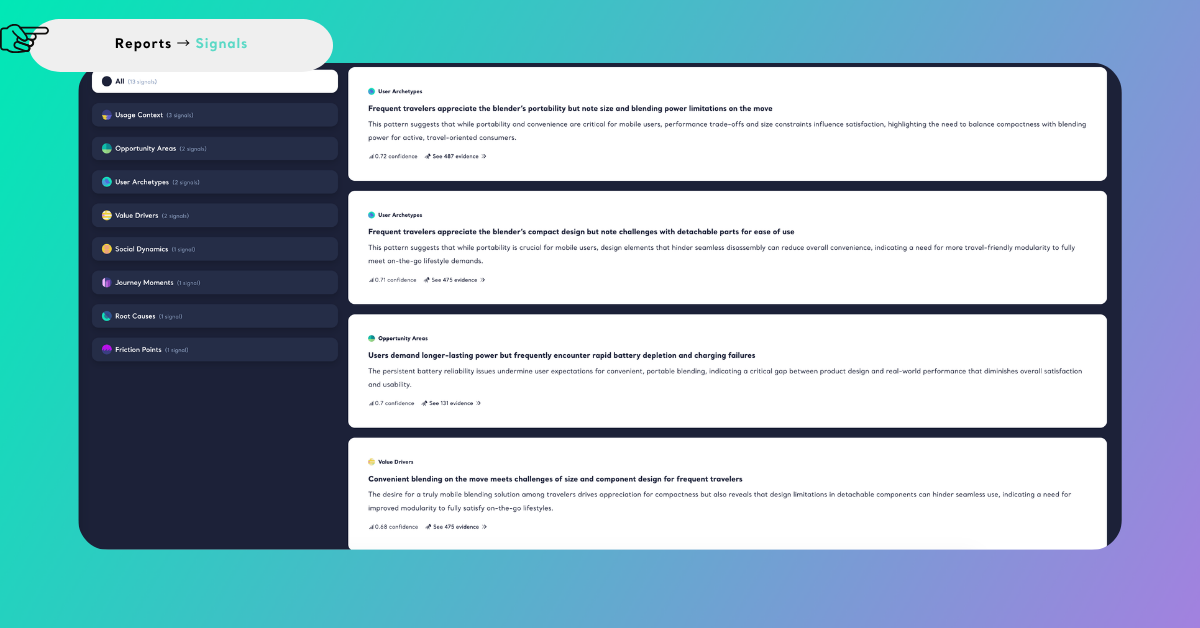
In the portable juice blender category, these relationships reveal a consistent story. Consumers are primarily attracted to portable blenders because they support healthy, on-the-go lifestyles, combining portability, convenience, and the ability to prepare fresh drinks wherever they are. Signals repeatedly connect these motivations with everyday usage contexts such as work, travel, and fitness, showing that convenience is one of the category's strongest value drivers.
At the same time, the report shows that portability alone is not enough to create a satisfying ownership experience. Signals consistently link positive expectations with recurring concerns about blending performance, battery life, and product durability. Difficulties blending frozen ingredients, charging problems, and mechanical failures emerge across multiple analyses, suggesting that reliability has a greater influence on long-term satisfaction than portability alone.
Signals also point to clear opportunities for improvement. Enhancing motor power, extending battery life, improving durability, and simplifying maintenance appear repeatedly throughout the report, indicating that consumers are looking for products that combine portability with dependable everyday performance rather than portability alone.
Together, these patterns suggest that the success of a portable juice blender depends not only on making healthy routines more convenient, but also on delivering a product that performs consistently over time. In the following sections, we'll explore the individual analyses behind these Signals to better understand the motivations, challenges, and opportunities shaping the category.
Signals are generated automatically when your report includes enough analyses to identify meaningful relationships across them. If only a few dimensions are selected, Signals may not be available.
What Defines the Portable Juice Blender Experience
Portable juice blenders are designed to make healthy habits more convenient, but customer experiences extend far beyond simply blending drinks. Consumers evaluate these products based on how well they fit into everyday routines, how effectively they blend different ingredients, and whether they continue to perform reliably over time.
The Themes analysis reveals the aspects of the product that attract the most attention throughout the ownership experience. The Performance dashboard complements this by measuring the true level of customer satisfaction for each theme using statistically adjusted satisfaction scores, allowing fair comparisons across themes of different sizes.
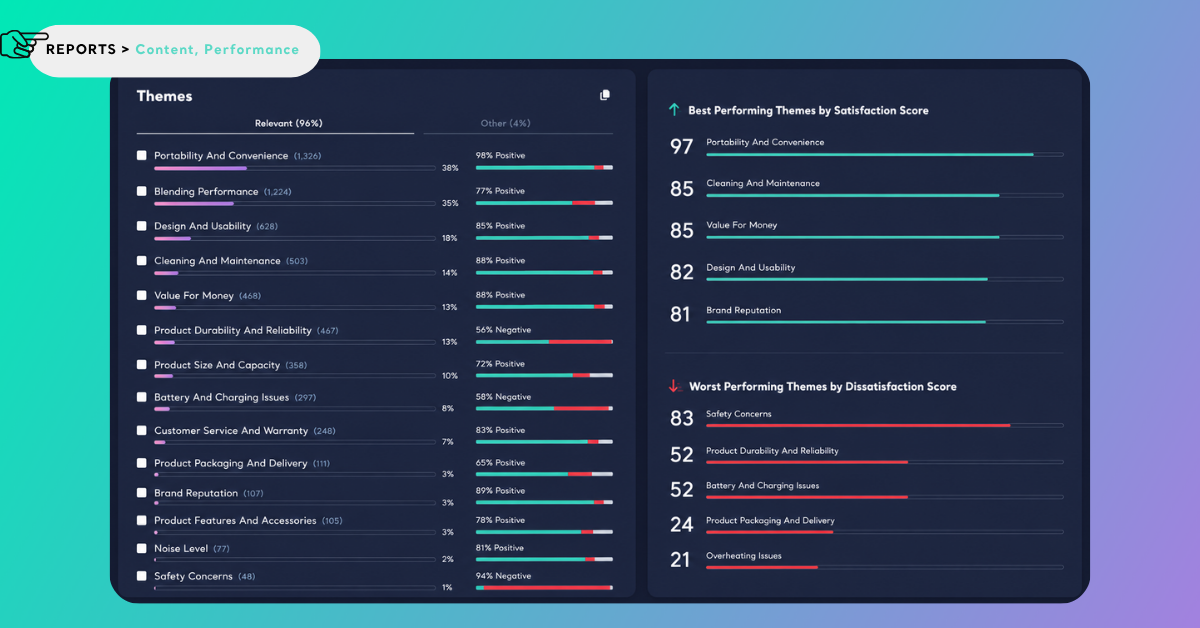
In our example report, Portability & Convenience dominates customer conversations, accounting for 38% of all theme-related discussions. Consumers consistently praise the ability to prepare fresh smoothies and shakes wherever they are, highlighting portability, compact design, and ease of transport as defining strengths of the category. Supported by one of the highest satisfaction scores in the report, this suggests that portability is one of the category's strongest strengths.
The second most frequently discussed theme, Blending Performance, presents a more balanced picture. While many consumers praise the blender's ability to prepare smoothies, protein shakes, and other everyday drinks, others report difficulties blending frozen ingredients, ice, and tougher foods. This contrast shows that blending performance is one of the most influential factors shaping overall customer satisfaction.
The Performance dashboard also highlights where the greatest opportunities for improvement lie. Product Durability & Reliability and Battery & Charging Issues receive some of the lowest satisfaction scores, indicating that long-term satisfaction depends not only on portability, but also on whether the blender continues to perform consistently through everyday use.
Together, Themes and Performance show that the portable juice blender experience is defined by a balance between convenience and dependable performance. While portability attracts consumers to the category, consistent blending, reliable operation, and long-term durability ultimately determine whether the product lives up to customer expectations.
The next step is understanding why consumers choose portable juice blenders in the first place and the needs they hope these products will fulfill.
What Drives Consumers to Choose Portable Juice Blenders
Before evaluating whether a product meets expectations, it's important to understand why consumers decide to purchase it in the first place and what they hope it will help them achieve.
The Motivations analysis identifies the goals, needs, and expectations that drive purchase decisions. Rather than focusing on product features, it reveals the underlying reasons consumers enter the category.
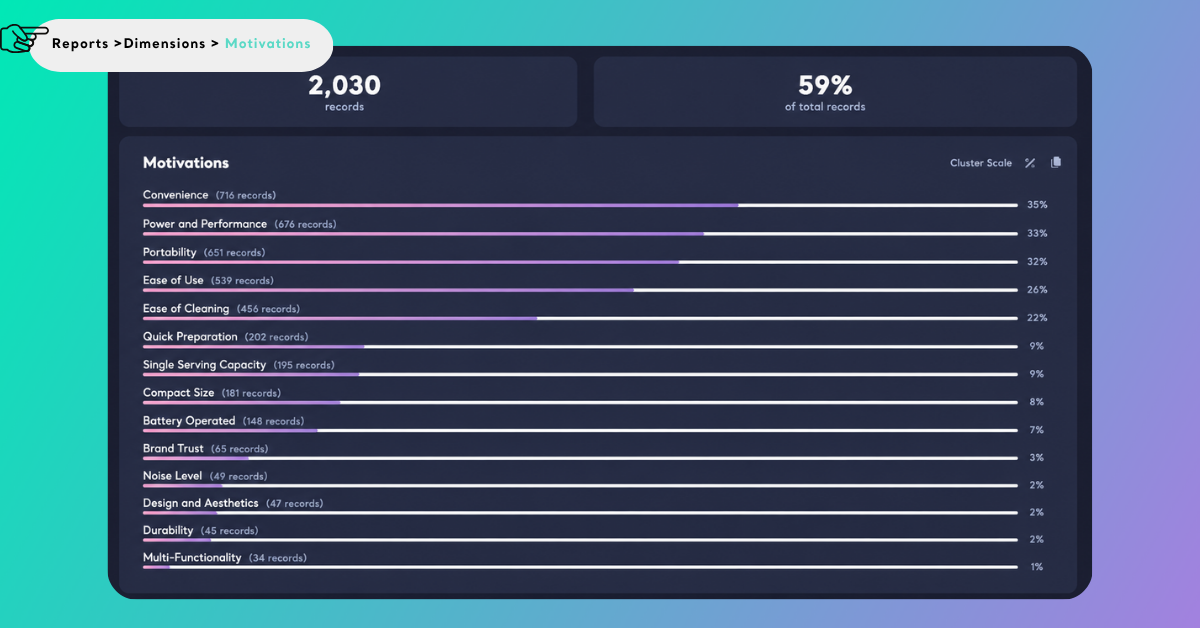
Across the report, convenience emerges as one of the strongest purchase drivers. Consumers value the ability to prepare fresh smoothies and protein shakes quickly without relying on a full-sized kitchen appliance. Portability further strengthens this appeal, enabling healthy routines to extend beyond the home into workplaces, gyms, travel, and other everyday settings.
The analysis also shows that consumers are motivated by performance. While portability attracts attention, customers still expect portable blenders to deliver smooth, consistent results across a variety of ingredients. Ease of cleaning, compact design, and long-term durability further contribute to purchasing decisions, reflecting a desire for products that integrate seamlessly into busy lifestyles.
Taken together, these motivations suggest that consumers are not simply purchasing a blender—they are investing in a convenient way to maintain healthier daily habits. The product is expected to save time, fit into everyday routines, and provide reliable performance wherever it is used.
The next step is exploring the challenges that prevent these products from consistently meeting those expectations.
Why Doesn't the Experience Always Meet Expectations
Understanding why consumers choose portable juice blenders is only part of the story. While these products promise convenience and support healthier daily routines, customer feedback also reveals the recurring challenges that prevent them from consistently meeting consumer expectations.
The Pain Points analysis identifies the issues that generate the greatest frustration throughout the customer experience. Rather than highlighting individual complaints, it groups similar conversations together to reveal the recurring obstacles that have the biggest impact on customer satisfaction.
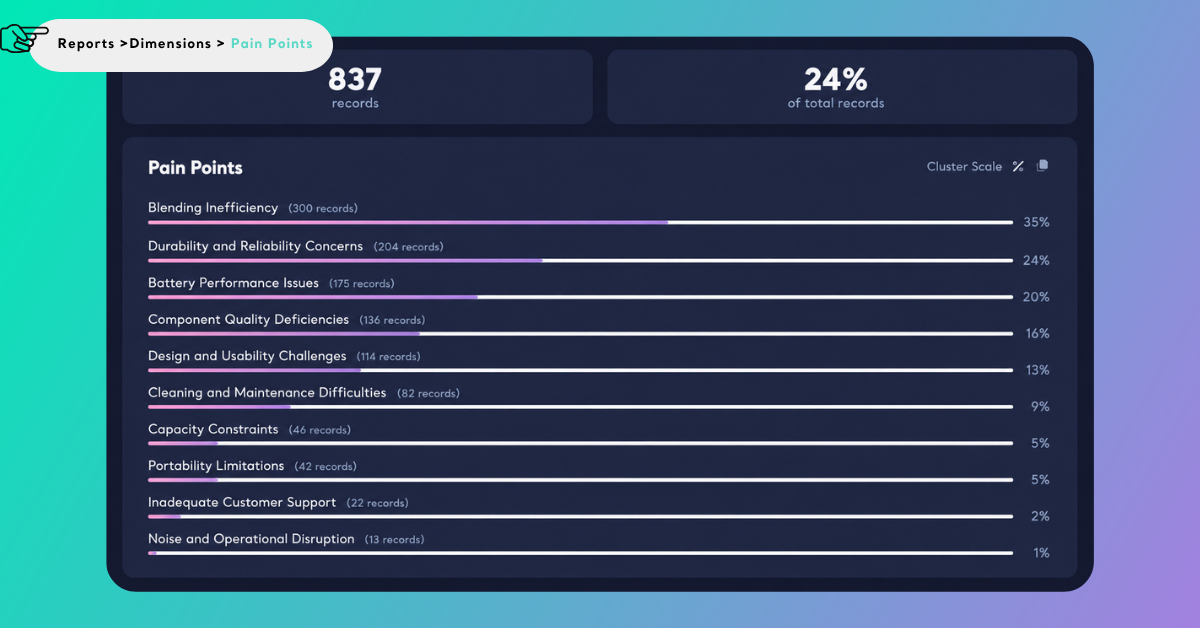
Looking at the results, Blending Inefficiency, Durability & Reliability Concerns, and Battery Performance Issues emerge as the category's leading pain points. Together, they suggest that consumers are generally satisfied with the idea of portable blending, but become frustrated when products fail to deliver consistent performance or maintain their reliability over time.
Looking beyond individual complaints, the analysis helps researchers distinguish recurring problems from isolated incidents, making it easier to prioritize improvement opportunities based on the issues that affect the largest number of consumers.
Pain Points reveal what consumers struggle with, but they don't always explain why these challenges occur. The next step is exploring the underlying causes behind these recurring issues.
What's Behind Recurring Customer Frustrations
The Pain Points analysis reveals the challenges consumers experience, but recurring problems rarely exist without an underlying cause. The Underlying Causes analysis helps uncover the factors behind those recurring frustrations, making it easier to understand why similar issues appear across customer feedback.
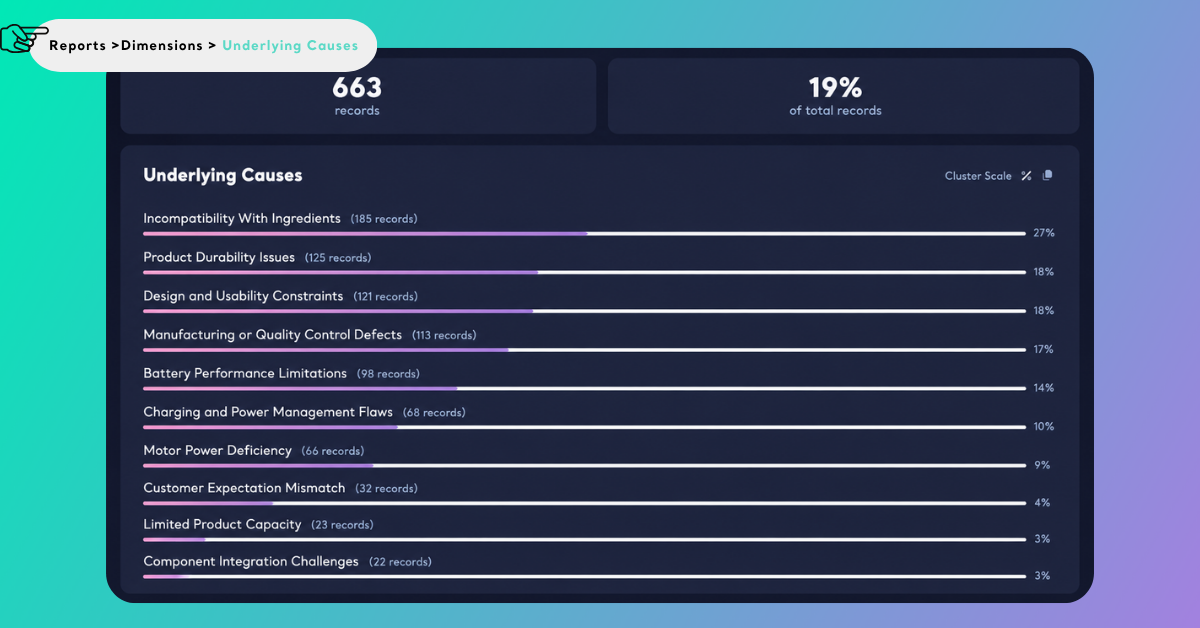
The analysis highlights a clear pattern. Blending power limitations, battery-related factors, and component quality emerge as some of the most common underlying causes associated with customer frustrations. Rather than representing isolated technical issues, these findings suggest that many recurring complaints stem from a relatively small number of underlying product limitations.
Looking at customer feedback through the lens of underlying causes helps researchers move beyond identifying what consumers struggle with and begin understanding why those experiences occur. This perspective makes it easier to prioritize improvements that address the source of recurring problems rather than only their symptoms.
Understanding these root causes also provides valuable context for interpreting consumer expectations. The next step is exploring the improvements consumers are looking for and the needs that remain unmet.
What Improvements Matter Most to Consumers
While customer feedback often highlights existing problems, it can also reveal opportunities for innovation. The Unmet Needs analysis identifies the improvements consumers are looking for, helping businesses understand where future product development can create the greatest value.
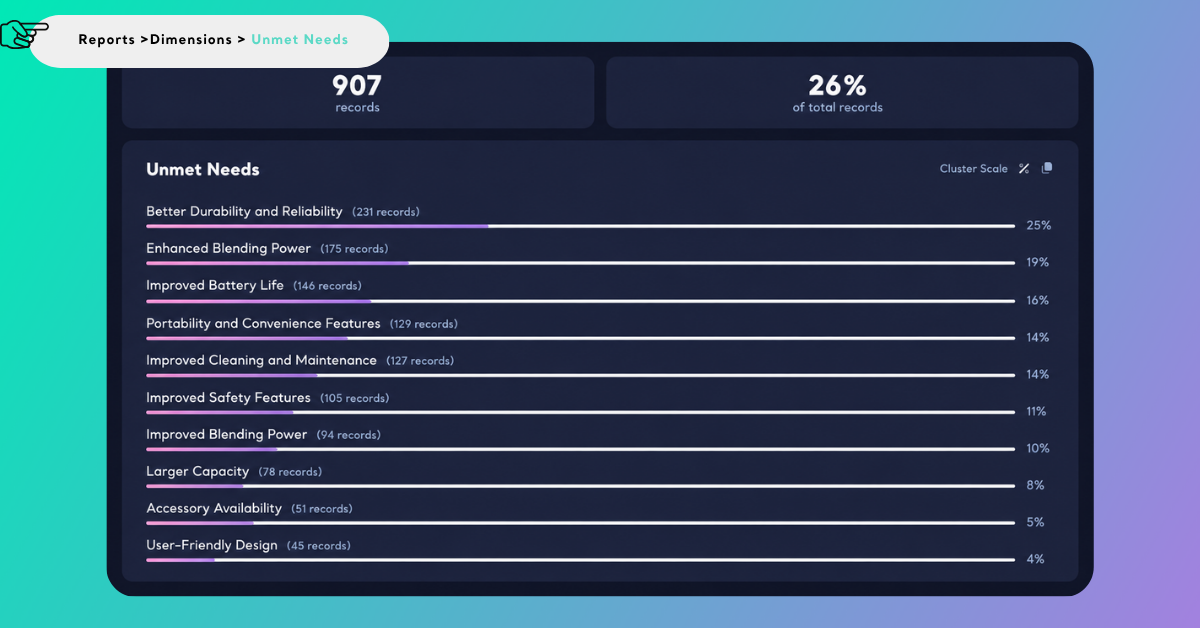
The findings reveal a clear pattern. Better Durability & Reliability, Enhanced Blending Power, and Improved Battery Life emerge as the most prominent unmet needs, suggesting that consumers are looking for products that combine portability with dependable, long-term performance.
The analysis also highlights opportunities beyond core product functionality. Needs such as improved cleaning and maintenance, greater portability and convenience, enhanced safety features, and larger capacity show that consumers evaluate portable juice blenders not only by how well they blend, but also by how easily they fit into everyday life.
Rather than focusing solely on current customer experiences, the Unmet Needs analysis helps researchers identify where expectations remain unfulfilled. These insights can guide product development, feature prioritization, and innovation by highlighting the improvements most likely to create a better customer experience.
This naturally leads to another question: do these experiences differ across different product configurations?
Does Blade Count Influence the Customer Experience
Throughout this report, blending performance has emerged as one of the defining aspects of the portable juice blender experience. It influences why consumers choose these products, appears as one of the category's biggest pain points, and remains a recurring opportunity for improvement. This naturally raises another research question: does blade count influence how consumers experience blending performance?
The Compare feature makes it possible to answer questions like this by examining analyses across structured attributes in your dataset. Rather than viewing all customer feedback as a single group, researchers can explore how different product characteristics shape customer experiences.
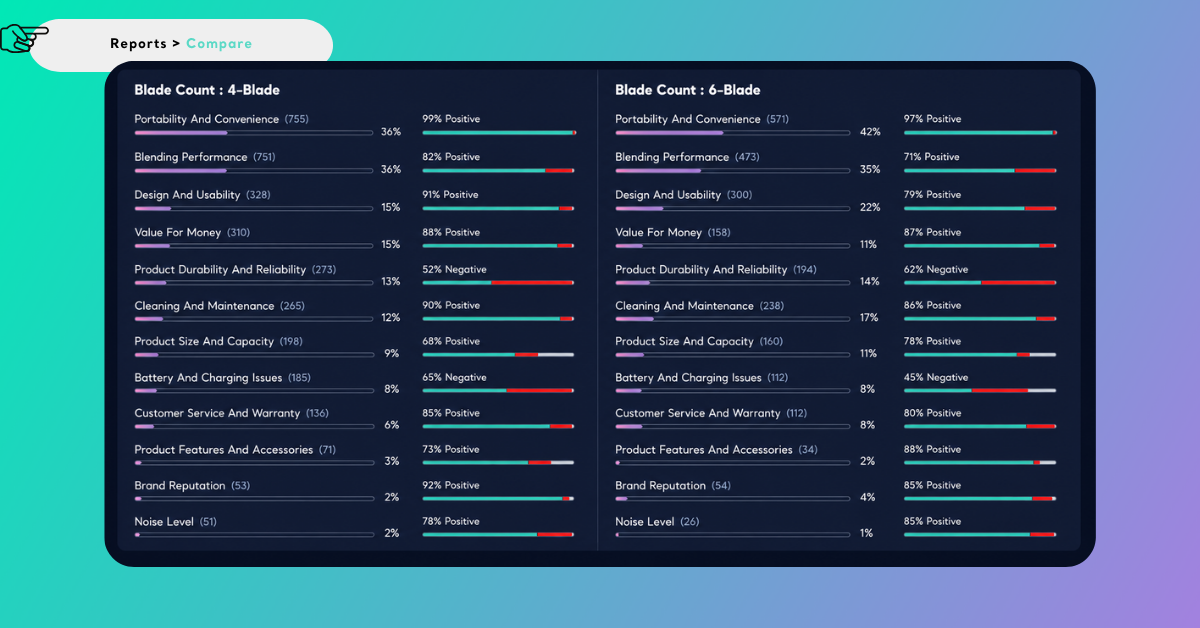
The comparison shows that 4-blade and 6-blade models generate very similar levels of discussion around Blending Performance, yet the overall sentiment differs. While blending performance is mentioned at nearly the same rate in both groups, 4-blade models receive more positive feedback, suggesting that blade count alone does not explain how consumers evaluate blending performance.
The results also reveal broader differences between the two product configurations. 6-blade models generate more conversations around Design & Usability, Cleaning & Maintenance, and Product Size & Capacity, while Product Durability & Reliability remains a challenge regardless of blade configuration. Together, these findings demonstrate that customer experience is influenced by multiple product characteristics rather than a single specification.
Rather than assuming a single product characteristic explains customer satisfaction, Compare helps researchers test those assumptions with real customer feedback. This makes it possible to identify which product attributes genuinely influence the customer experience and which have a more limited impact. The same approach can be applied to other structured attributes, such as Capacity or Charging Type, enabling a deeper understanding of how different product characteristics shape customer perceptions.
Compare supports up to five values at a time, making it easy to evaluate multiple product variations side by side. See the Compare Analyses article to learn more about filtering and comparing structured column values.
Conclusion
Customer feedback contains far more than individual opinions. When analyzed from multiple perspectives, it becomes a powerful source of consumer intelligence that helps businesses understand not only what consumers experience, but also why those experiences occur and how they differ across products.
In this tutorial, we've built a complete consumer research report using a fictional portable juice blender dataset. Along the way, you've explored how different analyses contribute to a deeper understanding of the category—from defining the customer experience and uncovering purchase motivations to identifying recurring pain points, understanding their underlying causes, discovering unmet needs, and comparing experiences across product variations. No single analysis tells the whole story. Meaningful consumer insights emerge when different analyses are interpreted together.
Although this tutorial focused on portable juice blenders, the same research workflow can be applied to virtually any product or service. Start with a well-structured dataset, select the analyses that best answer your research questions, and connect their findings to build a more complete understanding of the customer experience.
Now it's your turn. Download the sample dataset, recreate this report in your own Kimola workspace, and start exploring the questions that matter most for your business.
- Creating a Consumer Research Report for the LED Face Mask Category
- Creating a Consumer Research Report for the Automatic Pet Feeder Category
- Creating a Consumer Research Report for the Air Purifier Category
- Creating a Consumer Research Report for the Instant Camera Category
- Creating a Consumer Research Report for the Lash Serum Category