Creating a Consumer Research Report for the Instant Camera Category
14 mins read - Created on Jul 16, 2026Instant cameras offer something digital photography often cannot: the ability to turn everyday moments into physical memories. Their nostalgic appeal, instant prints, and social nature have made them popular for everything from family gatherings to special occasions.
But what defines a great instant camera experience? In this tutorial, we'll build a complete consumer research report to explore what consumers value most, where frustrations emerge, and how different analyses work together to answer meaningful consumer research questions.
By the end of this tutorial, you'll know how to transform customer feedback into actionable consumer insights that support product development, customer experience, and business decisions.
Before diving into the analyses, download the sample dataset and upload it to your Kimola workspace. Throughout this tutorial, we'll use it to build a complete consumer research report and explore each analysis step by step.
If you don't already have a Kimola account, simply sign up, log in, and open the Dashboard Home page to get started.
Understanding Your Dataset
Before exploring the analyses, let's take a closer look at the dataset we'll use throughout this tutorial.
Our sample dataset contains 1,630 customer reviews collected across multiple e-commerce platforms for a fictional instant camera brand called Retrosnap. Although fictional, it reflects the type of customer feedback organizations commonly collect from e-commerce platforms, customer surveys, support channels, and online communities.
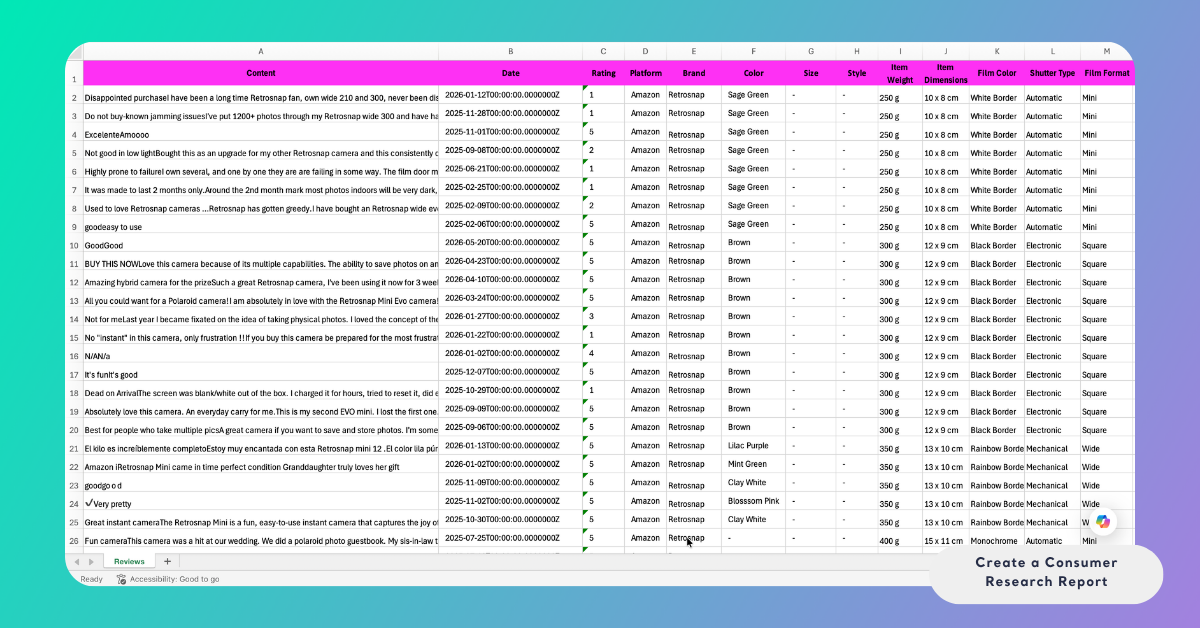
The Content column contains the customer reviews that Kimola analyzes to identify recurring themes, consumer motivations, pain points, unmet needs, and other patterns within the category.
Alongside the review text, the dataset includes structured attributes such as Brand, Platform, Rating, Color, Style, Film Format, Shutter Type, Film Color, and other product specifications. These attributes provide valuable context for each review, making it possible to compare different product configurations and understand how customer experiences vary across different camera features.
Build your dataset with your research questions in mind. Including relevant structured attributes alongside customer feedback makes it easier to compare product variations, identify meaningful patterns, and answer more specific business questions throughout your research.
Creating Your Report
With your dataset in place, you're ready to turn raw customer feedback into a structured research report.
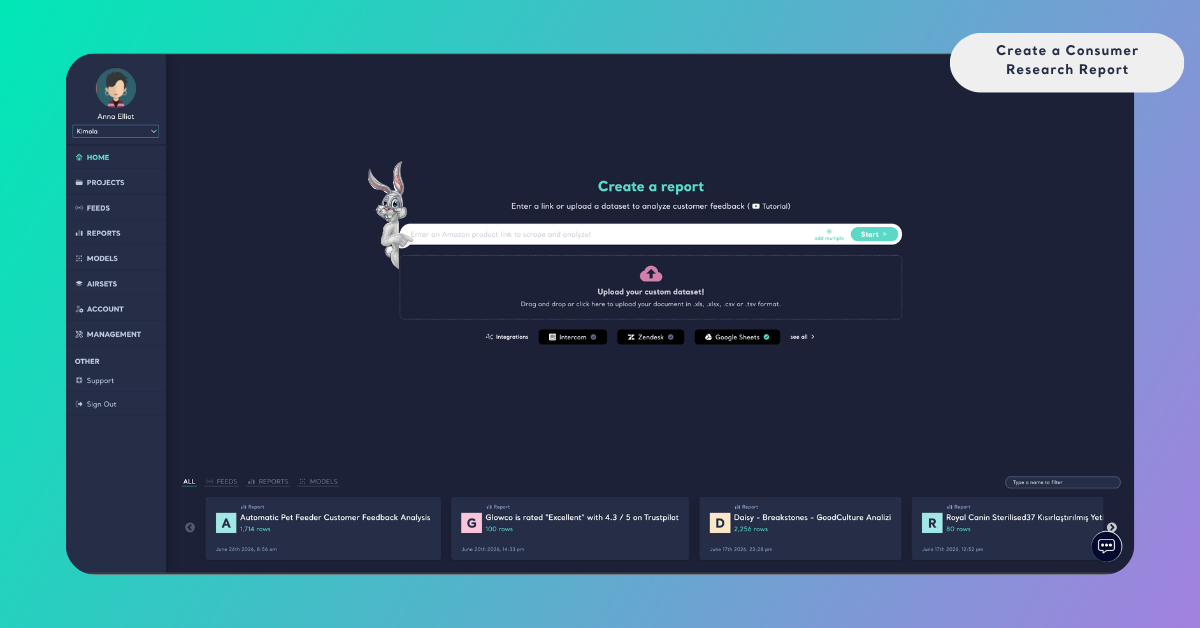
Start from the Dashboard Home page and upload the sample dataset using the Upload your custom dataset option. Kimola will then guide you through a short setup process before generating your analyses.
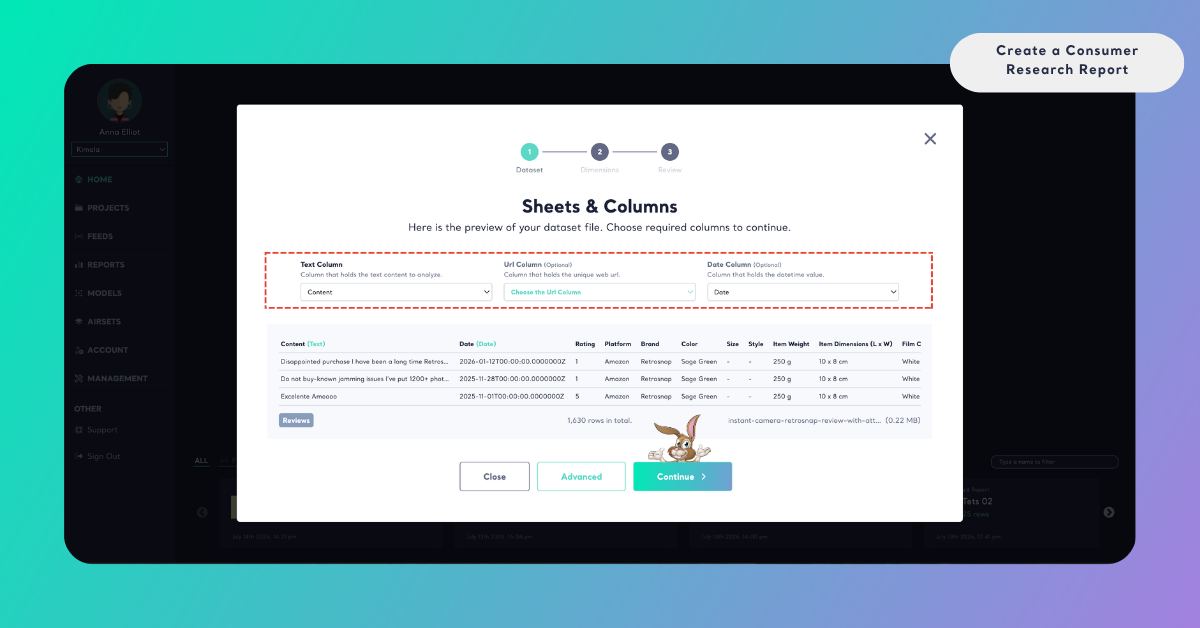
The first step is to review your dataset and map the required columns. Assign the Content column as the Text Column so Kimola knows which field contains the customer feedback to analyze. If your dataset includes additional information such as dates, URLs, ratings, or structured product attributes, you can map those fields as well.
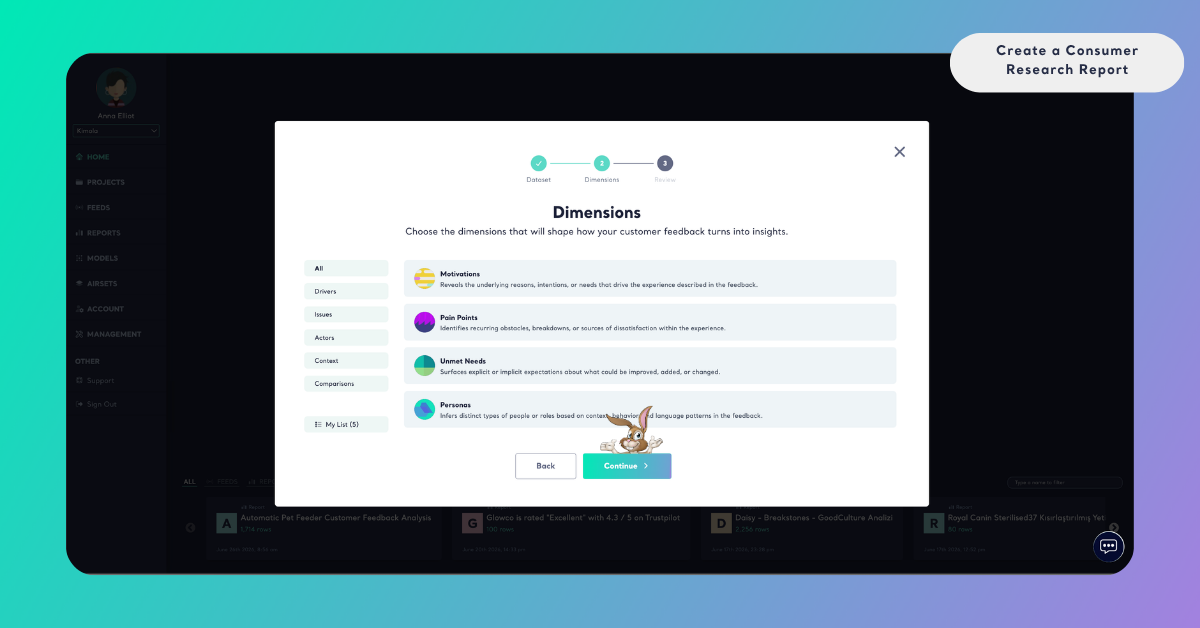
Next, select the dimensions you want to include in your report. Each dimension approaches the same customer feedback from a different analytical perspective, helping answer a different type of consumer research question.
Once everything is configured, review your report settings, give your report a name, choose the report language, and click Create Report.
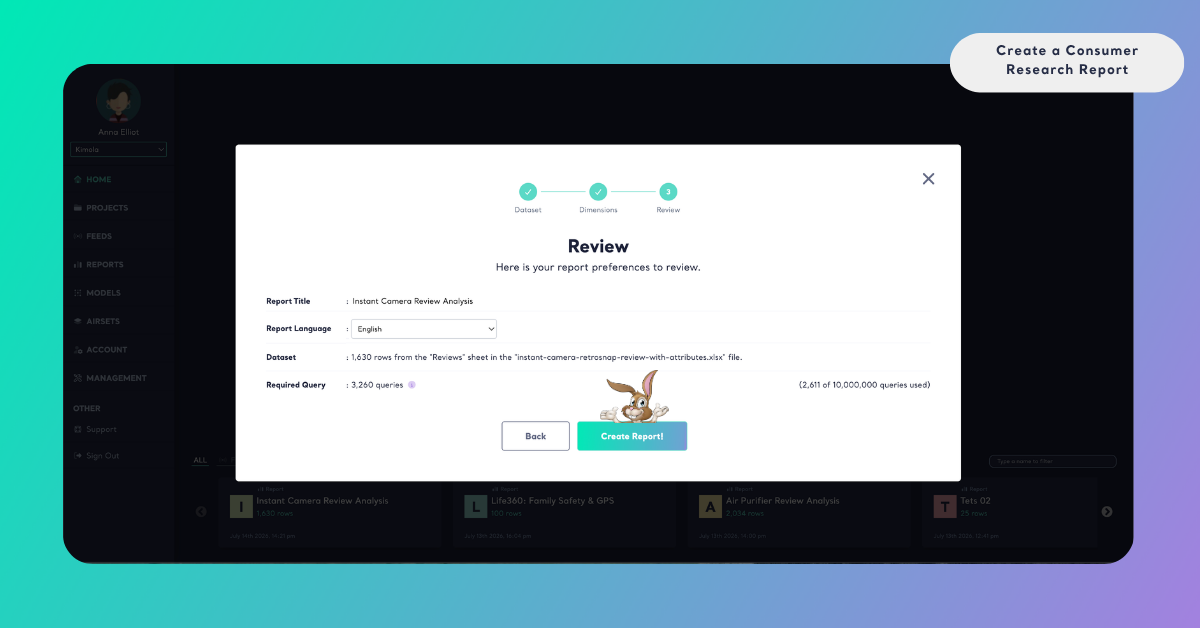
You don't need to include every dimension when creating your report. Start with the dimensions that answer your current research questions. As your research evolves, you can always return to the report and add additional dimensions without creating a new one.
Kimola will automatically process your dataset and generate the selected analyses. Once the report is ready, you can begin exploring the customer story hidden within the data.
A First Look at Your Report
Once processing is complete, your report is ready to explore.
Before diving into individual analyses, it's useful to step back and look at the report as a whole. The Overview page provides a high-level summary of the dataset, highlighting overall sentiment, the strongest and weakest performing themes, automatically generated Signals, and the key dimensions included in the report.
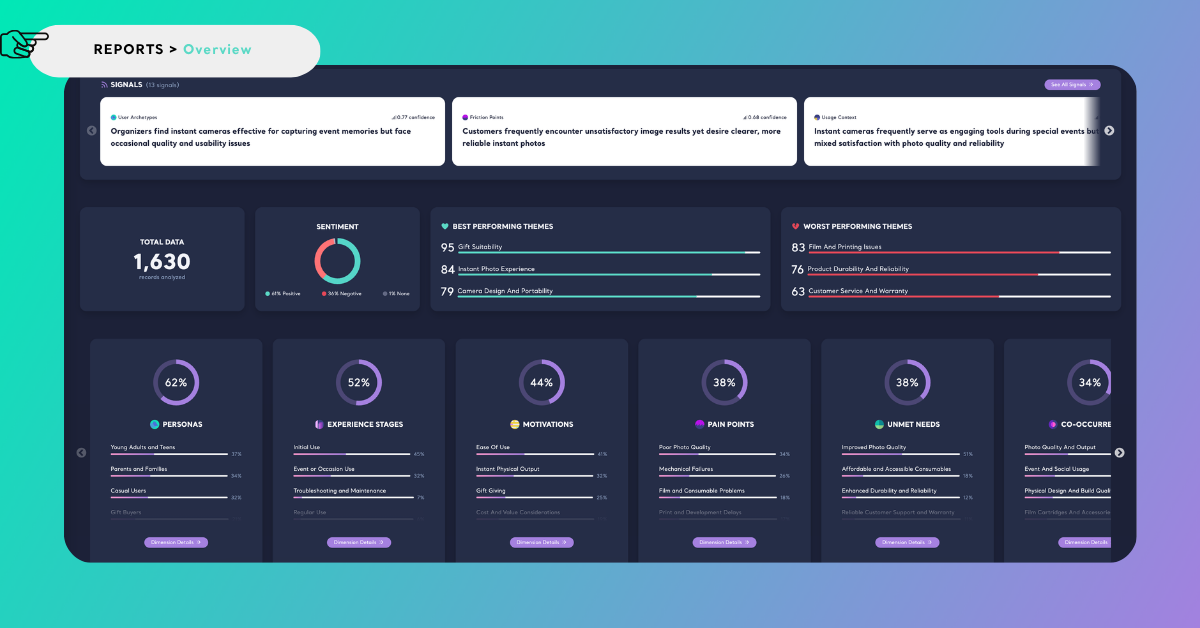
Rather than answering a single research question, this page helps you understand the overall shape of the conversation. It shows where customer satisfaction is concentrated, where recurring problems emerge, and which topics deserve closer investigation.
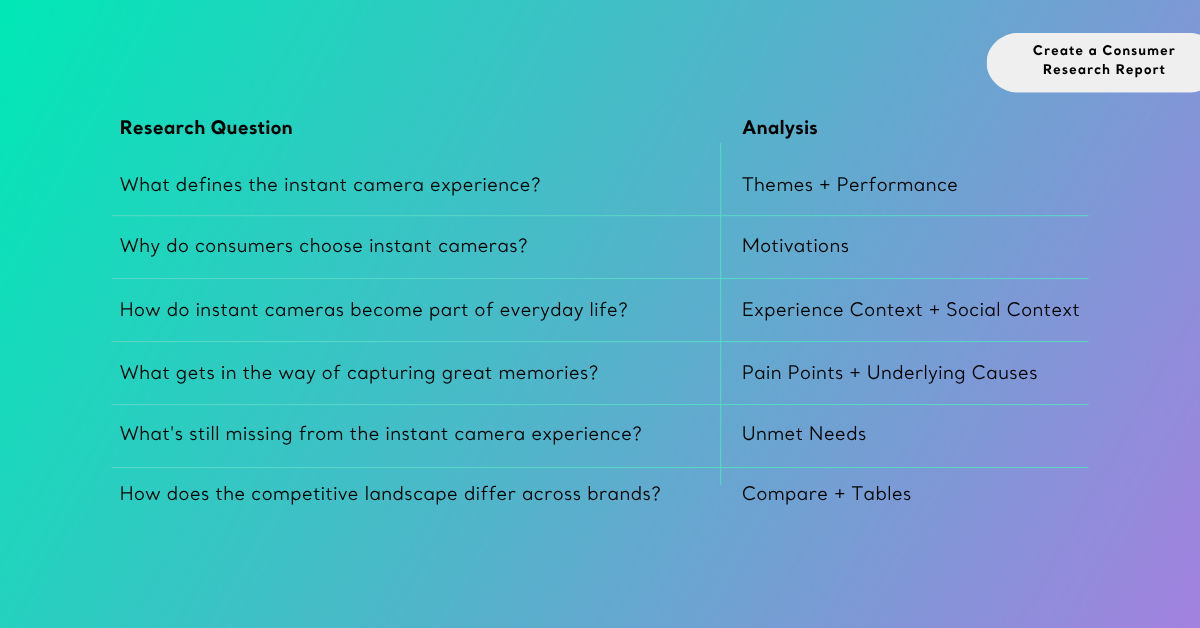
The Overview also introduces the dimensions that will guide the rest of this tutorial. Together, these analyses help explain not only what customers say about instant cameras, but also why they buy them, how they use them, where frustrations occur, and what improvements they expect.
The following sections explore each of these analyses step by step, building a complete picture of the instant camera customer experience.
What Story Do the Signals Reveal
Every analysis answers a different research question, but the most valuable insights often emerge when those findings are viewed together. Signals automatically connect recurring patterns across the report, helping researchers identify the broader narratives that individual analyses alone may not reveal.

In the instant camera category, the signals point to a clear story: consumers are not simply buying a camera—they are buying an experience centered on preserving and sharing memories. Across the report, instant photography consistently appears as a way to make celebrations, family gatherings, gifts, and everyday moments more tangible and memorable.
At the same time, Signals reveal a recurring tension between emotional value and product performance. While users appreciate the nostalgia and immediacy of printed photos, recurring issues such as inconsistent image quality, unreliable printing, battery limitations, and film-related costs repeatedly undermine the experience. These patterns appear across multiple analyses, suggesting they are structural challenges rather than isolated complaints.
Signals also highlight where the category is evolving. Consumers increasingly expect better mobile connectivity, stronger app integration, improved low-light performance, and more reliable hardware, indicating that expectations now extend beyond instant printing toward a more seamless hybrid photography experience.
For researchers, Signals provide an efficient way to understand the category before diving into individual analyses. They surface the strongest recurring narratives, reveal how different dimensions reinforce one another, and establish the context for interpreting the rest of the report.
Signals are generated automatically when your report includes enough analyses to identify meaningful relationships across different dimensions. Reports with only a few analyses may not generate enough connections for Signals to appear.
The next step is exploring the themes that dominate customer conversations and define the instant camera experience.
What Shapes the Conversation Around Instant Cameras
Customer reviews often mention more than one aspect of a product at the same time. A single review may discuss photo quality, printing, battery life, and ease of use together. Rather than assigning each review to only one topic, the Themes analysis automatically groups every relevant part of the conversation, allowing the same review to contribute to multiple themes.
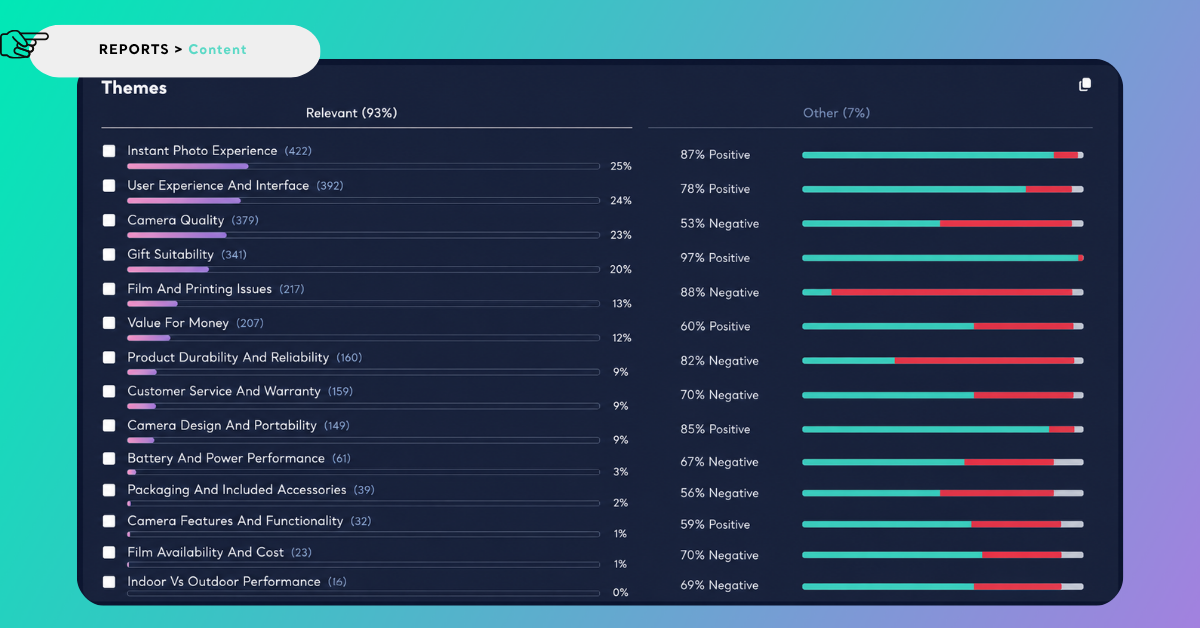
To understand how these themes perform, Kimola complements Themes with the Performance analysis. Instead of relying only on positive and negative sentiment, Performance calculates statistically adjusted Satisfaction and Dissatisfaction Scores, making it possible to compare themes fairly regardless of how frequently they appear.
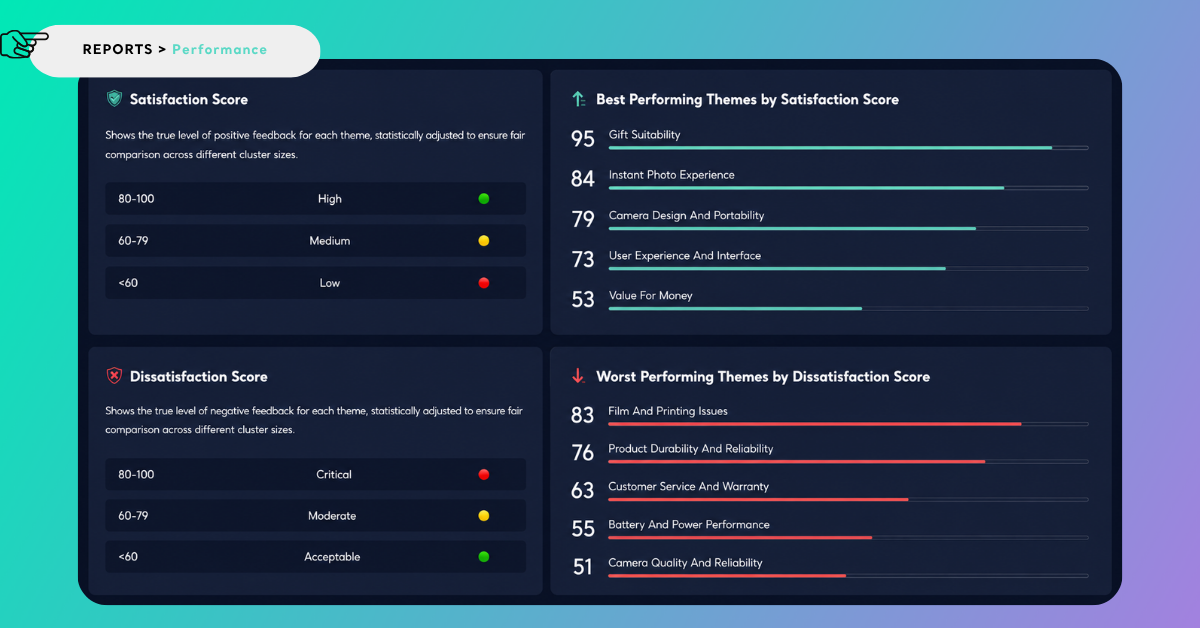
The results show that Instant Photo Experience, User Experience & Interface, and Camera Quality dominate the conversation, highlighting that consumers evaluate instant cameras not only for the fun of printing memories, but also for the quality and reliability of the overall experience.
Performance adds another layer of insight. Gift Suitability and Instant Photo Experience stand out as the strongest-performing themes, while Film & Printing Issues, Product Durability & Reliability, and Customer Service & Warranty emerge as the weakest. Although instant cameras succeed in creating memorable experiences, recurring technical and reliability issues continue to limit overall satisfaction.
Together, Themes and Performance help researchers understand both what consumers talk about and which parts of the experience perform well or require improvement.
What Really Drives Instant Camera Purchases
One of the first questions a researcher might ask is: Why do consumers buy instant cameras? The Motivations analysis answers this by identifying the underlying needs and expectations that drive purchase decisions, helping researchers understand why consumers enter the category in the first place.
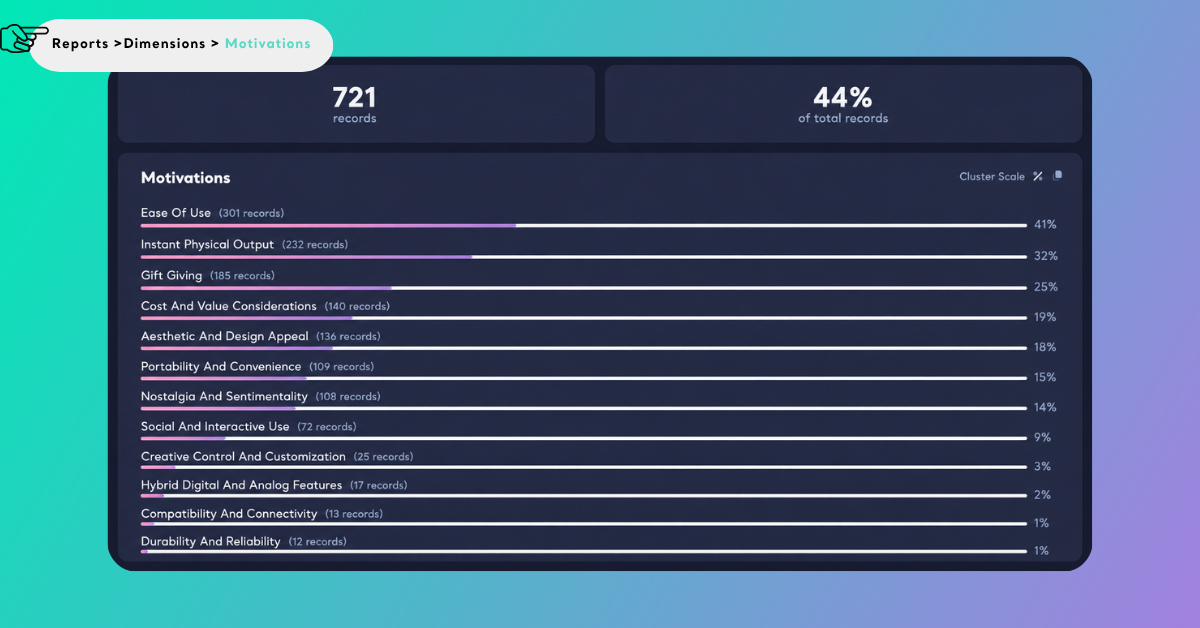
The findings show that Ease of Use is the strongest purchase driver, appearing in 41% of motivation-related conversations. Consumers value cameras that are intuitive, require little setup, and allow them to focus on capturing moments rather than learning complicated controls.
Another key motivation is Instant Physical Output. Rather than leaving memories on a smartphone, consumers value receiving a printed photograph immediately after taking it, making the experience feel more tangible and personal. The analysis also highlights strong emotional drivers such as Gift Giving, Nostalgia & Sentimentality, and Aesthetic & Design Appeal, showing that instant cameras are often purchased for the experiences and memories they help create rather than for technical specifications alone.
For researchers, the Motivations analysis provides essential context for interpreting the rest of the report. Understanding why consumers choose instant cameras makes it easier to explain later findings, including where the experience takes place, what frustrations emerge, and which improvements matter most.
How Do Instant Cameras Become Part of Everyday Life
A product's value is shaped not only by why people buy it, but also by how it fits into their daily lives. The combination of Experience Context and Social Context helps answer this by revealing where instant cameras are used, which occasions they become part of, and who those experiences are shared with.
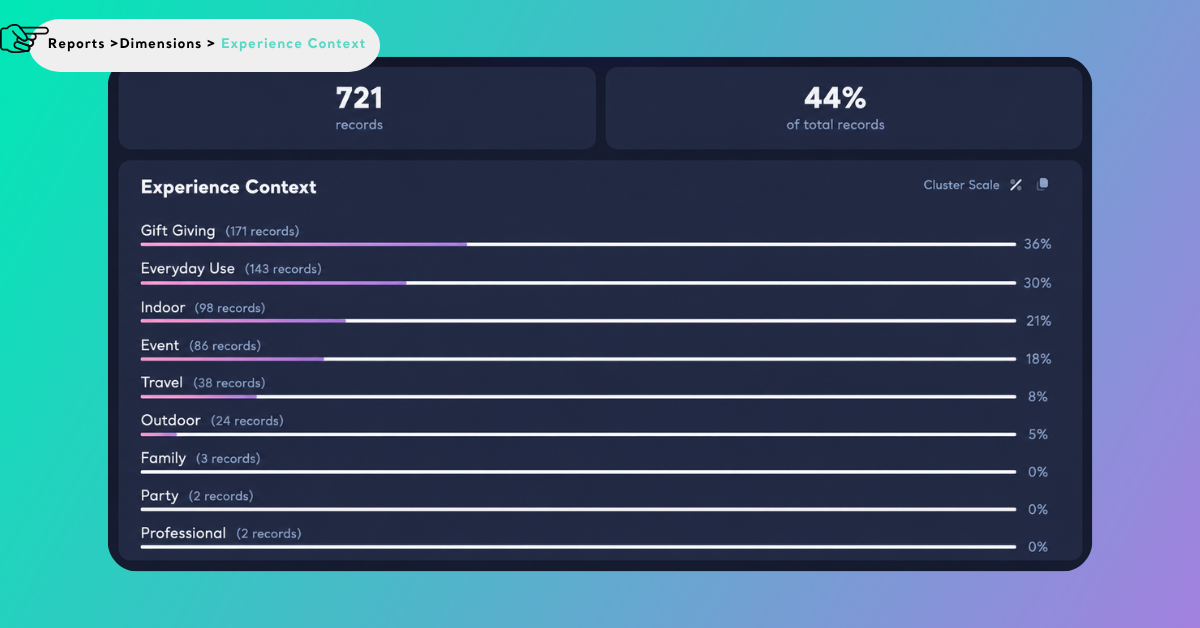
The Experience Context analysis shows that instant cameras are most closely associated with family gatherings, celebrations, vacations, parties, travel, and school activities. Rather than being used for everyday photography, they are brought out during meaningful moments where taking and instantly printing photos becomes part of the occasion itself.
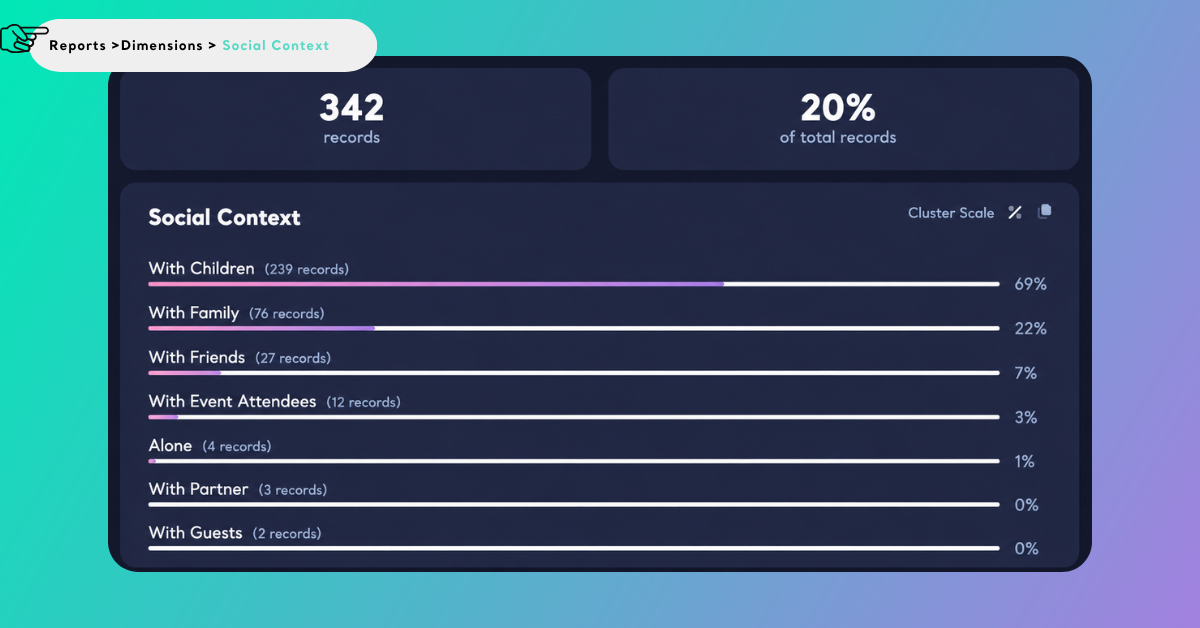
The Social Context analysis adds another dimension by identifying the people involved in those moments. Customer feedback frequently refers to family members, friends, children, guests, and loved ones, showing that instant cameras are designed as much for shared experiences as they are for photography. The product often becomes a conversation starter, a group activity, and a way to create physical memories together.
Viewed together, these analyses reveal that instant cameras are not simply devices for taking pictures—they are products that support social interaction, celebration, and memory-making. For researchers, this context provides essential background for understanding why consumers evaluate the category so differently from traditional digital cameras and why emotional expectations play such an important role throughout the customer journey.
Next, we'll explore the challenges that prevent these experiences from consistently meeting consumer expectations.
What Gets in the Way of Capturing Great Memories
Every product has moments where expectations and reality diverge. The Pain Points analysis identifies the challenges consumers encounter most frequently, helping explain where the instant camera experience begins to fall short.
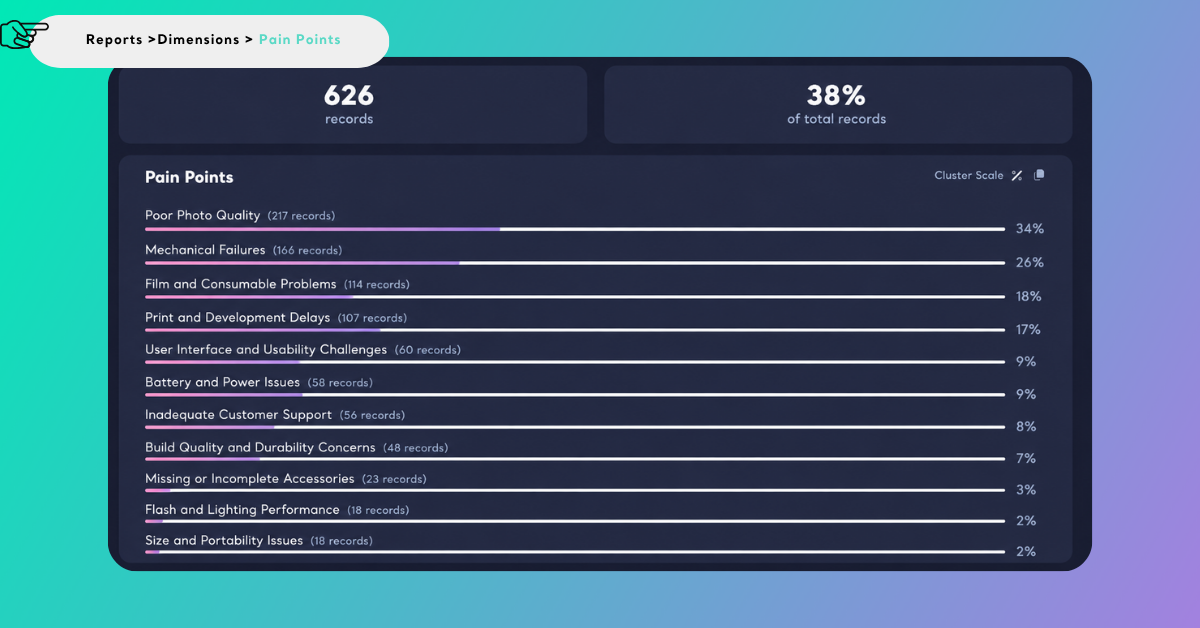
The findings show that Photo Quality is the category's most significant pain point. Blurry images, inconsistent exposure, disappointing print quality, and inaccurate colors repeatedly appear in customer feedback, suggesting that the final photo often fails to reflect the moment consumers hoped to preserve. Other recurring frustrations include Film Jams & Ejection Problems, Mechanical & Hardware Failures, Battery & Power Issues, and the ongoing cost of film, all of which interrupt the experience and reduce overall satisfaction.
Identifying customer frustrations is only the beginning. The Underlying Causes analysis looks beyond the symptoms to uncover the recurring factors that drive these issues.
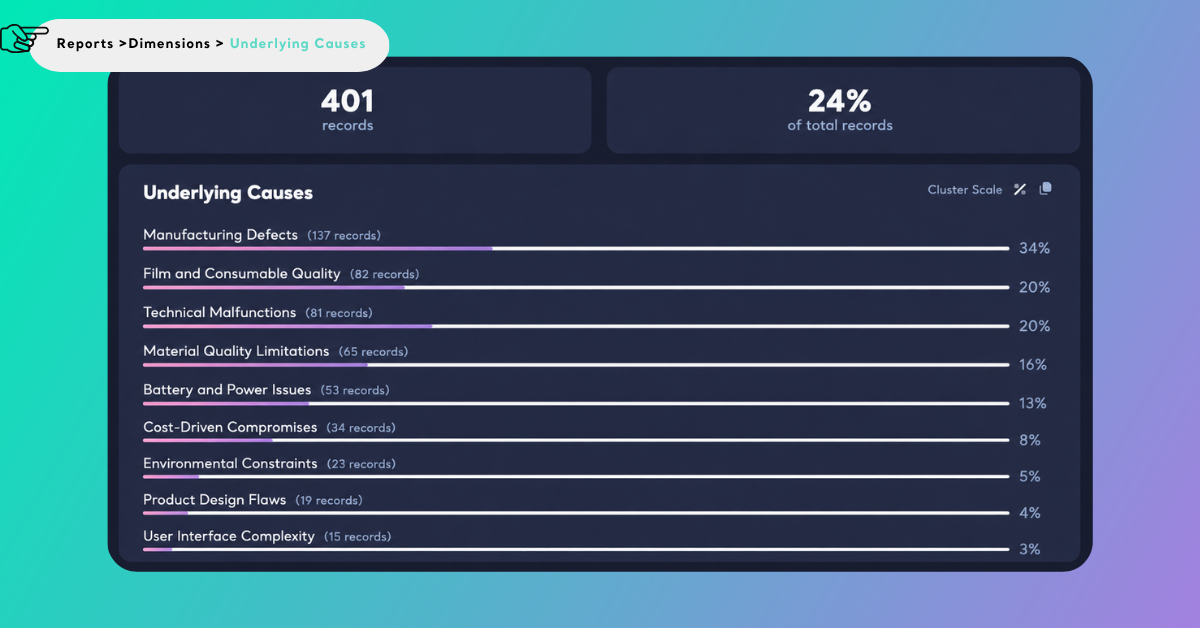
The analysis points to recurring problems related to camera hardware, exposure performance, film mechanisms, material quality, and manufacturing consistency. Rather than isolated defects, many complaints stem from technical limitations that repeatedly affect image quality, reliability, and ease of use.
Looking beyond individual complaints reveals a much clearer picture of the category. While Pain Points highlight where the customer experience breaks down, Underlying Causes explain why those problems continue to recur. This makes it easier to distinguish one-off issues from broader product challenges and identify where improvements are likely to have the greatest impact.
What's Still Missing from the Instant Camera Experience
Customer feedback doesn't only reflect today's experience—it also reveals what consumers believe is still missing. The Unmet Needs analysis highlights the improvements customers repeatedly ask for, helping identify where the category has the greatest opportunity to evolve.
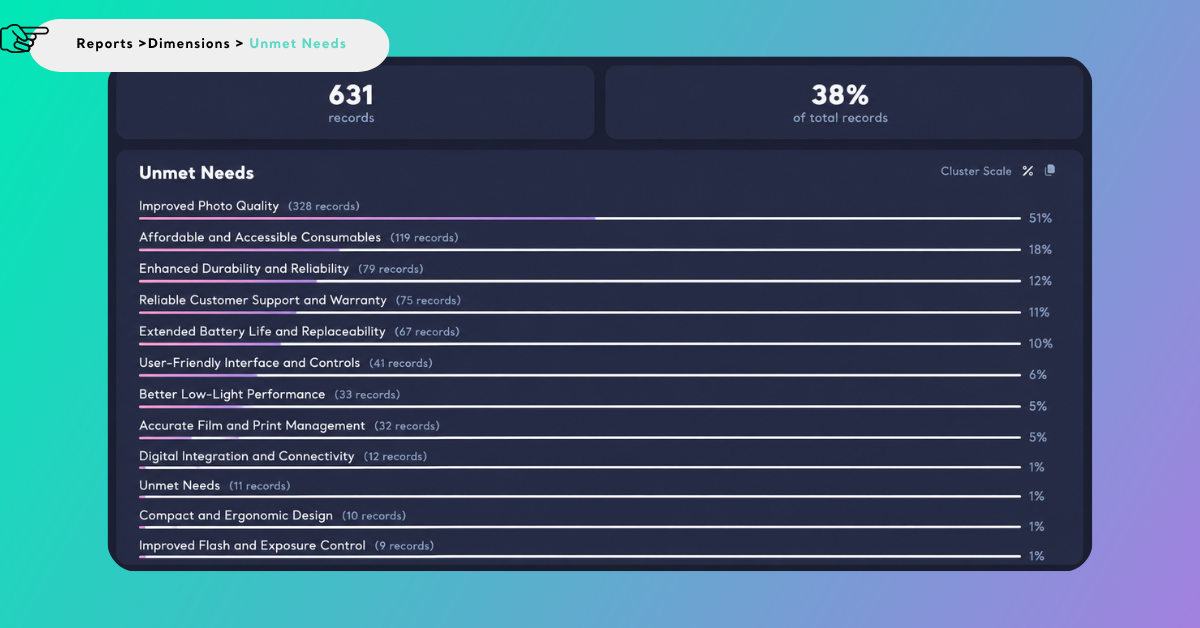
The most frequently expressed need is Improved Photo Quality, accounting for more than half of all unmet need mentions. Consumers want sharper images, more consistent exposure, richer colors, and better overall print quality, suggesting that image performance remains the category's biggest opportunity for improvement.
Beyond image quality, many requests focus on making ownership easier and more reliable. Consumers ask for Affordable and Accessible Consumables, Enhanced Durability and Reliability, Reliable Customer Support and Warranty, and Extended Battery Life and Replaceability, highlighting expectations that extend well beyond the camera itself.
Smaller but meaningful requests also emerge, including User-Friendly Interface and Controls, Better Low-Light Performance, Accurate Film and Print Management, and improved Digital Integration and Connectivity. Together, these findings suggest that consumers want instant cameras to preserve their nostalgic appeal while delivering a more dependable and modern user experience.
Next, we'll explore how competing brands are positioned within the instant camera category and uncover what differentiates them through competitive benchmarking.
How Does the Competitive Landscape Differ Across Brands
Understanding the category is an important first step, but consumer research often goes further by examining how competing brands are positioned within the market. Competitive benchmarking helps reveal where brands generate similar conversations, where they differ, and which aspects of the customer experience define their competitive position.
To begin, we'll compare the leading instant camera brands in the dataset using the Compare analysis.
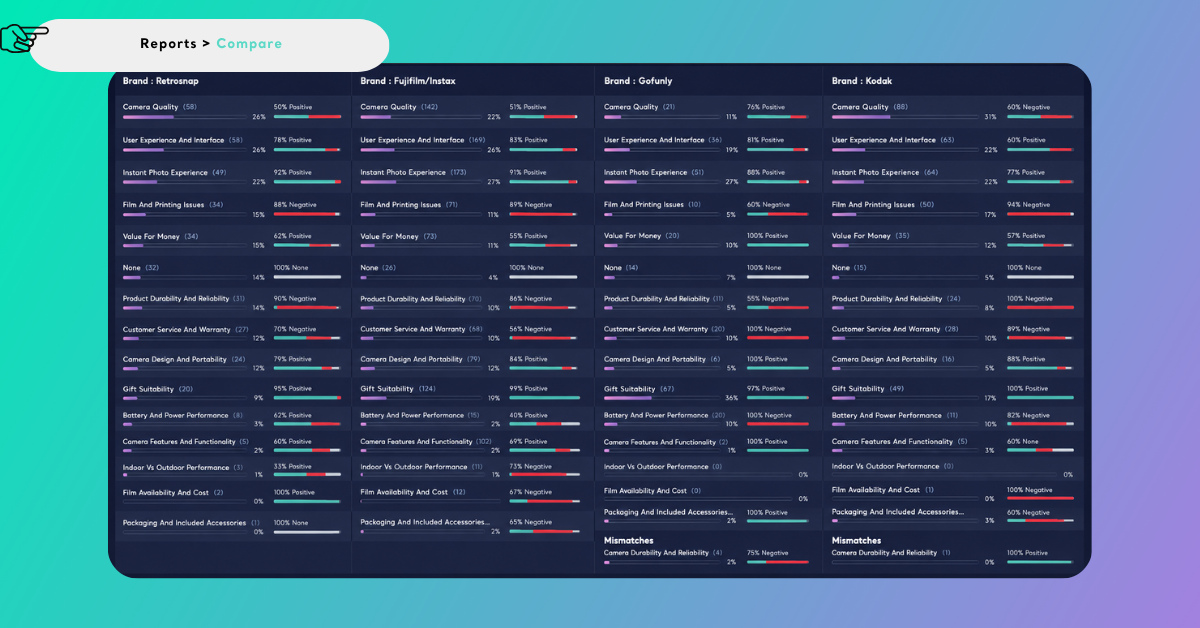
The comparison shows that Fujifilm/Instax generates the largest share of customer conversations, followed by Kodak, Retrosnap, Gofunly, and Polaroid. While overall sentiment remains broadly positive across the category, the distribution of conversations and themes varies noticeably between brands. Although Instant Photo Experience and User Experience & Interface remain central topics throughout the category, other themes—including Camera Quality, Gift Suitability, Value for Money, and Customer Service & Warranty—receive different levels of attention across competitors, highlighting how each brand is perceived from a slightly different perspective.
Compare supports up to five values at a time. Choose only the values that are most relevant to your research question to keep comparisons focused and easier to interpret. See the Compare Analyses article to learn more about filtering and comparing structured column values.
Compare helps identify where brands differ, but researchers often want to understand why those differences exist. This is where Tables becomes valuable, allowing structured attributes such as Brand to be cross-analyzed with any analysis dimension in the report.
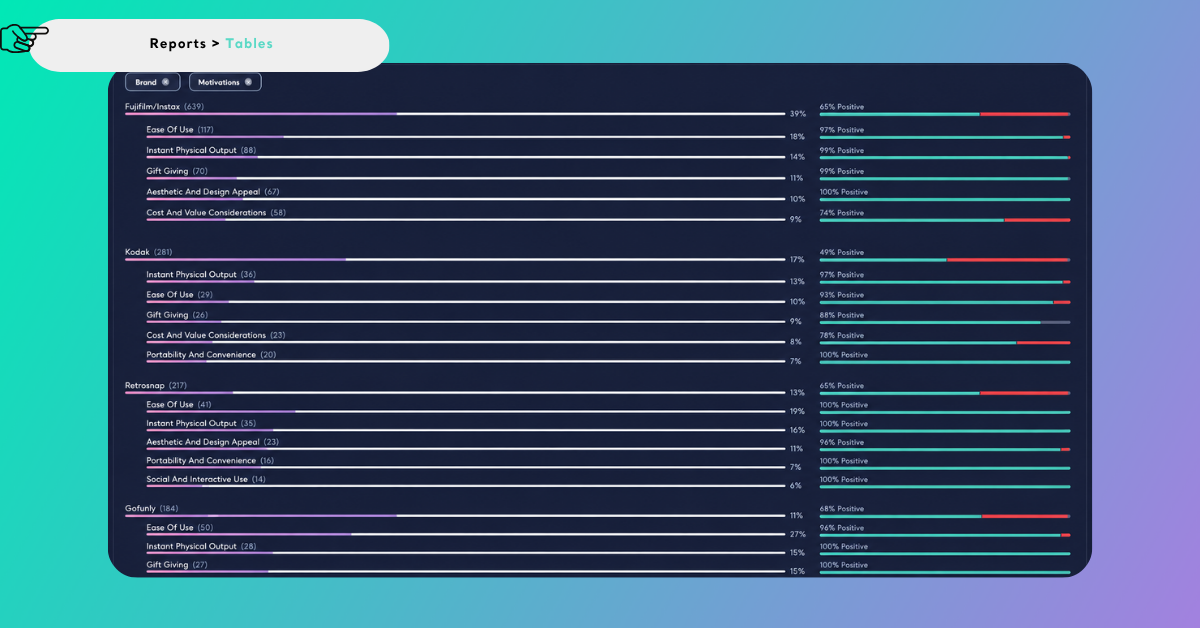
For example, comparing Brand with Motivations reveals that brands attracting similar conversation volumes are not necessarily chosen for the same reasons. While motivations such as Ease of Use, Instant Physical Output, and Gift Giving appear across multiple brands, their relative importance differs, providing a clearer picture of how each competitor appeals to consumers.
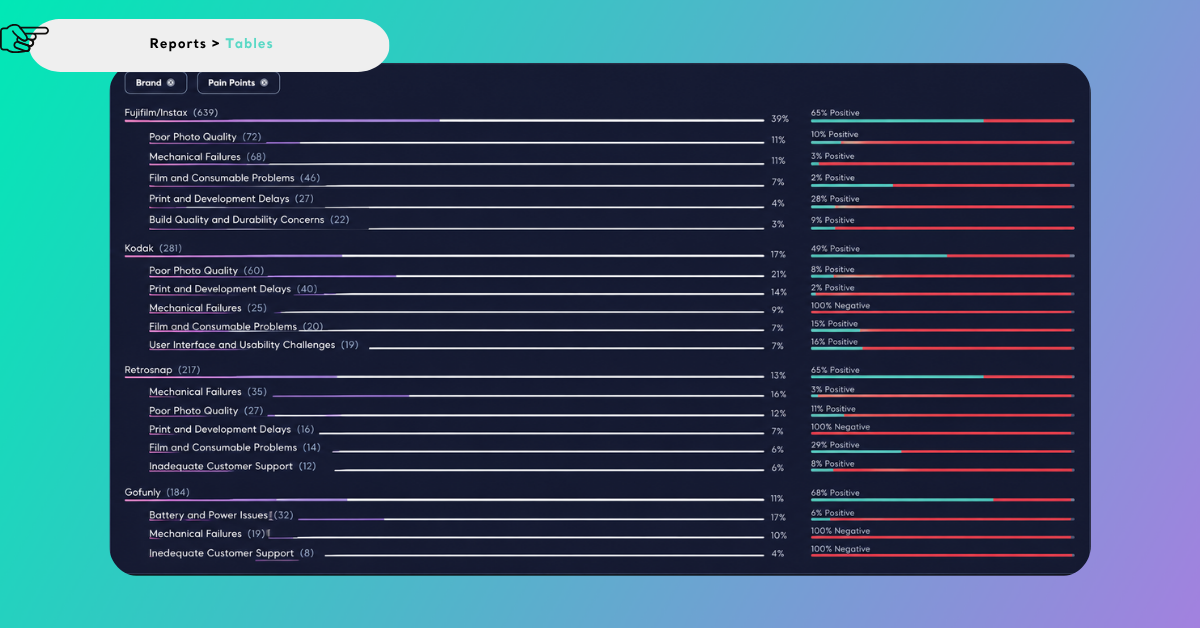
Cross-analyzing Brand with Pain Points adds another layer of competitive insight by showing that recurring frustrations are not distributed evenly across the market. Although issues such as Poor Photo Quality appear across several brands, the prominence of challenges like Mechanical Failures, Film & Consumable Problems, or Battery & Power Issues varies between competitors, helping identify the specific weaknesses that distinguish one brand from another.
Together, Compare and Tables provide a practical workflow for competitive analysis. Compare highlights where brands begin to diverge, while Tables helps explain the underlying drivers behind those differences, enabling researchers to move beyond category-level insights and develop a deeper understanding of competitive positioning.
Conclusion
At first glance, instant cameras might appear to be simple products built around taking and printing photos. This research shows that the category is shaped by far more than image quality alone. Consumer feedback reveals a combination of emotional motivations, shared experiences, technical expectations, and recurring frustrations that together define the overall customer experience.
Throughout this tutorial, we've explored how different analyses answer different research questions. Themes revealed what consumers talk about most, Motivations explained why they choose instant cameras, Experience Context and Social Context showed how these products become part of everyday life, while Pain Points, Underlying Causes, and Unmet Needs highlighted where expectations remain unmet. Finally, competitive benchmarking demonstrated how brands differentiate within the category and how combining Compare with Tables helps uncover the factors behind those differences.
Taken together, these analyses transform thousands of customer reviews into a structured understanding of the market. Rather than relying on individual opinions, researchers can identify recurring patterns, benchmark competitors, and uncover opportunities for product development, customer experience, and brand strategy.
Although this tutorial focused on instant cameras, the same research workflow can be applied to virtually any product category. By starting with customer feedback and approaching it through multiple analytical perspectives, you can move beyond isolated reviews and build a complete picture of what truly shapes consumer experiences.