RapidMiner Alternatives for Customer Feedback Analysis: 8 Tools Compared
Oct 23, 2026 - 14 minute read
RapidMiner is still available, but under a new owner and a new name: Altair acquired it in 2022, Siemens acquired Altair in 2025, and the desktop product is now sold as Rapidminer AI Studio. If you are looking for an alternative to analyze customer feedback, the right choice depends on who will do the work. Technical teams that want to build their own models and pipelines can look at KNIME, Alteryx, IBM watsonx.ai Studio or Amazon Comprehend. Teams that want to analyze feedback directly, without a data science project, will find Kimola, Thematic, Caplena and Chattermill closer to the job.
RapidMiner earned its reputation as a visual data science platform: analysts and data scientists build workflows for data preparation, machine learning and text mining by connecting operators instead of writing code. That flexibility is its strength, but analyzing customer reviews or survey responses in it is still a modeling project, and the output is a model or a set of labels rather than research a team can act on.
This guide is written by the Kimola team. Kimola is our product, so we explain where it fits and where it doesn't, and we describe every other tool based on its public documentation.
What Is RapidMiner Today?
Rapidminer AI Studio is a data science and machine learning platform for building models through visual, drag-and-drop workflows. It covers data preparation, machine learning, automated modeling and generative AI features, and extensions add capabilities such as text and web mining. It was developed at the Technical University of Dortmund in 2001 and became the company RapidMiner in 2013.
Its ownership has changed twice in recent years. Altair Engineering completed its acquisition of RapidMiner in September 2022, and during that period the desktop product was referred to as AI Studio. Siemens completed its acquisition of Altair in March 2025, and Siemens now offers the product as part of a Rapidminer portfolio that also includes Graph Studio, Monarch, Panopticon, SLC and Knowledge Studio. The latest release of Rapidminer AI Studio is version 2026.1, and in June 2026 Siemens announced that parts of the portfolio, including AI Studio, are being brought into its industrial AI software, Intelligence Center X.
Rapidminer remains a strong choice for organizations that want full control over their models: it connects to many data sources, combines structured and unstructured data, and Siemens positions it around auditable models that trace back to their source data. It is designed for analytics teams with data science skills rather than for business users who want ready-made analysis.
Why Teams Look for RapidMiner Alternatives for Feedback Analysis
The most common reason is the gap between the tool and the task. To analyze customer feedback in a data science platform, someone has to clean and tokenize the text, choose or train a model, validate it and then interpret the results. Teams that have a data scientist available can do this well. Teams that do not, or that want the analysis faster, often look for a tool built specifically for feedback.
Other reasons are situational. The output of a modeling workflow is labels and scores, so turning them into findings, comparisons and recommendations is still manual work. Pricing for Rapidminer is not published, which makes it harder to estimate cost before a sales conversation. And after two acquisitions in three years, some teams use the moment to reassess whether a broad industrial AI portfolio is the right home for a narrower analysis need.
How We Compared These Tools
We looked at each tool through the same criteria: the types of data it works with, how much setup and technical skill it needs, how far the analysis goes beyond classification and sentiment, and how easy it is to evaluate, including whether pricing is published and whether a free plan or trial is available. The tools fall into two groups. Kimola, Thematic, Caplena and Chattermill are built for analyzing customer feedback. KNIME, Alteryx, IBM watsonx.ai Studio and Amazon Comprehend are general platforms or services that technical teams use to build their own analysis. Product information comes from each vendor's own website.
1. Kimola
Kimola is an AI platform that turns customer feedback into enterprise-grade market research. Teams analyze the feedback they already have, such as survey responses, support tickets, call transcripts and social conversations, or collect public reviews by pasting a link to a product page on Amazon, Trustpilot, Google Play, the App Store and other platforms.
Compared with Rapidminer, Kimola does not ask you to build a workflow or train a model before the analysis starts. You upload a file or paste a link, and the output is research rather than a model.
Strengths
Analysis without a modeling project. Kimola's pretrained models work without setup. The Automatic Classifier finds themes in the data itself, without predefined categories, and gives each theme a clear name. Sentiment is assigned to every theme a comment mentions, so a review that praises the interface but complains about response times is positive on one and negative on the other. When a team wants the same labels in every analysis, it can build a custom model from a prompt, from a labeled training dataset or from an existing report, without writing code.
Research output instead of labels. In Kimola, classifying topics is only the first step. Kimola asks every comment research questions called Dimensions, such as what motivates customers, what pain points they face and what needs are still unmet. It then crosses every theme and Dimension with the columns in your data, such as country, product or customer segment, and with time. Only statistically significant differences and trends become Signals: if delivery complaints are concentrated in one country, Kimola surfaces that as a Signal only if the difference is significant. Action Plans form hypotheses from the analysis, test each one against the feedback, and keep only the actions the evidence supports, with every figure and quote checked. Scores are deterministic, so the same data always produces the same ranking, which matters to analysts who care about reproducible results.
Easy to evaluate, with an on-premises option. Every account starts on a free Starter plan with no credit card, paid plans start at $49 per month, and pricing is public. The pricing page lists API access on every plan. For banks, insurers, public institutions and other organizations that cannot send customer data outside their own environment, Kimola On-Premises runs on the organization's own infrastructure, and no data is sent to external AI services.
Limitations
Kimola is built for analyzing customer feedback, not as a general data science platform. It does not build predictive models, prepare data for other machine learning tasks or let you design your own algorithms, so teams that need that flexibility are better served by the platforms later in this guide. It does not design or send surveys. Custom models are available on paid plans, not on the free Starter plan, which is limited to 150 queries per month. Spaces and Funnels, which keep a growing feedback channel consistently classified over time, are available only on the Enterprise plan, and the On-Premises version does not include Feeds or third-party integrations such as Zendesk, Intercom and Google Sheets.
Pricing
Kimola has a free Starter plan, and paid plans start at $49 per month. Usage is measured in queries, and the full plan details are on the pricing page. Enterprise plans are priced individually.
Best For
Kimola is a good fit for research, insights, product and marketing teams that want to understand why customers feel the way they do from reviews, survey responses, support tickets or social conversations, without a data scientist building the analysis first.
2. Thematic
Thematic describes itself as a customer intelligence layer for enterprise CX. Thematic is built for theme and sentiment analysis of the feedback a team already collects, and it is designed to work alongside an existing CX stack.
Strengths
Thematic ingests surveys, support tickets, call transcripts, app reviews and CRM notes. It builds themes from customers' own language, and every theme can be traced back to the comments behind it and adjusted by the team, which gives analysts control over the results without building a model themselves. API access is included in its plans.
Limitations
Thematic is aimed at enterprise organizations, and its entry plan is priced for annual programs. Smaller teams, or teams that analyze feedback occasionally, may find this more than they need. Instead of a free trial, Thematic offers a paid pilot.
Pricing
Thematic's Foundation plan is listed at $25,000 per year for up to 25,000 comments, and Enterprise pricing is available as a custom proposal.
Best For
Thematic fits enterprise CX and insights teams that want a dedicated feedback analytics layer on top of their existing survey and support tools. Kimola adds research Dimensions, statistically tested Signals and the ability to collect public reviews directly; see our Kimola vs Thematic comparison.
3. Caplena
Caplena describes itself as an intelligence layer for customer feedback. Caplena is built for coding open-ended responses, and it serves both brands and market research agencies.
Strengths
Caplena analyzes open-ended responses in more than 100 languages with topic and sentiment analysis, and lets teams cross-tabulate results with quantitative survey variables, which covers much of what a researcher would otherwise build in a data science tool. It integrates with survey and support platforms, accepts file uploads and provides API documentation. A dedicated plan for agencies supports ad hoc and tracking studies with consistency across projects and languages.
Limitations
Caplena's focus is survey and research data, so teams that mainly analyze support tickets or product reviews should check how well it fits those sources. Pricing is not published, and the website offers a free sample report rather than a free trial.
Pricing
Caplena lists Team, Enterprise and Agency plans. Pricing is not published and is available on request.
Best For
Caplena fits market research agencies and brand-side teams that code large volumes of open-ended survey responses. Kimola goes further by structuring feedback into research Dimensions and showing how patterns differ across segments and over time; see our Kimola vs Caplena comparison.
4. Chattermill
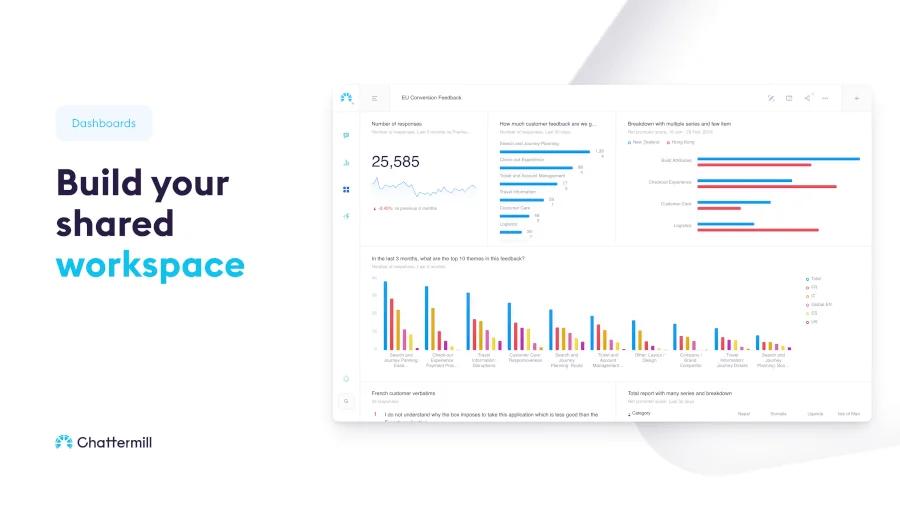
Chattermill is a customer experience analytics platform that brings feedback from surveys, support tickets, reviews, social media and app stores into one place. Chattermill is built for customer experience analytics, connecting themes and sentiment to metrics such as NPS, CSAT and CES.
Strengths
Chattermill gives CX, insights and product teams a unified view of feedback across many channels, in multiple languages. Anomaly detection alerts teams when a metric shifts unexpectedly, and dashboards make the results available to the wider organization. Integrations cover survey, CRM, support and data warehouse tools.
Limitations
Chattermill is built for organizations that analyze feedback from many channels on an ongoing basis. A team that wants to analyze a single dataset or run occasional studies may find a full CX analytics rollout heavier than the job requires. Pricing is not published.
Pricing
Chattermill does not publish its prices. Pricing is based on feedback volume and the number of connected data sources, and is available through a demo.
Best For
Chattermill fits mid-market and enterprise CX teams that want feedback from many channels tied to the experience metrics they already report on. Kimola structures feedback into research Dimensions such as motivations, pain points and unmet needs, and works self-service without custom model setup; see our Kimola vs Chattermill comparison.
5. KNIME
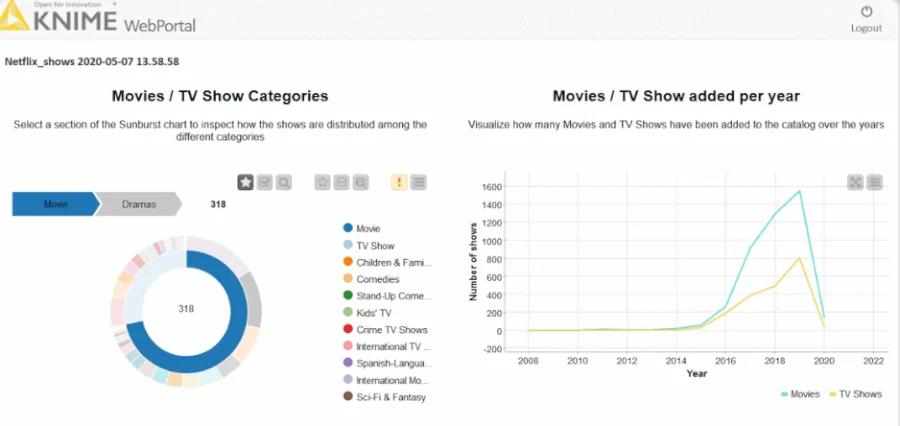
KNIME Analytics Platform is a free and open-source platform for building data workflows visually. Of the tools in this guide, it is the closest to Rapidminer in how it works: users connect nodes to access, blend, analyze and model data, with coding optional.
Strengths
The desktop platform is free, which makes it easy for analysts to try and for teams to adopt without a purchase decision. Its Text Processing extension supports text preprocessing and feature extraction, and KNIME publishes example workflows for sentiment analysis with machine learning, lexicons or BERT models. A generative AI assistant helps users build workflows and write scripts, and the platform supports popular machine learning libraries, including large language models. A large community shares workflows and components on KNIME Hub.
Limitations
Like Rapidminer, KNIME gives you building blocks rather than finished analysis. Analyzing customer feedback means designing the workflow, preparing the text and validating the model yourself, so it suits teams with analytics skills. Collaboration, scheduling and deployment require a paid KNIME Hub plan.
Pricing
KNIME Analytics Platform is free and open source. KNIME Hub has a free Personal plan, a Pro plan from $19 per month and a Team plan from $99 per month with three users included and $49 per month for each additional user. Business Hub pricing is available on request.
Best For
KNIME fits analysts and data scientists who like Rapidminer's visual workflow approach and want a free, open-source alternative they can extend.
6. Alteryx
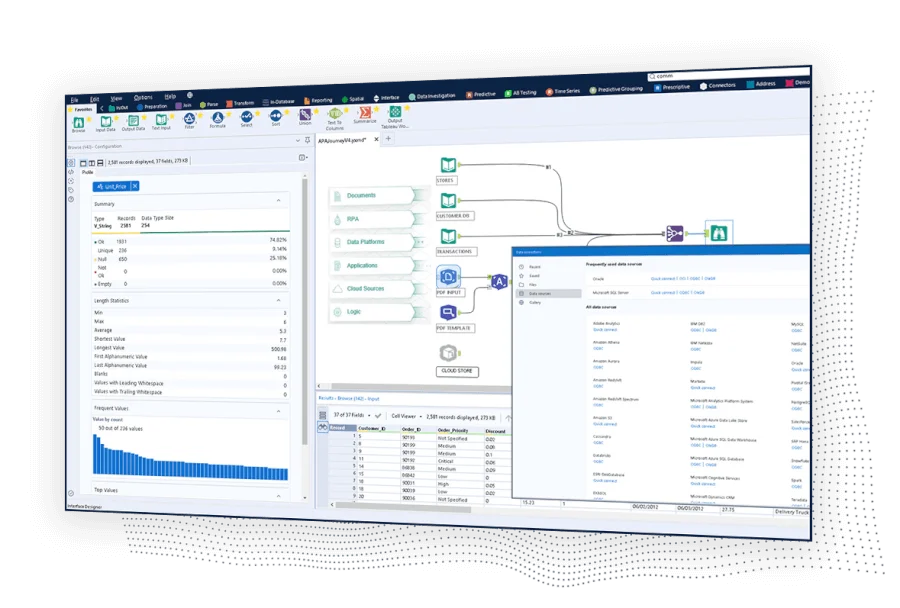
Alteryx is an analytics automation platform, now offered as Alteryx One, that helps analysts prepare, blend and analyze data in repeatable workflows. Its Intelligence Suite adds machine learning and text mining tools to the Designer workflow environment.
Strengths
Alteryx is built for business and data analysts who work with spreadsheets and databases and want to automate that work without coding. For text, the Intelligence Suite includes sentiment analysis, topic modeling, named entity recognition, text classification, zero-shot text classification, text summaries and word clouds, so feedback analysis can sit inside the same workflows a team already uses for other data. A 30-day free trial is available.
Limitations
Alteryx is priced per user for analytics teams, so it is a significant investment if feedback analysis is the only use case. Text mining is a set of tools within a workflow rather than a finished analysis, so analysts still need to configure the steps and interpret the results. Teams should check which edition includes the Intelligence Suite before buying.
Pricing
Alteryx's Starter Edition is $250 per user per month, billed annually, for one to ten users. Professional and Enterprise Edition pricing is available through sales.
Best For
Alteryx fits analyst teams that already automate data preparation and reporting and want to add text analysis to those workflows.
7. IBM watsonx.ai Studio
IBM watsonx.ai Studio, formerly known as Watson Studio, is IBM's environment for data scientists and data engineers to prepare data and build, train and deploy models collaboratively. It is part of IBM's watsonx portfolio.
Strengths
watsonx.ai Studio combines several ways of working in one environment: Jupyter notebooks and RStudio for code, SPSS Modeler for building models through visual flows, and Data Refinery for preparing data. Teams that already use SPSS will find a familiar visual approach. It also gives access to the foundation models in watsonx.ai, and IBM publishes its pricing, with a free trial and a pay-as-you-go plan.
Limitations
watsonx.ai Studio is built for technical teams, and analyzing customer feedback in it is a development project, much as it is in Rapidminer. Its pricing is based on capacity units, tokens and hosting, which makes costs depend on how the team builds and runs its workloads.
Pricing
IBM watsonx.ai offers a free trial with monthly limits on tokens and compute hours, a pay-as-you-go Essentials plan starting at $0 per month with machine learning at $0.55 per capacity unit-hour, and a Standard plan starting at $1,110 per month. IBM notes that prices may vary by country.
Best For
IBM watsonx.ai Studio fits data science teams in organizations that use IBM's ecosystem, or SPSS, and want notebooks, visual modeling and foundation models in one place.
8. Amazon Comprehend
Amazon Comprehend is a natural language processing service from Amazon Web Services. It provides text analysis through an API and is aimed at developers building their own applications and pipelines.
Strengths
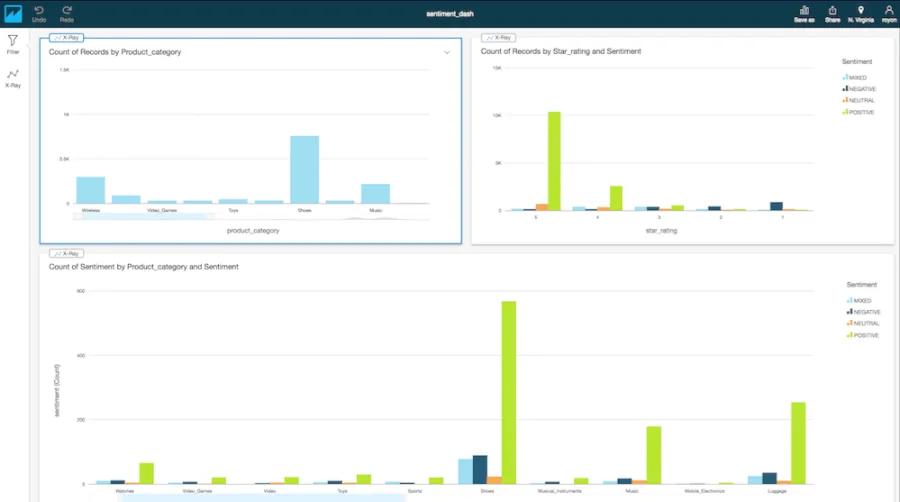
Comprehend offers sentiment analysis, targeted sentiment toward specific entities, entity recognition and language detection without training a model. Its custom classification feature lets teams train text classification models with their own business-specific labels. Pricing is pay-as-you-go and published, and it runs within the AWS ecosystem many engineering teams already use, which makes it a lighter option than a full data science platform for teams that only need text analysis.
Limitations
Comprehend needs developers to set up, integrate and maintain, and its output is labels and scores rather than finished analysis; turning them into findings is left to the team. AWS has made topic modeling and event detection unavailable to new customers, while other features are not affected. For a broader look at this category, see our guide to Amazon Comprehend alternatives.
Pricing
Comprehend charges per unit of 100 characters, with a minimum of three units per request. Custom classification adds charges for model training ($3 per hour) and model management ($0.50 per month), and custom models have no free tier. Full details are on the AWS pricing page.
Best For
Amazon Comprehend fits engineering teams that want to add sentiment and text classification to their own products or data pipelines through an API.
How to Choose the Right RapidMiner Alternative
If you want a visual data science platform that works the way Rapidminer does, KNIME is the closest match and its desktop platform is free. If your analysts already automate data preparation and reporting, Alteryx lets you add text mining to the same workflows. If your data science team works in IBM's ecosystem or with SPSS, IBM watsonx.ai Studio brings notebooks, visual modeling and foundation models together. If developers will build text analysis into your own products, Amazon Comprehend offers it as an API. And if your team already uses Rapidminer and has the skills to build feedback workflows in it, staying is a reasonable choice.
If you want to analyze feedback without a modeling project, the purpose-built tools are a better fit. Thematic and Chattermill are designed for ongoing customer experience programs across many channels, and Caplena is built for coding open-ended survey responses. If you want to understand why customers feel the way they do, from the feedback you already have or public reviews you collect, with statistically tested findings and no data scientist required, Kimola is built for that, and you can start without a sales call.
Frequently Asked Questions
What happened to RapidMiner?
RapidMiner was acquired by Altair in September 2022, and Siemens acquired Altair in March 2025. Siemens offers the desktop product as Rapidminer AI Studio, as part of a wider Rapidminer portfolio of data and AI software.
Is there a free alternative to RapidMiner?
KNIME Analytics Platform is free and open source and works in a similar visual way. Kimola has a free Starter plan with 150 queries per month and no credit card, for teams that want to analyze feedback directly. Alteryx offers a 30-day free trial, and IBM watsonx.ai has a free trial with monthly usage limits.
Do I need a data scientist to analyze customer feedback?
Not necessarily. Data science platforms such as Rapidminer, KNIME and IBM watsonx.ai Studio give you full control, but building and validating a text analysis workflow takes technical skills. Tools built for feedback analysis, such as Kimola, Thematic, Caplena and Chattermill, provide themes and sentiment without a modeling step.
Why not just use ChatGPT to analyze customer feedback?
Chat assistants are useful for summarizing a small set of comments. Classifying thousands of records consistently, getting the same result from the same data every time, testing differences between segments statistically and tracing every number back to its source requires purpose-built infrastructure. That is the gap both data science platforms and feedback analysis tools are designed to fill, in different ways.
Conclusion
RapidMiner lives on as Rapidminer AI Studio within Siemens, and the right alternative depends on whether you want to build your own analysis or get it ready-made. Data science platforms and APIs give technical teams flexibility, while feedback analysis tools take the modeling step off your plate. If you want to see how Kimola handles your own data, you can start on the free Starter plan.