MonkeyLearn Alternatives: 7 Text Analysis Tools to Use Instead
Oct 23, 2026 - 12 minute read
MonkeyLearn is no longer available as a standalone product. Medallia acquired it in February 2022, and monkeylearn.com now redirects to Medallia's website. If you used MonkeyLearn to classify text without code, the closest replacements depend on the job: Caplena and Cauliflower are built for coding open-ended survey responses, Thematic, Chattermill and Keatext focus on customer experience feedback, and Amazon Comprehend suits developers who used MonkeyLearn through its API. Kimola fits teams that want classification, sentiment and custom models, plus research that explains why customers feel the way they do.
MonkeyLearn was popular because it made text classification accessible: teams could use ready-made models for sentiment and topics, train their own models with their own labels, and connect everything through an API, without a data science team. Former users are now looking for a tool that covers the same jobs and that they can still sign up for and try on their own.
This guide is written by the Kimola team. Kimola is our product, so we explain where it fits and where it doesn't, and we describe every other tool based on its public documentation.
What Happened to MonkeyLearn?
MonkeyLearn was a no-code text analysis platform. It offered pretrained models for sentiment analysis, topic classification and keyword extraction, extractors for data such as email addresses and phone numbers, and tools for training custom classifiers with a team's own labels. Results could be explored in dashboards or sent to other applications through an API.
Medallia, an experience management platform, completed its acquisition of MonkeyLearn on February 15, 2022. MonkeyLearn's technology became part of Medallia's platform, and monkeylearn.com redirects to medallia.com. It is no longer possible to sign up for MonkeyLearn as a separate product.
For organizations that already run, or plan to run, an organization-wide experience management program, Medallia is the natural place where MonkeyLearn's technology lives today. Medallia is built to run experience management programs across large organizations, and it is sold through sales conversations rather than self-service plans. Teams that used MonkeyLearn on a monthly subscription to classify a specific set of feedback will usually find the tools below closer to how they worked.
What MonkeyLearn Users Need From a Replacement
Most MonkeyLearn users relied on a combination of a few things. They wanted to classify text without writing code, using ready-made models for sentiment and common topics. They wanted to train custom models with labels that matched their own business. Many connected MonkeyLearn to other tools through its API. And they valued being able to sign up, see the price and test the product on their own data.
A good replacement should cover the jobs that matter to your team, but it is also worth asking what you did with the labels once you had them. If your team spent time turning classified comments into findings and recommendations, a tool that goes further than classification may save more time than a like-for-like replacement.
How We Compared These Tools
We looked at each tool through the same criteria: the types of text it works with, how deep the analysis goes beyond classification and sentiment, how much setup and technical skill it needs, and how easy it is to evaluate, including whether pricing is published and whether a free plan or trial is available. Product information comes from each vendor's own website.
1. Kimola
Kimola is an AI platform that turns customer feedback into enterprise-grade market research. Teams analyze the feedback they already have, such as survey responses, support tickets, call transcripts and social conversations, or collect public reviews by pasting a link to a product page on Amazon, Trustpilot, Google Play, the App Store and other platforms.
For former MonkeyLearn users, Kimola covers the familiar jobs, ready-made models, custom models with your own labels and an API, and then adds a research layer on top of the classification.
Strengths
Ready-made and custom models. Kimola's pretrained models work without setup. The Automatic Classifier finds themes in the data itself, without predefined categories, and gives each theme a clear name. The Sentiment Classifier gives every theme mentioned in a comment its own sentiment, so a review that praises the interface but complains about response times is positive on one and negative on the other. Industry classifiers cover areas such as e-commerce, mobile apps, software, banking, automotive and hospitality. When a team wants to use the same labels in every analysis, it can build a custom model from a prompt, from a labeled training dataset or from an existing report.
Research beyond the labels. In Kimola, classifying topics is only the first step. Kimola asks every comment research questions called Dimensions, such as what motivates customers, what pain points they face and what needs are still unmet. It then crosses every theme and Dimension with the columns in your data, such as country, product or customer segment, and with time. Only statistically significant differences and trends become Signals. If delivery complaints are concentrated in one country, Kimola surfaces that as a Signal only if the difference is significant. Action Plans form hypotheses from the analysis, test each one against the feedback, and keep only the actions the evidence supports. Scores are deterministic, so the same data always produces the same ranking.
Easy to evaluate and connect. Every account starts on a free Starter plan with no credit card, paid plans start at $49 per month, and pricing is public. The pricing page lists API access on every plan. Kimola can also collect public reviews from a link to a product, business or app page, which makes it possible to analyze a competitor's reviews with the same models you use for your own feedback, and it analyzes feedback in more than 30 languages within the same analysis.
Limitations
Kimola is built for analyzing customer feedback rather than as a general-purpose text processing toolkit, so it does not offer utilities such as extracting email addresses or phone numbers from arbitrary text. It does not design or send surveys. Custom models are available on paid plans, not on the free Starter plan, which is limited to 150 queries per month. Spaces and Funnels, which keep a growing feedback channel consistently classified over time, are available only on the Enterprise plan.
Pricing
Kimola has a free Starter plan, and paid plans start at $49 per month. Usage is measured in queries, and the full plan details are on the pricing page. Enterprise plans are priced individually.
Best For
Kimola is a good fit for research, insights, product and marketing teams that used MonkeyLearn to classify feedback and want a self-service tool with ready-made and custom models, plus research output that explains why customers feel the way they do.
2. Thematic
Thematic describes itself as a customer intelligence layer for enterprise CX. Thematic is built for theme and sentiment analysis of the feedback a team already collects, and it is designed to work alongside an existing CX stack.
Strengths
Thematic ingests surveys, support tickets, call transcripts, app reviews and CRM notes. It builds themes from customers' own language, and every theme can be traced back to the comments behind it and adjusted by the team, which gives teams control similar to editing a custom classifier. API access is included in its plans, so data can be sent to Thematic from other systems.
Limitations
Thematic is aimed at enterprise organizations, and its entry plan is priced for annual programs. Teams that used MonkeyLearn on a small monthly plan may find this more than they need. Instead of a free trial, Thematic offers a paid pilot.
Pricing
Thematic's Foundation plan is listed at $25,000 per year for up to 25,000 comments, and Enterprise pricing is available as a custom proposal.
Best For
Thematic fits enterprise CX and insights teams that want a dedicated feedback analytics layer on top of their existing survey and support tools. Kimola adds research Dimensions, statistically tested Signals and the ability to collect public reviews directly; see our Kimola vs Thematic comparison.
3. Caplena
Caplena describes itself as an intelligence layer for customer feedback. Caplena is built for coding open-ended responses, and it serves both brands and market research agencies.
Strengths
Caplena analyzes open-ended responses in more than 100 languages with topic and sentiment analysis, and lets teams cross-tabulate results with quantitative survey variables. It integrates with survey and support platforms, accepts file uploads and provides API documentation. A dedicated plan for agencies supports ad hoc and tracking studies with consistency across projects and languages.
Limitations
Caplena's focus is survey and research data, so teams that used MonkeyLearn for other kinds of text, such as support tickets or product reviews, should check how well it fits those sources. Pricing is not published, and the website offers a free sample report rather than a free trial.
Pricing
Caplena lists Team, Enterprise and Agency plans. Pricing is not published and is available on request.
Best For
Caplena fits market research agencies and brand-side teams that code large volumes of open-ended survey responses. Kimola goes further by structuring feedback into research Dimensions and showing how patterns differ across segments and over time; see our Kimola vs Caplena comparison.
4. Keatext
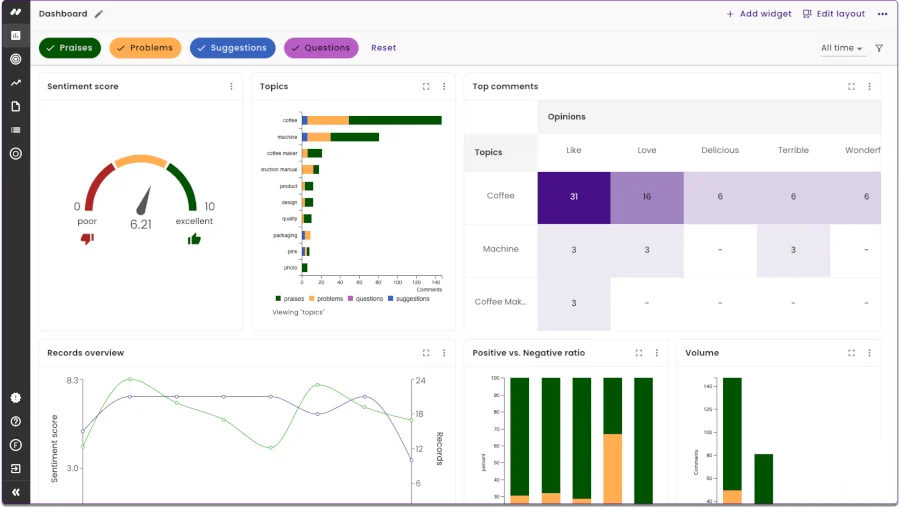
Keatext is an AI-based text analytics platform for customer experience teams. It analyzes feedback from surveys, reviews and support tickets.
Strengths
Keatext publishes its pricing, which makes it easier to budget for than many tools in this category. It offers a free two-week proof of concept with your own data, so teams can see results before committing. Its focus on CX feedback makes it a direct option for teams that want a dedicated text analytics tool rather than a general-purpose classifier.
Limitations
There is no free plan, and the proof of concept is arranged through a demo request. Plans are sized by annual record volume, and features such as cloud application integrations are offered as add-ons. Its pricing page lists CSV and data connector integrations rather than an API, so teams that relied on MonkeyLearn's API should confirm the integration options.
Pricing
Keatext's Basic plan is $550 per month for up to 10,000 records a year, Pro is $999 per month for up to 20,000 records a year, and Enterprise starts at $1,650 per month for 30,000 or more records a year.
Best For
Keatext fits CX teams that want a dedicated text analytics tool with published pricing and a structured trial on their own data.
5. Chattermill
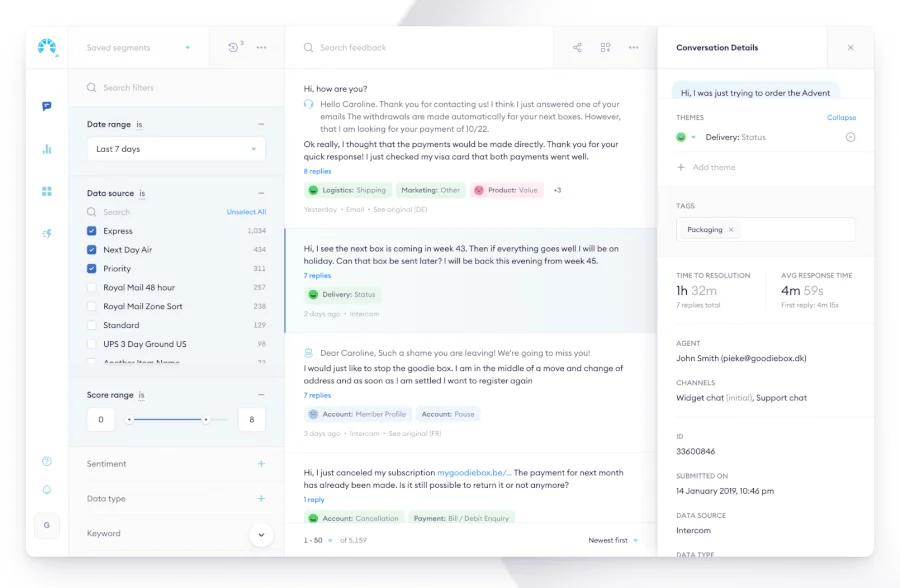
Chattermill is a customer experience analytics platform that brings feedback from surveys, support tickets, reviews, social media and app stores into one place. Chattermill is built for customer experience analytics, connecting themes and sentiment to metrics such as NPS, CSAT and CES.
Strengths
Chattermill gives CX, insights and product teams a unified view of feedback across many channels, in multiple languages. Anomaly detection alerts teams when a metric shifts unexpectedly, and dashboards make the results available to the wider organization. Integrations cover survey, CRM, support and data warehouse tools.
Limitations
Chattermill is built for organizations that analyze feedback from many channels on an ongoing basis. A team that used MonkeyLearn to classify one dataset at a time may find a full CX analytics rollout heavier than the job requires. Pricing is not published.
Pricing
Chattermill does not publish its prices. Pricing is based on feedback volume and the number of connected data sources, and is available through a demo.
Best For
Chattermill fits mid-market and enterprise CX teams that want feedback from many channels tied to the experience metrics they already report on. Kimola structures feedback into research Dimensions such as motivations, pain points and unmet needs, and works self-service without custom model setup; see our Kimola vs Chattermill comparison.
6. Cauliflower
Cauliflower is AI software for market research teams. It analyzes survey data, codes open-ended answers, compares audiences and turns results into presentation-ready output.
Strengths
Cauliflower is designed around the work of research teams rather than general text classification. Beyond coding open-ended responses, it helps compare audiences across survey waves and exports editable PowerPoint slides, which shortens the step from analysis to reporting. An AI assistant answers questions about the data in a dashboard. Cauliflower publishes its pricing and hosts data in the EU.
Limitations
Cauliflower is focused on survey research, so teams that used MonkeyLearn for support tickets, reviews or other operational text may find it less suited to those sources. Its website is primarily in German, and plans are billed annually.
Pricing
Cauliflower's plans are listed per month, billed annually and excluding VAT: Duo at €79 for up to two editors, Team at €239 for up to five, Business at €599 for up to ten, Agency from €1,990 and Company Enterprise from €3,990, both with unlimited editors.
Best For
Cauliflower fits market research teams and agencies, especially in Europe, that analyze survey data regularly and want coding, audience comparisons and presentation output in one tool.
7. Amazon Comprehend
Amazon Comprehend is a natural language processing service from Amazon Web Services. It provides text analysis through an API and is aimed at developers building their own applications and pipelines.
Strengths
Comprehend offers sentiment analysis, targeted sentiment toward specific entities, entity recognition and language detection. Its custom classification feature lets teams train text classification models with their own business-specific labels, which is the closest match to MonkeyLearn's custom classifiers for teams that worked through the API. Pricing is pay-as-you-go and published, and it runs within the AWS ecosystem many engineering teams already use.
Limitations
Comprehend needs developers to set up, integrate and maintain, and its output is labels and scores rather than finished analysis; turning them into findings is left to the team. AWS has made topic modeling and event detection unavailable to new customers, while other features are not affected. For a broader look at this category, see our guide to Amazon Comprehend alternatives.
Pricing
Comprehend charges per unit of 100 characters, with a minimum of three units per request. Custom classification adds charges for model training ($3 per hour) and model management ($0.50 per month), and custom models have no free tier. Full details are on the AWS pricing page.
Best For
Amazon Comprehend fits engineering teams that used MonkeyLearn's API inside their own products or data pipelines and want a managed NLP service they can build on.
How to Choose the Right MonkeyLearn Alternative
If you used MonkeyLearn's API inside your own application or data pipeline, Amazon Comprehend is the most direct replacement, as long as you have developers to build and maintain the integration. If your main job is coding open-ended survey responses, Caplena and Cauliflower are built for that work, with Cauliflower adding presentation output and Caplena an agency plan. If you run an ongoing customer experience program across many channels, Thematic and Chattermill are designed for that scale, and Keatext offers CX text analytics with published pricing.
If your organization is already moving toward an organization-wide experience management program, Medallia is where MonkeyLearn's technology lives today. If you want to classify feedback with ready-made or custom models and also understand why customers feel the way they do, from the feedback you already have or public reviews you collect, Kimola is built for that, and you can start without a sales call.
Frequently Asked Questions
Is MonkeyLearn still available?
No, not as a standalone product. Medallia acquired MonkeyLearn in February 2022, and monkeylearn.com redirects to Medallia's website. It is no longer possible to sign up for MonkeyLearn on its own.
Can I still use MonkeyLearn through Medallia?
MonkeyLearn's technology became part of Medallia's platform, so its capabilities are available to Medallia customers as part of that platform. Medallia is an experience management suite sold through sales conversations, so it is a different kind of purchase from a MonkeyLearn subscription.
Is there a free alternative to MonkeyLearn?
Kimola has a free Starter plan with 150 queries per month and no credit card, which includes its pretrained models. Amazon Comprehend has published pay-as-you-go pricing, though custom classification has no free tier. Most other tools in this guide offer a demo, a proof of concept or a paid pilot rather than a free plan.
Why not just use ChatGPT to classify customer feedback?
Chat assistants are useful for summarizing a small set of comments. Classifying thousands of records consistently, getting the same result from the same data every time, testing differences between segments statistically and tracing every number back to its source requires purpose-built infrastructure. That is the gap tools in this guide are designed to fill.
Conclusion
MonkeyLearn is no longer available on its own, and the right replacement depends on which part of it your team relied on: the API, survey coding, CX analytics or self-service classification. Each tool in this guide covers a different part of that picture. If you want to see how Kimola handles your own data, you can start on the free Starter plan.