Wonderflow Alternatives & Competitors: 6 Tools Compared
Oct 26, 2026 - 12 minute read
If you are looking for a Wonderflow alternative, the right choice depends on what you need from customer feedback. Revuze and Yogi are the closest options for consumer brands that analyze product reviews at SKU and category level. Thematic and Chattermill suit enterprise teams that analyze feedback across surveys, support and reviews, and Medallia fits large organizations that want a full experience management suite. Kimola fits teams that want to turn the feedback they already have, or product reviews they collect from a link, into research that explains why customers feel the way they do.
Wonderflow is a Voice of Customer platform for enterprise consumer brands, built around product reviews collected from online stores and combined with other feedback and business data. Teams usually look for an alternative because their needs differ from what Wonderflow is designed for: they work with a smaller product range or a single feedback channel, they want pricing they can see before a sales conversation, or they need research output beyond review analytics.
This guide is written by the Kimola team. Kimola is our product, so we explain where it fits and where it doesn't, and we describe every other tool based on its public documentation.
What Is Wonderflow?
Wonderflow describes itself as an agentic consumer intelligence platform and a Voice of Customer platform for enterprise organizations. It has worked with customer feedback since 2015.
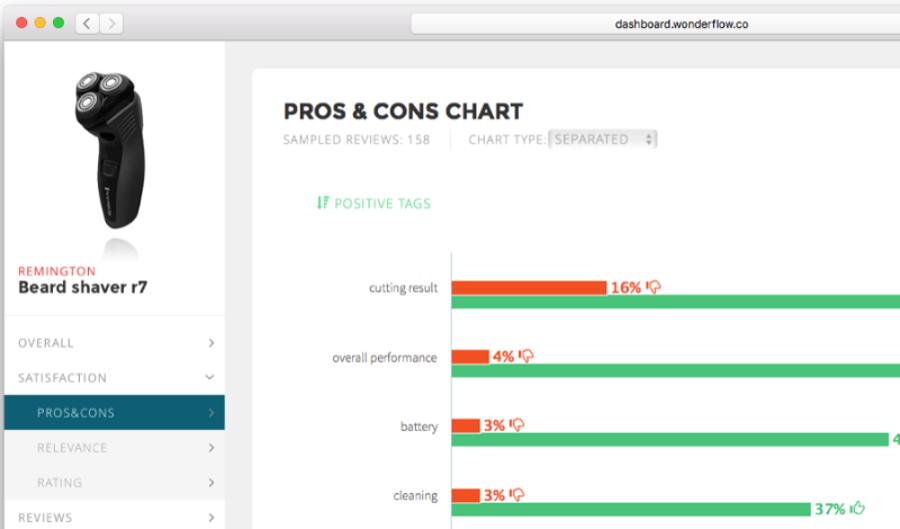
Wonderflow collects reviews, ratings, questions, prices and product attributes from more than 1,000 online stores, and can combine them with customer care feedback, NPS, social media and business data such as sales and inventory. It analyzes feedback in more than 100 languages with sentiment analysis, topic discovery, AI summaries and alerts. AI agents called Wonder Agents handle recurring tasks such as building personas or tracking product performance, and an API sends data to BI tools.
Wonderflow is designed for large consumer brands in categories such as consumer electronics, household appliances, beauty, apparel and pet food. Its product, R&D, e-commerce, marketing and customer care teams use it to compare product performance, benchmark competitors and track how consumers react to launches.
Why Teams Look for Wonderflow Alternatives
The most common reason is scope. Wonderflow is built for brands with large product portfolios across many markets and retailers. A team that sells a few products, or wants to analyze one review source or one survey, may find an enterprise rollout more than the job requires.
Pricing is another factor. Wonderflow does not publish prices; pricing depends on data sources, product categories and the scale of analysis, and is provided as a custom proposal after a short questionnaire and demo. Teams that want to test a tool with their own data before involving procurement often look for options they can try first.
Some teams also need a different focus. Wonderflow organizes feedback around products and retail channels, which suits consumer brands. Teams whose main sources are surveys, support tickets or call transcripts, or who need to understand motivations and unmet needs across customer segments, may look for tools built around those questions.
How We Compared These Tools
We looked at each tool through the same criteria: the types of feedback it works with, and in particular whether it can collect product reviews itself; how deep the analysis goes beyond themes and sentiment; how much setup it needs before a team sees results; and how easy it is to evaluate, including whether pricing is published and whether a free plan or trial is available. Product information comes from each vendor's own website.
1. Kimola
Kimola is an AI platform that turns customer feedback into enterprise-grade market research. Teams analyze the feedback they already have, such as survey responses, support tickets, call transcripts and social conversations, or collect public reviews by pasting a link to a product page on Amazon, Trustpilot, Google Play, the App Store and other platforms.
Kimola finds themes in the data itself, without predefined categories, and gives every theme mentioned in a comment its own sentiment. Where Wonderflow is built for enterprise review analytics across large product portfolios, Kimola lets any team collect reviews from a link and analyze them with research questions, starting on a free plan.
Strengths
Product reviews from a link. Kimola can collect public reviews when you paste a link to a product, business or app page on platforms such as Amazon, Walmart.com, Trustpilot, Tripadvisor, Google Business, Google Play and the App Store. A browser extension covers more than 30 sources, including G2, Reddit and Etsy. The same method works for a competitor's product page, so you can compare your own product with a rival's using the same analysis. Kimola analyzes feedback in more than 30 languages within the same analysis.
Research questions on every review. Classifying topics is only the first step in Kimola. It asks every comment research questions called Dimensions: what motivates customers to buy, what pain points they face, what needs are still unmet, which personas and experience stages they represent, and what underlying causes sit behind a complaint. For a product team, this turns "customers mention installation" into "first-time buyers struggle with installation because the instructions assume prior experience."
Findings that are statistically tested. Kimola crosses every theme and Dimension with the columns in your data, such as product model, country or retailer, and with time. This usually produces thousands of combinations, and Kimola tests each one. Only statistically significant differences and trends become Signals, ranked so that what needs attention comes first. If installation complaints are concentrated on one product model, Kimola surfaces that as a Signal only if the difference is significant. Scores are deterministic, so the same data always produces the same ranking, and they take the number of comments into account as well as the ratio. Action Plans then form hypotheses from the analysis, test each one against the feedback, and keep only the actions the evidence supports, with every figure and quote checked.
Easy to evaluate. Every account starts on a free Starter plan with no credit card, paid plans start at $49 per month, and pricing is public. Smaller teams use Kimola self-service, while larger organizations work with an account manager to set up Spaces and custom models on the same platform.
Limitations
Kimola analyzes feedback; it does not design or send surveys, and it does not combine reviews with sales, pricing or inventory data into a market model the way Wonderflow and Revuze do. It is not designed as a real-time monitoring dashboard. Spaces, which keep a growing feedback channel consistently classified over time, and related features such as Funnels, Customers and Tasks are available only on the Enterprise plan. The free Starter plan is limited to 150 queries per month.
Pricing
Kimola has a free Starter plan, and paid plans start at $49 per month. Usage is measured in queries, and the full plan details are on the pricing page. Enterprise plans are priced individually.
Best For
Kimola is a good fit for product, insights, research and marketing teams that want to understand why customers feel the way they do, from the feedback they already have or from their own and competitors' product reviews, and that want to evaluate a tool with their own data before talking to sales.
2. Revuze
Revuze describes itself as an AI market intelligence layer for category-to-SKU clarity. Like Wonderflow, it is built for consumer brands that want to understand how products perform across categories, brands and individual SKUs.
Strengths
Revuze combines ratings and reviews with social conversations, including Reddit, surveys, customer care, returns, point-of-sale data and product catalogs. Separate hubs serve product, social, consumer insights and e-commerce teams, and AI agents monitor launches, detect issues, discover trends and track competitors. A chat interface called Vee answers questions grounded in category, brand and SKU data, and an MCP connection makes the same data available to AI assistants. It focuses on industries such as cosmetics, home appliances, personal care, apparel and food and beverage.
Limitations
Revuze is organized around products and categories, so teams whose main feedback comes from support conversations or surveys outside a product context may find it less suited to their questions. Pricing is not published, and the website does not describe the terms of its free trial.
Pricing
Revuze does not publish its pricing. The website offers a free trial and a demo.
Best For
Revuze fits consumer brands that want SKU-level and category-level insight from reviews and social data, combined with sales and product data, and that are comparing enterprise review analytics platforms.
3. Yogi
Yogi describes itself as an AI-powered Unified Voice of Customer platform built for enterprise consumer goods brands. It brings product reviews and ratings together with other feedback in one place, which makes it one of the closest alternatives to Wonderflow.
Strengths
Yogi collects reviews and ratings from more than 400 retailers, along with app reviews, social and forum posts, consumer care data, surveys and video. It analyzes feedback at SKU level, benchmarks products against competitors and helps teams improve product detail pages. Ask Yogi answers natural-language questions with charts, themes and verbatim quotes, and automated digests and alerts flag shifts in perception. It integrates with tools such as Bazaarvoice, Zendesk, Salesforce, Qualtrics and Sprout Social, and offers an MCP server.
Limitations
Yogi is designed for enterprise consumer goods brands, so teams outside retail and consumer products, or with a small number of products, may find its focus narrower than their use case. Pricing is not published.
Pricing
Yogi does not publish its pricing. The website offers a free start option and a demo.
Best For
Yogi fits consumer goods brands, especially insights, brand, R&D and e-commerce teams, that want retailer reviews and other consumer feedback analyzed together at product level.
4. Thematic
Thematic describes itself as a customer intelligence layer for enterprise CX. Thematic is built to find themes in the feedback a team provides, and it is designed to work alongside an existing CX stack rather than replace it.
Strengths
Thematic ingests surveys, support tickets, call transcripts, app reviews and CRM notes, with translation and redaction of personal information. It builds themes from customers' own language, and every theme can be traced back to the comments behind it and adjusted by the team. Beyond themes, it predicts scores such as NPS, churn propensity and effort from feedback, and ranks themes by the revenue tied to them.
Limitations
Thematic is aimed at enterprise organizations, and its entry plan is priced for annual programs. Teams with a small volume of feedback or a one-off project may find this more than they need. Thematic offers demos on your own data and a paid pilot instead of a free trial.
Pricing
Thematic's Foundation plan is listed at $25,000 per year for up to 25,000 comments and 3 datasets. Enterprise pricing is available as a custom proposal.
Best For
Thematic fits enterprise CX and insights teams that want a dedicated feedback analytics layer on top of their existing survey and support tools. Kimola also collects feedback from reviews and goes beyond theme detection with research Dimensions and evidence-checked Action Plans; see our Kimola vs Thematic comparison.
5. Chattermill
Chattermill describes itself as an AI-native voice of customer and feedback analysis platform. Chattermill is built for customer experience analytics, bringing feedback from many channels into one view.
Strengths
Chattermill analyzes surveys, reviews, support tickets, contact center calls, social media and chats through more than 65 native integrations, including Zendesk, Intercom, Qualtrics, Trustpilot and Salesforce. Its AI analyst, Lyra, answers questions with quantified evidence and linked customer quotes, and proactive insights surface spikes and emerging issues. Impact analysis shows what drives metrics such as NPS, and alerts route to Slack, email and Jira. Chattermill does not charge per user.
Limitations
Chattermill is designed for ongoing analysis at volume. By its own description, it is not a good fit for teams that collect fewer than about 5,000 feedback items per month or that need a one-off analysis. Pricing is not published.
Pricing
Chattermill does not publish its pricing. The website offers an interactive product tour and a demo.
Best For
Chattermill fits CX, insights and product teams at enterprises and fast-growing brands that want continuous, multi-channel feedback analytics tied to experience metrics. Kimola structures feedback into research Dimensions such as motivations, pain points and unmet needs, and works self-service without custom model setup; see our Kimola vs Chattermill comparison.
6. Medallia
Medallia is an experience management platform. Medallia is built to run experience management programs across large organizations, covering customer experience, employee experience, contact centers and market research. Text analytics is one part of this wider platform.
Strengths
Medallia combines feedback capture, analytics and workflows in a single suite. Its text analytics detects themes, sentiment, intent, effort and emotion across many languages, with prebuilt industry topic models and tools for building custom ones. Alerts flag shifts in topics or sentiment so emerging issues reach the right people. For large companies that want survey programs, feedback collection and analysis managed together, this breadth is the main reason to choose it.
Limitations
Medallia is designed for organization-wide experience programs, so teams that mainly want to analyze product reviews may find the rollout heavier than the job requires. Pricing is not published, and evaluation runs through demos and sales conversations rather than a free trial.
Pricing
Medallia prices its platform in annual tiers based on Experience Data Records, a unit that covers the data tied to each customer or employee interaction. Users are not billed separately, and pricing is available through sales.
Best For
Medallia fits large organizations that want survey programs, feedback collection and analytics managed together in one experience management program.
How to Choose the Right Wonderflow Alternative
If you are a consumer brand that wants SKU-level and category-level insight from reviews combined with sales and product data, Revuze is the closest match. If you want retailer reviews analyzed at product level with competitive benchmarking and product page recommendations, look at Yogi. If you need an enterprise feedback analytics layer on top of your survey and support tools, consider Thematic, and if you want continuous multi-channel analytics tied to NPS and other metrics, Chattermill is built for that. If you want survey programs, collection and analysis in a single suite across a large organization, Medallia is the broader platform.
If you want to understand why customers feel the way they do, from the feedback you already have or from your own and competitors' product reviews collected from a link, and you want to try it with your own data before talking to sales, Kimola is built for that.
Frequently Asked Questions
Is there a free alternative to Wonderflow?
Kimola has a free Starter plan with 150 queries per month and no credit card required, and it can collect product reviews from a link, so you can analyze your own or a competitor's reviews before choosing a paid plan. Revuze and Yogi offer free trial or free start options on their websites, while the other tools in this guide work through demos or paid pilots.
How much does Wonderflow cost?
Wonderflow does not publish its pricing. According to Wonderflow, pricing depends on data sources, product categories and the scale of analysis, and a custom proposal is available after a short questionnaire.
Can I analyze competitor product reviews without an enterprise contract?
Yes. Public reviews on platforms such as Amazon, Trustpilot, Google Play and the App Store can be collected and analyzed directly. In Kimola, you paste a link to a product, business or app page, and Kimola collects and analyzes the reviews on that page, including on the free plan.
Why not just use ChatGPT to analyze product reviews?
General-purpose AI assistants are good at summarizing a small set of reviews. Classifying thousands of reviews consistently, testing differences between products or markets statistically, getting the same result from the same data every time and showing the source of every number require a dedicated setup. That is the gap feedback analysis tools are built to fill.
Conclusion
Wonderflow is a strong option for enterprise consumer brands that analyze reviews across large product portfolios, and the right alternative depends on whether you need another enterprise review analytics platform, a broader feedback analytics layer, a full experience management suite or research that explains customer behavior. If you want to see how Kimola handles your own data or a competitor's reviews, you can start on the free Starter plan.