Kraftful Alternatives: 7 Product Feedback Tools to Use Instead
Oct 27, 2026 - 13 minute read
Kraftful is no longer available. Amplitude acquired the company in July 2025, and the Kraftful platform shut down on August 11, 2025. If you used Kraftful to turn app reviews, support tickets and customer calls into feature requests and pain points, the closest replacement depends on how your team works: Amplitude AI Feedback is the direct successor for teams already on Amplitude, Enterpret and Unwrap serve larger teams with high-volume, multi-source feedback, Productboard connects feedback to the roadmap, Dovetail suits interview-heavy research, and BuildBetter focuses on customer calls. Kimola fits teams that want to start self-service and get research that explains why users say what they say, including from competitors' app reviews.
Kraftful was popular with product teams because it made feedback analysis quick: connect your sources, and get a ranked list of what users ask for and complain about. Former users now need a tool that does the same job and that they can still sign up for today.
This guide is written by the Kimola team. Kimola is our product, so we explain where it fits and where it doesn't, and we describe every other tool based on its public documentation.
What Happened to Kraftful?
Kraftful was an AI tool for product teams, backed by Y Combinator. It collected feedback from app store reviews, support tickets, sales calls, user interviews, surveys and community channels such as Reddit, Discord and Slack. It analyzed this feedback every day, surfaced feature requests, bugs and pain points with how often each came up, and could turn findings into Jira or Linear tickets.
Amplitude, a product analytics company, announced its acquisition of Kraftful on July 10, 2025, and said the Kraftful platform would shut down on August 11. In November 2025, Amplitude launched AI Feedback, a feature developed after the acquisition with Kraftful's team and technology. It is no longer possible to sign up for Kraftful as a separate product.
What Kraftful Users Need From a Replacement
Most Kraftful users relied on a few things. They wanted feedback from many places, especially app reviews, support tickets and calls, analyzed in one place. They wanted a clear, counted list of feature requests, complaints and bugs. Many sent findings to Jira or Linear. And many valued being able to start on their own without a long sales process.
It is also worth asking what your team did with that list. A count of feature requests tells you what users ask for, but not always why, which users ask for it, or whether a problem is getting worse. If your team spent time answering those questions by hand, a tool that goes further than a ranked list may save more time than a like-for-like replacement.
How We Compared These Tools
We looked at each tool through the same criteria: which feedback sources it supports, how deep the analysis goes beyond themes and sentiment, how it connects to product workflows, how much setup it needs, and how easy it is to evaluate, including whether pricing is published and whether a free plan or trial is available. Product information comes from each vendor's own website and documentation.
1. Kimola
Kimola is an AI platform that turns customer feedback into enterprise-grade market research. Teams analyze the feedback they already have, such as survey responses, support tickets, call transcripts and social conversations, or collect public reviews by pasting a link to a product page on Amazon, Trustpilot, Google Play, the App Store and other platforms.
For former Kraftful users, Kimola covers the core job, finding what users request and complain about across sources, and then adds a research layer that explains why and for whom.
Strengths
App reviews from a link, yours and your competitors'. Kimola can collect public reviews when you paste the link to an app's page on the App Store or Google Play, or to a product or business page on platforms such as Amazon, Trustpilot and Google Business. Because any public page works, you can analyze a competitor's app reviews with the same method you use for your own. Your own feedback can come from a file upload or from the Zendesk, Intercom and Google Sheets integrations. Pretrained models, including classifiers built for mobile apps and software, work without setup, and Kimola analyzes feedback in more than 30 languages within the same analysis.
More than a list of feature requests. In Kimola, classifying topics is only the first step. Themes are found in the data itself, without predefined categories, and every theme a comment mentions gets its own sentiment. Kimola then asks every comment research questions called Dimensions: Pain Points show what goes wrong, Unmet Needs show what users expect to be added or changed, and Motivations show why people choose the product in the first place. Kimola crosses every theme and Dimension with the columns in your data, such as platform, app version or plan, and with time. Only statistically significant differences and trends become Signals. If complaints about sync problems rise only among Android users after a release, Kimola surfaces that as a Signal only if the difference is significant. Scores are deterministic, so the same data always produces the same ranking, and a theme with 50 comments is not outranked by one with 5 just because its percentage looks higher.
Easy to evaluate. Every account starts on a free Starter plan with no credit card, paid plans start at $49 per month, and pricing is public. Smaller teams use Kimola self-service, while larger organizations work with an account manager to set up Spaces and custom models on the same platform.
Limitations
Kimola analyzes feedback; it does not run surveys or user interviews, and it is not a roadmap or product management tool. It does not connect directly to call recording tools, so call transcripts are uploaded as files. Sending findings to Jira is available through Tasks, which, like Spaces and Funnels, is part of the Enterprise plan only. The free Starter plan is limited to 150 queries per month.
Pricing
Kimola has a free Starter plan, and paid plans start at $49 per month. Usage is measured in queries, and the full plan details are on the pricing page. Enterprise plans are priced individually.
Best For
Kimola is a good fit for product, research and marketing teams that want to start self-service, analyze their own and their competitors' app reviews alongside support and survey feedback, and get research output that explains why users feel the way they do. See how Kimola approaches product feedback analysis.
2. Amplitude AI Feedback
Amplitude AI Feedback is a feedback analysis feature inside Amplitude, a product analytics platform. It was developed after Amplitude acquired Kraftful, with Kraftful's team and technology, which makes it the closest thing to a direct successor for former Kraftful users.
Strengths
AI Feedback connects to support tools such as Zendesk, Intercom, Salesforce Service and Freshdesk, to HubSpot and Gong, to Slack and Discord, and to public sources such as the App Store, Google Play, G2, Trustpilot, X and Reddit. CSV and document uploads are also supported. It sorts feedback into categories such as feature requests, complaints, loved features, bugs and pain points, and rates each insight's severity. Its biggest advantage is context: for teams already on Amplitude, feedback sits next to product analytics, session replay and surveys in the same platform.
Limitations
AI Feedback is most useful for teams that use Amplitude as their analytics platform; teams that don't will be adopting a larger product to get the feature. According to Amplitude's documentation, summaries are generated in English, only the first 1,000 characters of each piece of feedback are analyzed, and exports to Jira and Linear are in early access.
Pricing
AI Feedback is included on every Amplitude plan, including the free plan, which has a monthly limit on feedback records. Growth and Enterprise customers can buy additional volume as an add-on. Details are on Amplitude's pricing page.
Best For
Amplitude AI Feedback is the natural choice for product teams that already use Amplitude and want feedback analysis next to their behavioral data, and for former Kraftful users who want to stay close to the original product.
3. Enterpret
Enterpret describes itself as the customer context layer for AI-native product teams. It unifies feedback from support, calls, app stores, review sites and community channels and links it to accounts, revenue and releases.
Strengths
Enterpret's Adaptive Taxonomy classifies feedback in customers' own language and updates as new themes appear. It offers more than 30 connectors, sends findings to tools such as Jira, Linear, Slack and Notion, and includes an agent that answers questions with links back to the original conversations and can watch for emerging issues. Connecting feedback to accounts and revenue helps product teams weigh requests by business impact, not only by volume.
Limitations
Enterpret is aimed at product and support organizations with large feedback volumes, and it is sold through demos rather than self-service plans. Teams that used Kraftful on a small self-service plan may find the evaluation process heavier than they need.
Pricing
Enterpret's pricing is not published and is available on request.
Best For
Enterpret is a strong fit for mid-sized and large product organizations that want feedback from many sources tied to accounts and revenue, and that are ready for a sales-led evaluation.
4. Unwrap
Unwrap describes itself as an AI-powered customer intelligence platform. It analyzes surveys, support tickets, calls and reviews, and surfaces trends and issues without manual tagging or dashboard building.
Strengths
Unwrap groups feedback automatically, lets teams ask questions in natural language, and sends alerts when issues emerge. It serves product, customer experience, support and insights teams, with features such as automatic PII redaction and a support quality assurance module. It does not charge per seat, so feedback can be shared across a large organization.
Limitations
Unwrap's pricing starts at an annual commitment that is sized for established teams, so smaller product teams that used Kraftful on a monthly plan may find it more than they need. Getting started goes through a sales conversation.
Pricing
Unwrap's pricing page lists plans starting at $24,000 per year, based on feedback volume and integrations. It mentions an option to start with a 30-day trial on your own data.
Best For
Unwrap fits larger companies, particularly in consumer, retail, travel and software, that need ongoing, automated monitoring of high-volume feedback across support, surveys and reviews.
5. Productboard
Productboard describes itself as an AI-powered product management platform. It brings customer feedback and product requests into the same place where teams prioritize features and build roadmaps.
Strengths
Productboard centralizes feedback from customers and colleagues, links insights to feature ideas, and ties those ideas to objectives and roadmaps. Its AI, Spark, is included in every plan and provides feedback summaries, findings and opportunities, and feedback reports. A customer-facing portal lets users see and vote on features under consideration. For teams whose main goal was getting from feedback to a prioritized backlog, this closes the loop in one tool.
Limitations
Productboard is a product management platform first, so its analysis is designed to support prioritization rather than to provide in-depth research on large volumes of public reviews. AI Themes is available only on the Enterprise plan, and both plans require a minimum of five makers.
Pricing
Productboard's pricing page lists Business and Enterprise plans without published prices; Business is available through a demo request and Enterprise through sales. AI usage is measured in credits, and extra credits can be purchased.
Best For
Productboard is a good fit for product teams that want feedback, prioritization and roadmaps in a single platform, and that care most about connecting requests to what gets built.
6. Dovetail
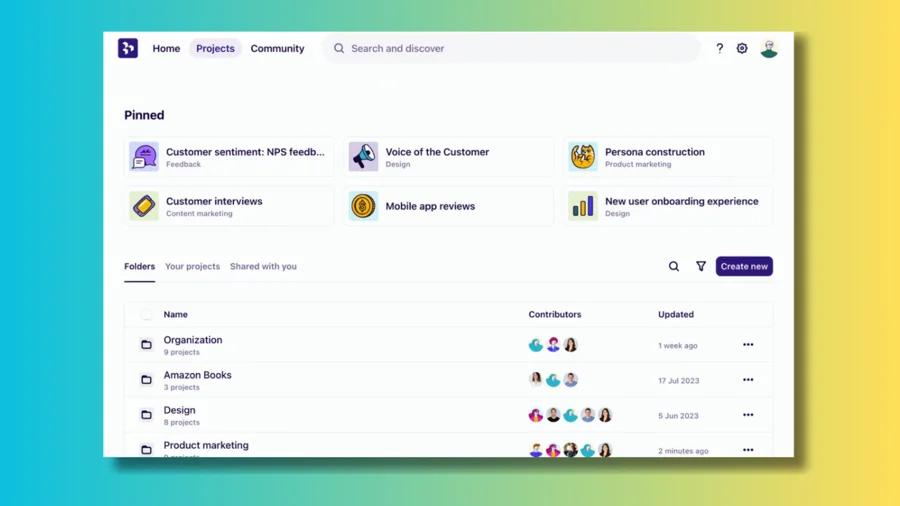
Dovetail describes itself as AI-powered customer intelligence. Dovetail is built to organize qualitative research such as interviews and usability tests, and it also offers channels that classify feedback from sources such as support tickets and app reviews.
Strengths
Dovetail transcribes calls, interviews and videos, links every line to the moment it was said, and makes studies searchable across the organization. Its channels track themes in support tickets, app reviews and other feedback, with more than 30 sources including Gong and G2. For teams that used Kraftful alongside regular user interviews, Dovetail keeps both kinds of evidence in one place.
Limitations
Dovetail's strength is organizing and searching research. Teams whose main need is statistical analysis of large volumes of reviews and support feedback may need a different tool for that part of the work. The free plan includes one feedback channel and one project; unlimited channels require Enterprise.
Pricing
Dovetail has a free plan, and Enterprise pricing is available through sales. Details are on Dovetail's pricing page.
Best For
Dovetail suits research and product teams that run regular user interviews and want a shared repository, with feedback channels as a complement. We compare the two tools in more detail on our Kimola vs Dovetail page.
7. BuildBetter
BuildBetter describes itself as a customer intelligence platform that gives sales, success, product and engineering teams shared customer context. It is built around calls, with tickets, documents and other feedback added to the same picture.
Strengths
BuildBetter records and reads customer calls and links each answer back to its source, such as the moment in a call. It maps feedback to accounts and product areas, and specs written in BuildBetter link every customer quote to the call it came from. Tickets, Slack conversations, CRM data and CSV files can be added on most plans, and all plans include unlimited seats.
Limitations
BuildBetter's focus is calls and internal customer conversations; its pricing page does not list public app reviews as a source. Teams that mainly used Kraftful for App Store and Google Play reviews will need another tool for that part of the work.
Pricing
BuildBetter publishes its prices, billed annually: Hobby at $95.88 per year, Starter at $1,608 per year, Explorer at $3,768 per year and Pro at $17,280 per year, with custom Enterprise plans. Details are on BuildBetter's pricing page.
Best For
BuildBetter is a good fit for teams whose most valuable feedback comes from sales and customer success calls, and who want product, sales and engineering to work from the same evidence.
How to Choose the Right Kraftful Alternative
If your team already uses Amplitude, start with Amplitude AI Feedback: it carries Kraftful's work forward and puts feedback next to your product analytics. If you have high volumes of feedback across many sources and want it tied to accounts and revenue, Enterpret and Unwrap are built for that scale. If your main goal is turning feedback into a prioritized roadmap, Productboard keeps both in one tool. If your research is built around user interviews, Dovetail is the stronger fit, and if your best feedback comes from sales and customer calls, look at BuildBetter.
If you want to start self-service, analyze your own and your competitors' app reviews alongside support and survey feedback, and understand why users feel the way they do, Kimola is built for that.
Frequently Asked Questions
Is Kraftful still available?
No. Amplitude acquired Kraftful in July 2025, and the Kraftful platform shut down on August 11, 2025. It is no longer possible to sign up for Kraftful as a separate product.
Can former Kraftful users move to Amplitude?
Yes. Amplitude launched AI Feedback in November 2025, building on Kraftful's team and technology, and it is available on every Amplitude plan, including the free plan. It works best for teams that also use Amplitude for product analytics.
Is there a free alternative to Kraftful?
Several tools on this list can be started for free. Kimola has a free Starter plan with no credit card, Amplitude's free plan includes AI Feedback with a monthly limit, and Dovetail has a free plan with one feedback channel.
Can I analyze competitors' app reviews?
Yes, if the reviews are public. In Kimola, you paste the link to a competitor's App Store or Google Play page, and the reviews are collected and analyzed with the same method you use for your own feedback. This makes it possible to compare what users praise and complain about across apps.
Why not just use ChatGPT to analyze product feedback?
Chat assistants are good at summarizing a small set of comments. Classifying thousands of reviews and tickets consistently, testing whether differences between platforms or releases are statistically significant, getting the same result from the same data every time, and tracing every number back to its source require a dedicated setup. That is what feedback analysis tools are built to provide.
Conclusion
Kraftful is gone, but the job it did, turning scattered user feedback into a clear view of what to fix and build, still matters. Amplitude AI Feedback is the direct successor for Amplitude users, while the other tools on this list cover different needs, from enterprise-scale feedback programs to roadmaps, interviews and calls. If you want to see how Kimola handles your own feedback or your competitors' app reviews, you can start on the free Starter plan.