Why Most Matcha Products Fail to Deliver on the "Green Gold" Promise
Apr 24, 2026 - 6 minute read
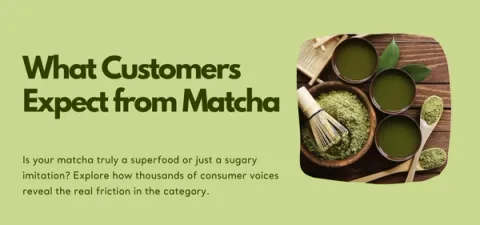
Matcha promises a vibrant, earthy, and mindful energy boost. Customers enter the category expecting a "superfood" experience—a clean, ceremonial-grade tea that balances health benefits with a sophisticated, vegetal flavor profile.
In reality, many users describe a "matcha-flavored confection" rather than a tea. Instead of the deep umami and vibrant green they anticipate, they find themselves consuming products dominated by cane sugar, non-dairy creamers, and artificial fillers.
The gap between expectation and experience is not random. It follows a consistent pattern: the "Latte-fication" of the category has prioritized convenience and mass-market sweetness over the very authenticity that drives people to matcha in the first place.
The Matcha Experience: Beyond the Froth
To understand the current state of the market, we analyzed over 1,400 customer reviews collected from Amazon, Target, and Walmart. This data reveals a complex user journey defined by a search for balance and authenticity.

The Sweetness Identity Crisis
A primary tension in the category is what we call the Sweetness Identity Crisis. Our analysis shows that 34% of negative feedback centers on excessive sweetness, while 11% of the total conversation revolves around the divide between sweetened and unsweetened options. While many users value the convenience and flavor similarity to commercial beverages—often finding the pre-sweetened mixes creamy and smooth—others report that sugar is often the primary ingredient, leaving them with a "sugary milk" taste that masks the authentic matcha profile. This creates a sensory mismatch for health-conscious buyers where the expected "bitter-sweet" balance is replaced by a cloying aftertaste.
Accessible Indulgence and Routine Replacement
Beyond the challenges, a significant portion of the user journey is defined by Accessible Indulgence and Routine Replacement. Many consumers report a high level of satisfaction when the product successfully replicates the "creamy and smooth" texture of expensive café beverages at a fraction of the cost. For these users, the experience is characterized by the ability to maintain a premium ritual within their daily routine.
The Solubility Friction
Another defining aspect of the consumer journey is what we identify as Solubility Friction. While the majority of users (84%) find the preparation straightforward when using the right tools, a persistent 9% struggle with clumping and graininess, particularly in cold preparations. This suggests that for a segment of the market, product "convenience" can be an over-promise. For these users, the physical experience of preparation remains a high-friction activity that prevents matcha from becoming a seamless, one-step daily routine.
The Serving Size Illusion
Finally, the consumer experience is significantly shaped by the Serving Size Illusion. Our analysis reveals that 10% of users report dissatisfaction regarding quantity expectations. While many appreciate the cost savings of replicating café-style drinks at home, a disconnect exists between labeling and actual consumption habits. To achieve the intense flavor of a professional latte, customers often use two to five times the recommended amount. This leads to rapid product depletion and a perceived loss of value as users "correct" the weak flavor of diluted mixes by over-using the powder, which ultimately impacts long-term brand trust.

Who are Matcha Consumers?

Understanding the category requires looking at the user groups shaping these trends. A significant portion of the market, roughly 32%, consists of individuals seeking a cost-effective alternative to expensive café lattes. These users are satisfied when a product mimics that specific "creamy" profile of a coffee shop, but they become quickly frustrated by poor mixability or "fishy" off-flavors that ruin their DIY experience.
Another 24% of the conversation is driven by the most discerning group: the enthusiasts. They value authenticity, Japanese origin, and organic certification above all else. They are frequently disappointed by "culinary grade" powders being sold as premium, citing the lack of vibrant color and the presence of "brown rice solids" as deal-breakers for their ceremonial practice.
Similarly, 24% of users are habitual drinkers who view matcha as a coffee replacement. They value sustained energy without the crash, but their primary frustration lies in packaging integrity. For this group, broken seals or non-resealable bags that compromise the freshness of their daily staple are a primary reason to switch brands.
Finally, about 11% of consumers are health-conscious optimizers who prioritize ingredient transparency. They are the first to call out hidden sugars or lead contamination warnings. They seek pure, clean-label formulations and are only satisfied when a product aligns with their strict wellness standards without any hidden fillers.
What Winning Matcha Brands Do Differently
To succeed in this highly competitive category, brands must look beyond generic quality claims and address the specific friction points identified in consumer data. Success is defined by how well a brand manages the gap between a customer's first purchase and their long-term ritual.
The "Sugar-First" Transparency
Winning brands turn the "Sweetness Identity Crisis" into an opportunity by leading with radical transparency. Instead of concealing sugar content behind health-focused marketing, successful players offer "Customizable Sweetness" or "Unsweetened Bases." By positioning the product as a foundation rather than a finished drink, they empower the user to control their caloric and flavor intake, fostering a sense of trust and personalization.
Engineering the No-Clump Guarantee
In a market where solubility remains a primary frustration, the leaders are those investing in fine-milling technology and "Cold-Water Solubility" formulas. If a consumer needs a blender to make a "convenient" mix, the product has failed its core promise. Top-performing brands don't just sell powder; they sell a seamless experience by removing the physical barriers to entry for beginners and cold-brew enthusiasts alike.
Closing the Value Gap through Serving Realism
Rather than inflating serving counts to appear more cost-effective, winning brands align their usage suggestions with "Flavor Reality." Consumers feel misled when they must use triple the recommended amount to achieve a café-quality taste. Brands that win long-term loyalty are those that are honest about the concentration required for a "Starbucks-style" result, leading to higher repurchase intent and more accurate expectations.
Explore This in Your Own Market
Patterns in a category are often invisible when looking at single reviews, but they become undeniable at scale. In the matcha market, the data shows a clear tension between the "Authenticity" seekers and the "Convenience" seekers—a tension that most brands are currently failing to navigate.
Understanding these macro-patterns is what allows a brand to stop "guessing" and start solving the real friction points of their customers. These insights were uncovered using Kimola’s consumer intelligence technology, which automatically turns thousands of scattered reviews into the strategic dimensions—Motivations, Pain Points, and Personas—needed to understand a category's true landscape.
Is your category suffering from a similar expectation-reality gap? Identifying similar patterns and strategic opportunities in your own market is facilitated by Kimola’s intelligence platform.