Why Portable Blenders Often Fail the On-the-Go Test
Oct 21, 2026 - 8 minute read
Portable blenders are sold on convenience: blend anywhere, anytime. But that promise comes with an expectation — users want the power of a full-size blender in a small, battery-powered device. This creates a built-in tension from the start. The product is expected to be both small and powerful, portable yet capable of handling demanding ingredients.
In practice, this balance is difficult to achieve. Many users encounter limitations that disrupt the experience — motors that struggle with frozen ingredients, inconsistent textures, or devices that stall mid-use. What is positioned as a quick and effortless routine often turns into a process that requires adjustment, patience, and repeated attempts.
The gap is not random. It reflects a structural constraint within the category itself. As portability increases, performance becomes harder to maintain at the level users expect. When the device cannot reliably deliver on basic use cases, the core promise of “on-the-go blending” starts to break down, not because the idea is flawed, but because the product cannot fully support it in practice.
Portability Works But Performance Falls Behind
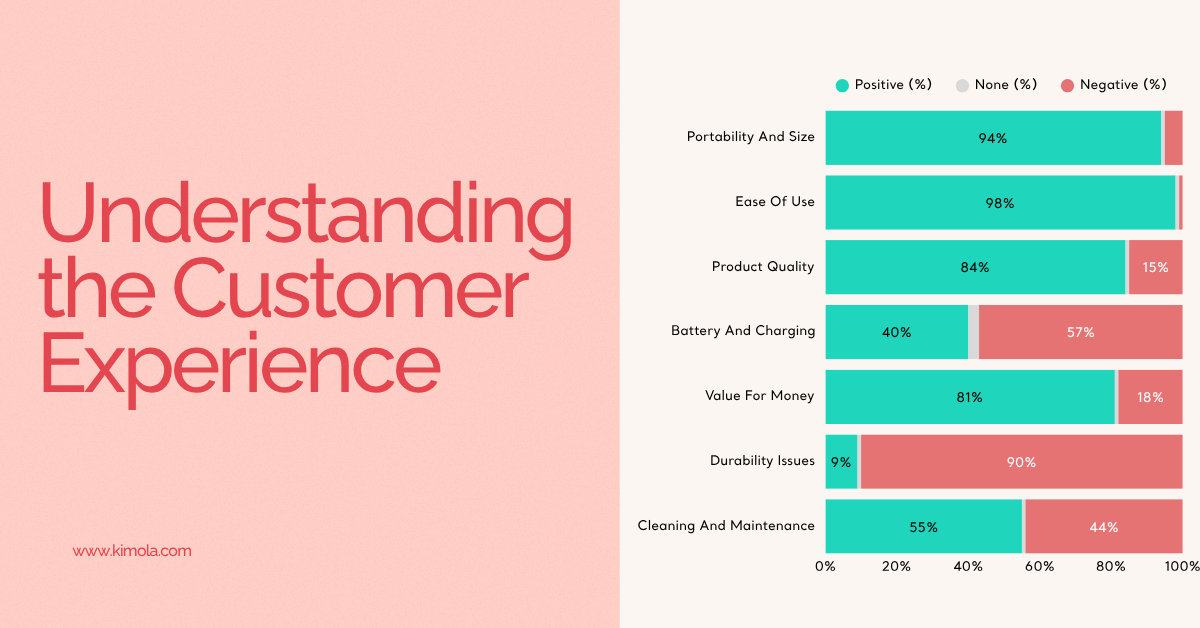
Analysis of 2,552 customer reviews reveals that while the category is built on the promise of "blend-and-go" freedom, the actual user experience is defined by a struggle between motor physics and portability. Based on customer feedback collected across a decade of usage, several consistent patterns emerge regarding how these devices perform in the wild.
Convenience Is Expected, Preparation Becomes Necessary
Users primarily enter this category motivated by Effective Blending Performance, expecting a device that fits seamlessly into a fast-paced morning routine. They expect the same "set-and-forget" experience of a countertop blender, specifically for ice and frozen fruits.
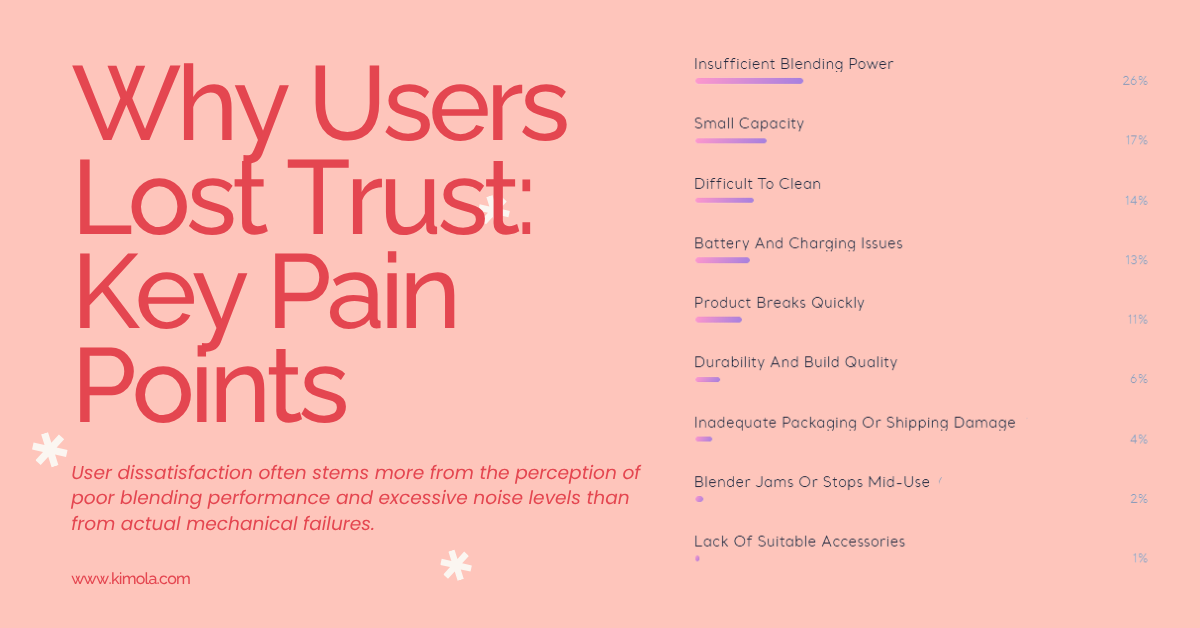
In practice, however, insufficient blending power is the most significant hurdle, affecting 26% of the experience. This gap occurs because the compact motors often lack the torque required for dense ingredients, leading to frequent jamming. Consequently, the "convenience" of the device is often offset by a new type of labor: users find they must pre-cut fruit into tiny pieces or manually shake the blender mid-cycle to achieve a smooth consistency.
Portability Is Delivered, Satiety Is Not
One of the most compelling aspects of the category is its portability and convenience, with users expecting a "grab-and-go" solution for the gym or office. The expectation is a lightweight companion that replaces bulky meal prep.
The reality reveals a "Portability Paradox": to make the device truly portable, manufacturers often limit the Capacity and Size, which 17% of users find insufficient for a full meal replacement or protein shake. This creates a disconnect where the device is easy to carry but requires multiple blending cycles to satisfy a standard nutritional need, effectively trading transportability for functional volume.
Convenience in Portability, Friction in Maintenance
A core expectation for users is ease of use and cleaning. Consumers expect a "rinse-and-go" design that matches their mobile lifestyle.
The actual experience often diverges due to design limitations. Because many models feature fixed blades or deep crevices to maintain a leak-proof seal, 14% of users report that the devices are surprisingly difficult to clean. This gap occurs because the very seals and gaskets required for portability create hard-to-reach zones, leading to hygiene concerns like residue buildup or mold growth if not meticulously maintained.
Performance Is Promised, Durability Falls Short
There is a high level of brand trust initially, with users expecting a durable appliance that supports a long-term health journey.
However, systemic battery and charging Issues and durability weaknesses (11% reporting early breakdowns) often cut this journey short. The gap exists because the high-drain nature of blending puts immense strain on small lithium batteries and plastic gears. While the blenders excel at light, liquid-based tasks, they often encounter a "reliability ceiling" when pushed to perform the heavy-duty daily tasks—like crushing ice—that their marketing suggests they can handle.
As a result, the experience shifts from effortless convenience to constant adjustment, where users compensate for the product’s limitations.
Who are Portable Blender Consumers?
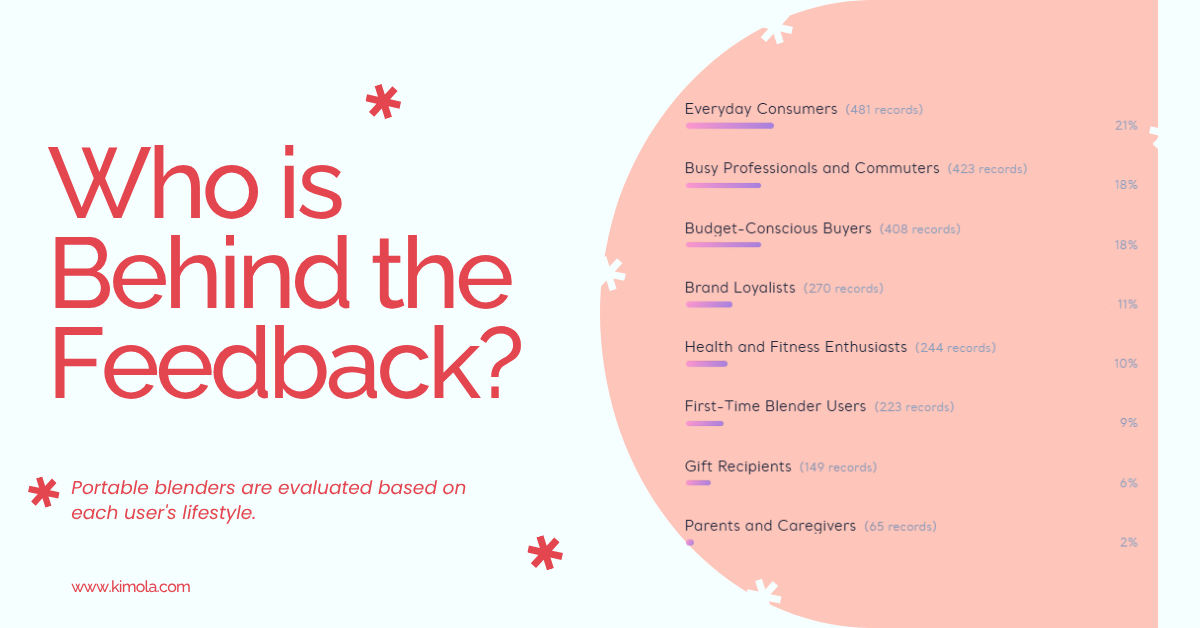
The data reveals that the portable blender market isn't a monolith; it’s a landscape divided by lifestyle needs and price expectations. Among portable blender users, the Everyday Individualist stands out as someone who prioritizes speed and portion control over industrial power. For this group, the device is not an occasional gadget but a daily kitchen staple, used for single-serving smoothies and quick meal replacements. Satisfaction comes from how easily it fits into a morning routine, especially through simple operation and minimal cleaning effort.
However, this frequent usage also exposes the category’s limits. For the Everyday Individualist, the main friction point is long-term dependability. A product does not fail when it struggles with extreme tasks like crushing ice, but when it cannot keep up with consistent, everyday use.
Another distinct group is the High-Mobility Professional, who needs a solution that works reliably outside the home. This segment requires a "commuter-proof" solution. These are users who blend at the office, the gym, or while traveling to maintain dietary goals during short breaks. Their satisfaction is driven by compact design and portability, yet they are the most vocal about battery limitations. For a professional blending on a 15-minute break, a dead battery or a charging inconsistency isn't just a minor glitch, it is a total disruption of their daily health maintenance beyond the home environment.
A space-driven segment is the Micro-Kitchen Minimalist, often represented by college students in dorms or individuals living in small apartments. They use the blender as their primary kitchen appliance for single-serving meals. Satisfaction comes from the ease of storage and a "rinse-and-go" cleaning process. Their main pain point is the "Capacity Paradox"—the blender is the right size for their counter, but the cup volume is often too small to hold a standard recipe, forcing them to blend in inconveniently small batches.
A more performance-driven segment is the Health and Fitness Enthusiast, who treats the blender as a practical tool within a disciplined routine. Unlike the casual user, they push the device to its technical limits, blending protein powders, frozen vegetables, and nutrient-rich supplements. For them, the "Performance and Power" gap is the most painful. They require a device that can integrate seamlessly into a pre- or post-workout routine without clumping or stalling. Their loyalty is earned when the product’s efficiency matches the high-intensity demands of their nutritional goals.
What Winning Portable Blenders Do Differently?
The difference between a market leader and a product that ends up at the back of a kitchen drawer lies in how a brand manages the "Performance vs. Portability" trade-off. Winning brands in the portable blender category don’t just focus on making the motor smaller; they focus on making the user experience smarter.
Instead of overpromising "industrial-strength ice crushing", which the data shows is a major source of negative sentiment, successful brands position their products as specialized tools for specific textures. They bridge the gap by educating the consumer on ingredient layering, ensuring that the "Ease of Use" mentioned in hundreds of reviews remains a reality rather than a frustrating troubleshooting session. These winners understand that they aren't replacing a 1200W countertop giant; they are dominating the "intermediate" space where convenience is king.
Furthermore, leading products recognize that for the High-Mobility Professional, a dead battery isn't just a minor inconvenience; it's a failed product promise. The winners in this space prioritize "Ready-to-Use" reliability, moving towards high-discharge lithium-ion tech and USB-C fast charging that fits a modern tech ecosystem. They don't aim to be a "miniature blender"; they position themselves as a perfectly executed "mobile nutrition companion." By aligning their marketing messaging with the actual torque of their motors and the reality of battery life, they set realistic expectations that turn first-time buyers into long-term Brand Loyalists.
What Looks Like Feedback Is Actually a Pattern
What separates observation from insight is not the volume of feedback, but the ability to see where patterns repeat — and where they break.
Across different user segments, the friction points are rarely random. They reflect how expectations, usage contexts, and product limitations intersect. What looks like individual comments starts to form structure when analyzed at scale.
This is where customer feedback becomes more than descriptive. It begins to explain not just what users say, but how they behave — where they adapt, where they compromise, and where they disengage.
This is also where tools like Kimola come into play. By aggregating feedback across platforms and structuring it into meaningful patterns, it becomes possible to move beyond isolated insights and see the underlying dynamics shaping the category.
The value is not in collecting more data, but in making sense of what is already there — and using those patterns to guide what to improve, what to communicate, and what to rethink