What Customers Expect from Matcha
Oct 11, 2026 - 7 minute read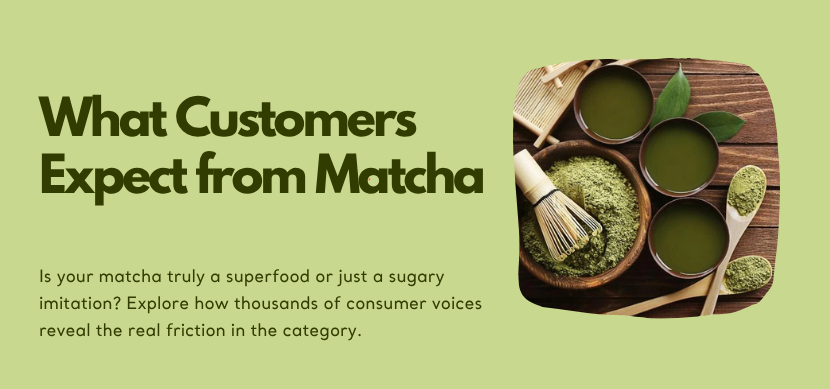
Matcha is positioned as a source of natural energy and a distinct flavor experience. Customers enter the category expecting a product that reflects traditional matcha characteristics—noticeable green tea intensity, a balanced taste profile, and a sense of ingredient quality.
In practice, many users describe something closer to a sweetened beverage mix than a tea. Instead of a clear matcha presence, the dominant experience is often sweetness, creaminess, or added flavoring, which shifts the product away from what customers initially associate with matcha.
This gap is not incidental. It reflects a consistent pattern in how the category has evolved—where convenience and pre-formulated taste profiles, particularly sweetness, take priority over matcha intensity and authenticity.
A Category Built on Trade-Offs, Not Balance
The gap between expectation and reality becomes clearer when looking at how customers consistently describe their experiences. Based on almost 1,500 customer reviews collected from global marketplaces such as Amazon, Walmart, and Targetseveral recurring patterns shape how matcha powders are evaluated.
The Sweetness Identity Crisis
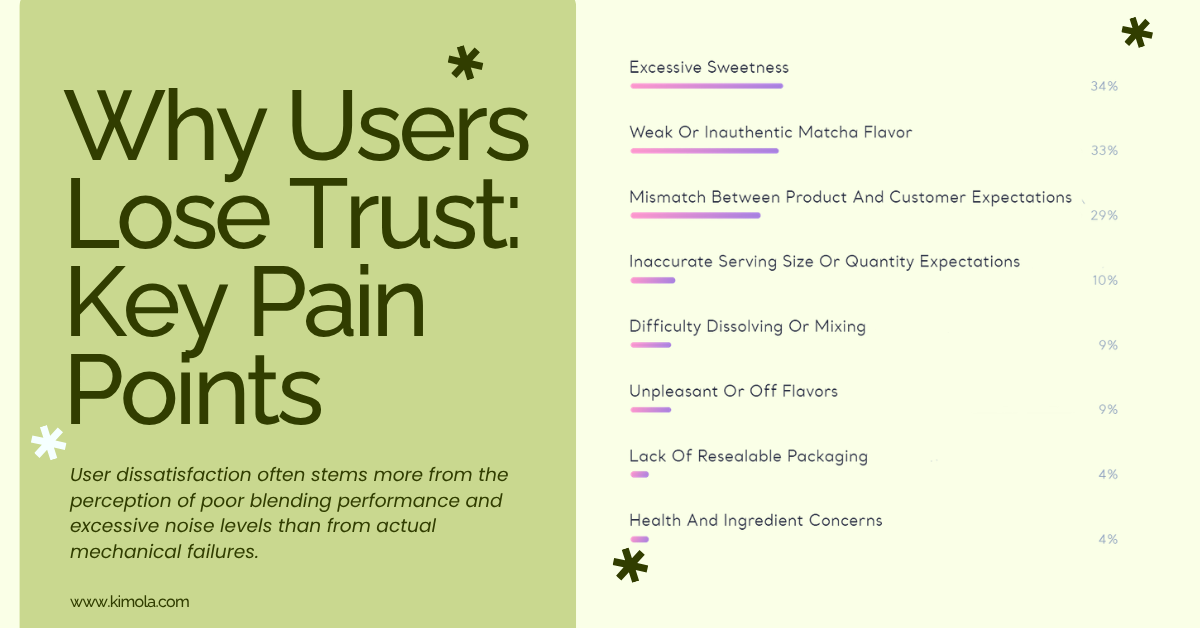
A primary tension in the category is what we call the Sweetness Identity Crisis. Our analysis shows that 34% of negative feedback centers on excessive sweetness, while 11% of the total conversation revolves around the divide between sweetened and unsweetened options. While many users value the convenience and flavor similarity to commercial beverages—often finding the pre-sweetened mixes creamy and smooth—others report that sugar is often the primary ingredient, leaving them with a "sugary milk" taste that masks the authentic matcha profile. This creates a sensory mismatch for health-conscious buyers where the expected "bitter-sweet" balance is replaced by a cloying aftertaste.
Accessible Indulgence and Routine Replacement
Beyond the challenges, a significant portion of the user journey is defined by Accessible Indulgence and Routine Replacement. Many consumers report a high level of satisfaction when the product successfully replicates the "creamy and smooth" texture of expensive café beverages at a fraction of the cost. For these users, the experience is characterized by the ability to maintain a premium ritual within their daily routine.
The Solubility Friction
Another defining aspect of the consumer journey is what we identify as Solubility Friction. While the majority of users (84%) find the preparation straightforward when using the right tools, a persistent 9% struggle with clumping and graininess, particularly in cold preparations. This suggests that for a segment of the market, product "convenience" can be an over-promise. For these users, the physical experience of preparation remains a high-friction activity that prevents matcha from becoming a seamless, one-step daily routine.
The Serving Size Illusion
Finally, the consumer experience is significantly shaped by the Serving Size Illusion. Our analysis reveals that 10% of users report dissatisfaction regarding quantity expectations. While many appreciate the cost savings of replicating café-style drinks at home, a disconnect exists between labeling and actual consumption habits. To achieve the intense flavor of a professional latte, customers often use two to five times the recommended amount. This leads to rapid product depletion and a perceived loss of value as users "correct" the weak flavor of diluted mixes by over-using the powder, which ultimately impacts long-term brand trust.
Matcha Consumer Personas: Who Wants What?
Customer feedback shows that expectations from matcha are not uniform. Instead, they cluster around distinct usage patterns, each defining the product in a different way.
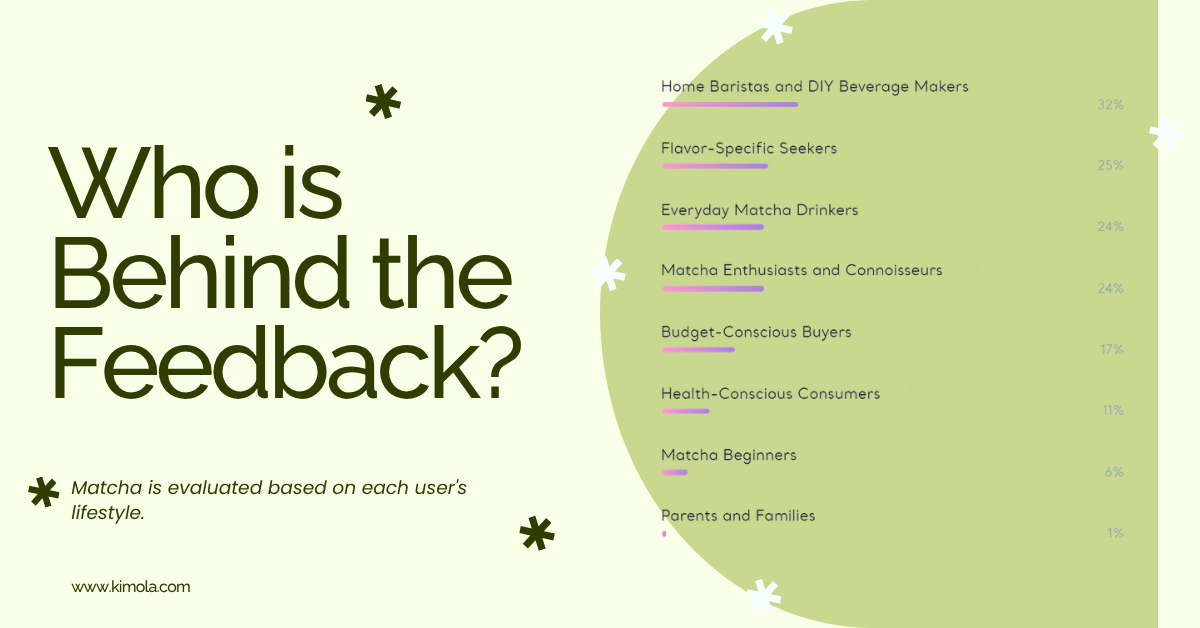
For many users, matcha is primarily a cost-effective alternative to coffee shop drinks. This group—identified as Home Baristas and DIY Beverage Makers—focuses on convenience and familiarity, expecting to recreate café-style lattes at home with minimal effort. Satisfaction depends on how easily the product delivers a similar taste and preparation experience. When the flavor feels artificial or requires adjustment to reach the expected result, the experience starts to break down.
Others approach the category with a much narrower tolerance for variation. Among these Flavor-Specific Seekers, the key expectation is balance—specifically between sweetness and authentic matcha flavor. When sugar dominates or artificial notes become noticeable, the product loses its appeal. For this group, dissatisfaction emerges not from effort, but from the inability to control and fine-tune the taste.
There is also a segment that integrates matcha into a daily routine, where consistency becomes critical. These users, referred to as Everyday Matcha Drinkers, expect stable flavor, reliable texture, and predictable results across repeated use. Issues such as clumping, variation in taste, or packaging problems are not isolated inconveniences—they disrupt a habit that depends on repeatability.
A more discerning group evaluates matcha through the lens of authenticity and quality. Within this segment, known as Matcha Enthusiasts and Connoisseurs, expectations are shaped by traditional matcha characteristics such as ingredient purity and flavor depth. When products contain added sugars, fillers, or fail to deliver a strong matcha profile, the mismatch is perceived as structural rather than preferential.
Across these segments, dissatisfaction does not stem from a single failure. It emerges because the category attempts to meet fundamentally different expectations with similar product formulations.
Closing the Gap Between Promise and Experience
To succeed in this highly competitive category, brands must look beyond generic quality claims and address the specific friction points identified in consumer data. Success is defined by how well a brand manages the gap between a customer's first purchase and their long-term ritual.
The "Sugar-First" Transparency
Winning brands turn the "Sweetness Identity Crisis" into an opportunity by leading with radical transparency. Instead of concealing sugar content behind health-focused marketing, successful players offer "Customizable Sweetness" or "Unsweetened Bases." By positioning the product as a foundation rather than a finished drink, they empower the user to control their caloric and flavor intake, fostering a sense of trust and personalization.
Engineering the No-Clump Guarantee
In a market where solubility remains a primary frustration, the leaders are those investing in fine-milling technology and "Cold-Water Solubility" formulas. If a consumer needs a blender to make a "convenient" mix, the product has failed its core promise. Top-performing brands don't just sell powder; they sell a seamless experience by removing the physical barriers to entry for beginners and cold-brew enthusiasts alike.
Closing the Value Gap through Serving Realism
Rather than inflating serving counts to appear more cost-effective, winning brands align their usage suggestions with "Flavor Reality." Consumers feel misled when they must use triple the recommended amount to achieve a café-quality taste. Brands that win long-term loyalty are those that are honest about the concentration required for a "Starbucks-style" result, leading to higher repurchase intent and more accurate expectations.
Why Structured Feedback Changes How Categories Are Understood
Customer feedback reveals patterns that are not visible at the product level. When analyzed in aggregate, individual complaints about taste, texture, or packaging form consistent signals about how an entire category behaves.
Structured analysis makes it possible to identify these recurring tensions—such as the trade-off between convenience and authenticity or the impact of sweetness on perceived quality. What appears as isolated dissatisfaction becomes, at scale, a clear and repeatable pattern.
This is where platforms like Kimola become critical. By automatically collecting and analyzing large volumes of customer feedback from structured sources, Kimola enables teams to move beyond surface-level observations and quickly uncover the underlying drivers of satisfaction and dissatisfaction.
More importantly, this approach is not limited to matcha. The same method can be applied to any product category where expectations and experiences diverge. By systematically analyzing customer feedback, teams can identify category-level patterns, redefine positioning, and address the root causes of dissatisfaction—not just the symptoms.
In categories like matcha, where expectations are shaped by both tradition and modern consumption habits, this level of clarity is essential. It allows brands to align product decisions, messaging, and user experience with what customers are actually experiencing—closing the gap between what is promised and what is delivered.