Why Do Air Purifiers Fail to Meet Expectations
Sep 29, 2026 - 7 minute read
As concerns about indoor air quality rise, our expectations for the air purifiers sitting in the corners of our homes have escalated accordingly. For consumers, purchasing an air purifier is more than just an investment in technology; it is an investment in a promise of "higher quality sleep" and "allergy-free mornings." However, the gap between these market promises and the actual user experience often leads these devices to be perceived as nothing more than an "expensive fan."
So, why does such a popular product category create such a significant mismatch between expectations and reality for a substantial portion of its users?
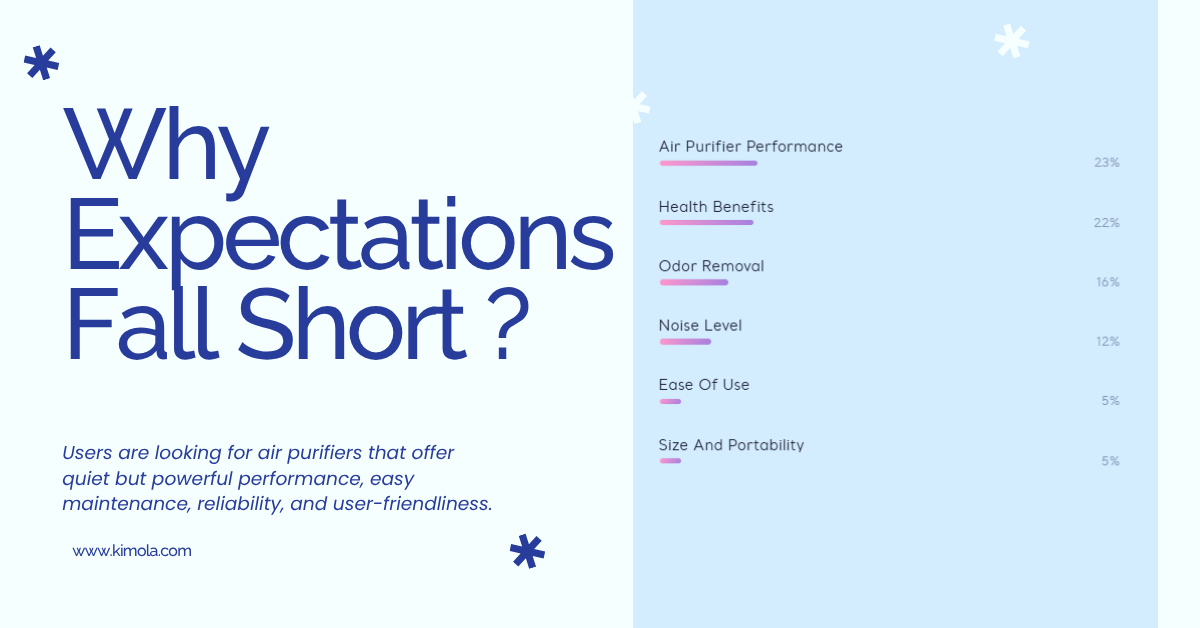
Air Purifier Contradictions in the User Experience
Air purifiers don’t fail in a straightforward way. The challenge is not always performance — it’s how that performance is perceived and evaluated.
Across more than 2,500 user experiences from platforms like Walmart and BestBuy, a consistent pattern appears. Users are not clearly reporting failure, but they are also not able to confidently verify that the device is delivering results.
This gap is driven by several recurring dynamics in the user experience.
When Quiet Feels Like Inactive
In user experience, the most praised feature can ironically transform into the primary source of doubt: Quiet operation. The whisper-level noise of these devices, particularly in sleep mode, creates a significant comfort zone for users. However, this silence brings with it a nagging question: "Is the device actually working, or is it just sitting there?" Users tend to measure an air purifier's performance by the sound it produces or the tangible airflow it creates. As devices become quieter, the search for concrete proof of purification intensifies, and when that proof remains elusive, satisfaction quickly gives way to skepticism.
Trusting the Blue Light
The strongest selling point for air purifiers is their impact on allergy and asthma symptoms. Many users report waking up with fewer sneezes or feeling more resilient against pet dander. However, this is where the colorful air quality indicators on the device come into play. Most users tend to trust that "blue light" on the machine more than the actual relief in their own lungs. If the sensor fails to detect a cooking odor or dust and doesn't change its light accordingly, all the health benefits the user felt up to that moment are suddenly called into question.
Compact Design Creates Doubt in Performance
Compact design and portability are among the elements that delight users most during the initial unboxing. Encountering a device that is smaller, lighter, and sleeker than expected creates a strong positive first impression. However, as the usage process continues, this "compactness" begins to be perceived as a technical limitation. Especially in large spaces or situations with high air pollution, the capacity of that stylish, small filter is called into question. The moment users feel that a product they admire aesthetically "falls short" or feels like a "toy" in terms of performance, the expectation curve drops rapidly.
Lingering Smells Undermine Perceived Effectiveness
The most significant inconsistency in our analysis emerges in odor removal performance. While one group of users claims that smoke and cooking smells disappear instantly, another group asserts that the device fails to trap odors. This discrepancy may stem from users confusing an air purifier with a "scent diffuser" or a "kitchen extractor fan." Even if the device successfully cleans the air, the persistence of embedded odors—such as those absorbed by furniture—creates a sense of failure in the user's mind.
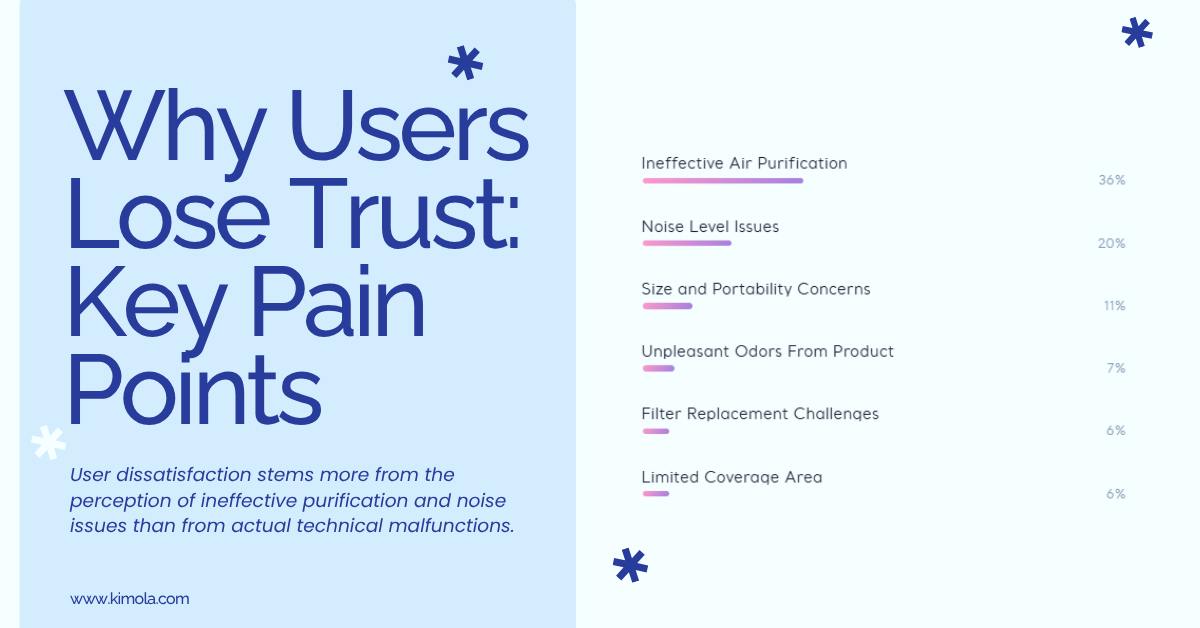
As a result, performance becomes something users try to interpret rather than directly observe. And when results cannot be clearly recognized, trust in the product weakens — even if the device is technically doing its job.
Who Are Air Purifier Users
Interest in air purifiers is not limited to a single type of user; on the contrary, these devices have integrated themselves into a vast spectrum of lifestyles. However, each persona approaches this "white box" with their own set of priorities and "deal-breakers."
Homeowners and apartment dwellers tend to prioritize space-saving and quiet operation over raw performance. In smaller living areas, bedrooms, or dorm rooms, the device is expected to blend into the environment without disruption. But this creates a trade-off: as the product becomes less noticeable, it also becomes harder to verify whether it is actively doing anything.
Allergy sufferers and users with respiratory sensitivities approach air purifiers as a necessity rather than a convenience. They expect a clear, physical improvement in symptoms such as sneezing, congestion, or coughing. But because the evaluation is tied directly to bodily outcomes, even slight inconsistencies or delays can quickly turn into disappointment.
Pet owners and odor-focused users are looking for immediate and noticeable change, especially when it comes to smells and airborne particles. For them, “clean air” is not an abstract concept — it is something that should be instantly recognizable. But when odors linger, even if air quality has technically improved, the device is perceived as ineffective.
Less tech-savvy users and older adults place as much importance on usability as they do on performance. Simple controls and intuitive interaction matter more than advanced features. But when the device becomes difficult to understand or operate, evaluating its effectiveness becomes secondary, and usability issues take over the experience.
What changes across personas is not the problem itself, but the threshold for proof — and when that proof is missing, confidence breaks regardless of the use case.
What Winning Air Purifiers Do Differently?
Transforming insights into strategy is not just about making "higher quality products". Our data shows that the real difference is created by brands that align user perception and expectations with reality. Here are the strategies to follow according to analysis results to stand out in the market:
Realistic Expectation Management Instead of Exaggerated Promises: Aligning marketing language with technical limits is crucial regarding issues like "odor elimination" and "large-area performance," which are major sources of user disappointment. Clearly stating that the device is not a "magic box" that can solve all problems and specifying under which conditions (such as a specific square meterage and airflow) it will provide the highest efficiency is the first step in preventing negative post-sales reviews.
Positioning the Product as Part of a Routine: Successful brands position the air purifier not as a standalone, world-saving miracle, but as part of a healthy home routine (such as allergy management, sleep hygiene, and pet care). This shifts the user's expectation from a "magical instant result" to "constant support" from the device.
Aligning the Message with Real Outcomes: To resolve users' "is it silent or is it working?" dilemma, it is necessary to convey the device's performance to users not just through a single light color, but through understandable and verifiable data (in-app detailed reports, concrete filter replacement indicators, etc.).
The Balance Between Usability and Design: Data shows that a compact design can create a perception of "weakness". At this point, winners establish a narrative that emphasizes the device's technical capabilities and durability (for example, focusing on filter lifespan and sensor sensitivity) while maintaining elegance.
In the end, the difference comes down to this: the most successful brands don’t just improve performance — they make it easier for users to see it, understand it, and believe in it.
What Looks Like Noise Is Actually a Pattern
As we saw in the example of air purifiers, the key to understanding the gap between a product's technical success and user perception lies in customer feedback. Understanding what customers say, why they say it, and with what emotions, enables you to decipher not only a single product but an entire category and the hidden patterns within that category.
This is exactly where Kimola steps in. Instead of manually sifting through thousands of scattered user comments, Kimola automatically collects and analyzes feedback, transforming complex data into structured strategic insights. Themes instantly reveal patterns among emotional states and users' hidden behavioral signals.
The key issue is not just reading individual reviews, but understanding what collective "big picture" these data paint. When these patterns become visible, it becomes much easier to identify the market's true needs and make strategic moves accordingly.
If you wish to discover these invisible patterns within your own category and transform your users' expectations into actionable roadmaps, you can start analyzing with Kimola right away. See with your own eyes how quickly individual insights are transformed into clear and actionable information.