Why Most Collagen Supplements Don’t Deliver
Oct 15, 2026 - 7 minute read
Collagen supplements are chosen with a clear expectation: visible, noticeable improvement. Stronger hair, smoother skin, reduced joint discomfort — outcomes that should become recognizable over time.
In practice, the experience is far less definitive. Some users report improvements, but these changes are often gradual, subtle, and difficult to clearly evaluate.
The issue is not whether the product works — but whether the results are clear and consistent enough to be recognized. The same product can lead to visible benefits for some, while others experience little to no change.
As a result, users are left without a clear signal. Not a confirmed success, not a clear failure — but an experience shaped by inconsistency.
The gap between expectation and experience is not random — it follows a repeatable pattern.
Results Exist But They Don’t Show Up the Same Way
What people are noticing first isn’t a result — it’s the absence of a clear one.
The changes users describe are often subtle and difficult to validate. Slightly smoother skin, stronger nails, reduced breakage. These shifts are noticeable, but they are not decisive. They don’t create a clear moment of confirmation, making it difficult to confidently attribute improvement to the product.
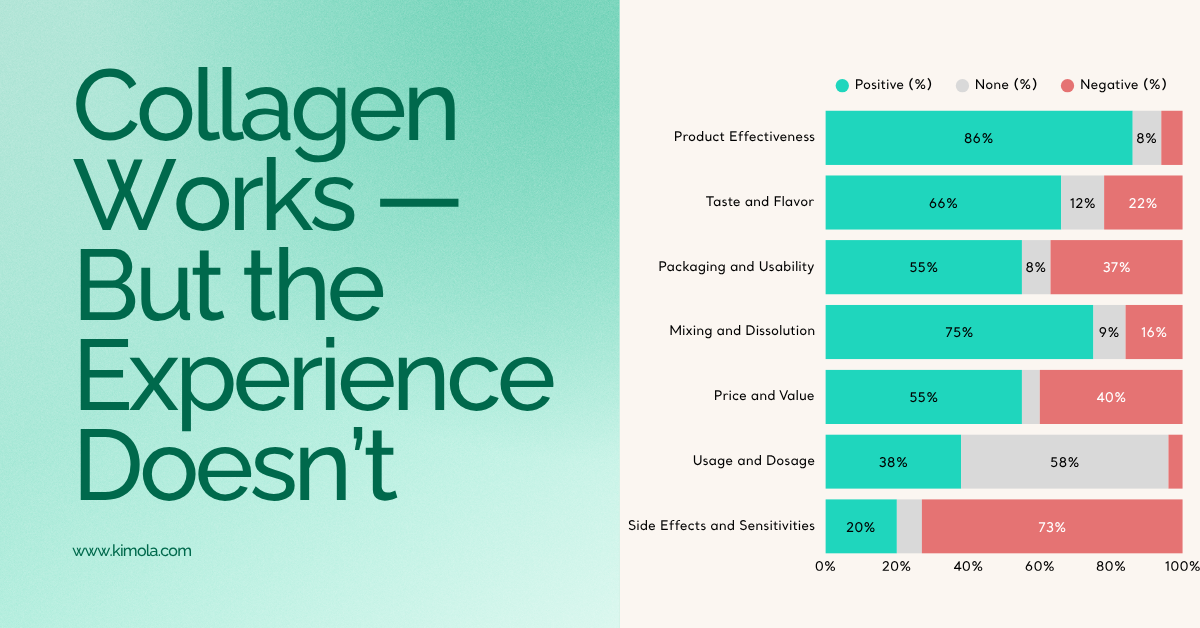
This is not an isolated experience. Across 3,704 customer feedback entries collected from Amazon, Target, Walmart, and iHerb, the same pattern repeats.
Users are not consistently reporting failure. But they are also not able to confirm success.
What emerges instead is a lack of clarity — an experience where results may exist, but do not translate into confidence.
Effectiveness Varies and That Breaks Trust
One of the most defining dynamics is variability in perceived effectiveness. While some users report improvements in skin hydration, nail strength, hair health, and joint comfort after sustained use, others report limited or no observable benefits.
This does not create a clear negative perception — it creates fragmentation. Results exist, but they are not experienced consistently across users.
Results Take Time But Uncertainty Starts Early
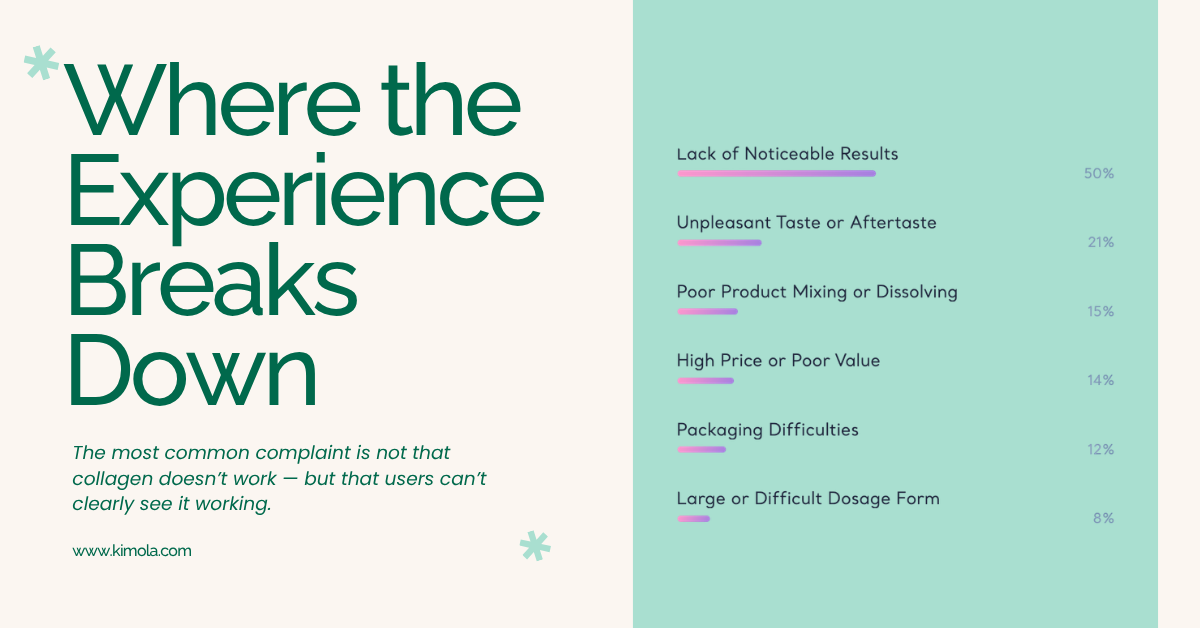
Time plays a critical role in this perception gap. Benefits are often associated with sustained use over several months, while early-stage experiences are frequently marked by uncertainty.
Without an early or clearly attributable signal, users struggle to determine whether the product is working — or whether they should continue.
Sensory Friction Disrupts Continuation
Sensory experience directly impacts continuation. Taste, aftertaste, odor, and mixability issues — particularly clumping in cold liquids — reduce adherence.
Even when functional benefits exist, unpleasant consumption experiences create enough friction to interrupt routine formation.
Usability Issues Undermine the Experience
Packaging and usability introduce an additional layer of friction. Difficult-to-open containers, misleading fill levels, lack of dosing tools, and large capsule sizes disrupt routine integration.
These issues are not related to efficacy directly, but they shape overall satisfaction, trust, and repurchase behavior.
Physical Reactions Create Early Drop-Off
Safety and physical reactions further complicate the experience. Digestive discomfort such as bloating or heartburn, as well as allergic reactions or ingredient sensitivities, lead to early discontinuation.
In some cases, concerns around product quality and contamination reduce trust entirely.
Collagen Is Rarely Used Alone
Collagen is rarely used in isolation. It is frequently combined with beverages such as coffee, tea, or smoothies, and used alongside supplements like vitamin C, biotin, zinc, and probiotics.
This creates a layered consumption context where outcomes become harder to attribute directly to collagen itself.
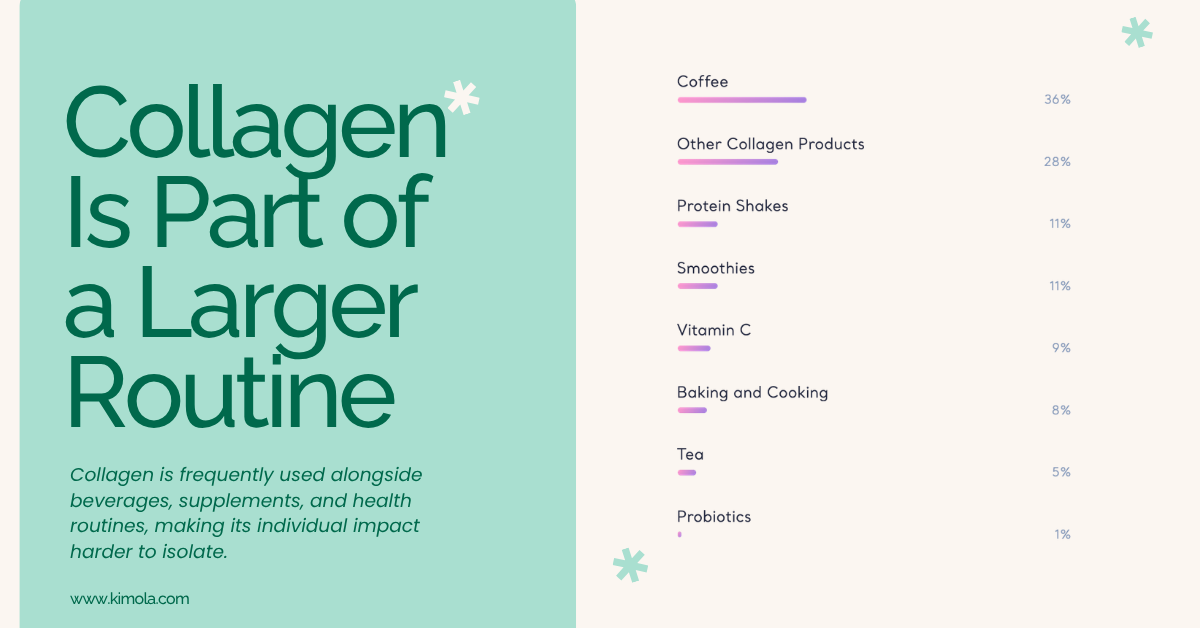
As a result, the category does not consistently fail — but it fails to provide clear, interpretable signals of success.
Who Are Collagen Consumers and Why Their Experiences Differ
Not all collagen users are evaluating the same thing — and that’s where the experience starts to split.
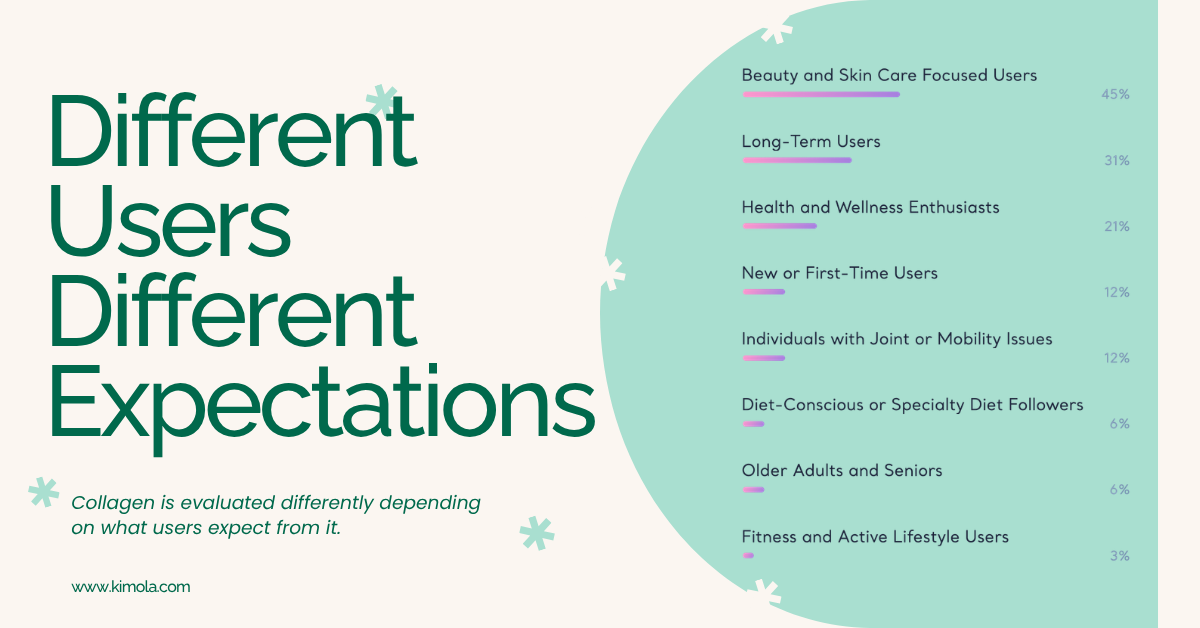
For some, collagen is expected to deliver visible change. Often aligned with Beauty and Skin Care Focused Users, this group looks for improvements that can be clearly seen — smoother skin, stronger hair, fewer signs of aging. When those signals don’t appear quickly, confidence drops. Subtle or delayed changes don’t register as success.
Others are not looking for a visible shift — at least not immediately. Among Long-Term Users, collagen is part of a routine rather than a result-driven decision. These users are more tolerant of gradual outcomes, but their continued use depends on how easily the product fits into daily life.
For Health-Conscious and Active Users, collagen is rarely evaluated on its own. It sits alongside exercise, nutrition, and other supplements. In this context, the question is not “does collagen work?” but “how does it contribute?” — making its impact harder to isolate, even when it is perceived as beneficial.
Then there are New Users, whose experience is shaped almost entirely by the first interaction. Taste, mixability, odor, and immediate physical reactions become the decision point. If the product creates friction early, users rarely stay long enough to evaluate long-term effects.
What emerges is not just different users — but different definitions of “working.”
Collagen Doesn’t Need Better Results, It Needs Clearer Ones
Collagen supplements are not being evaluated only on what they deliver — but on how clearly those outcomes can be recognized.
That changes what success looks like.
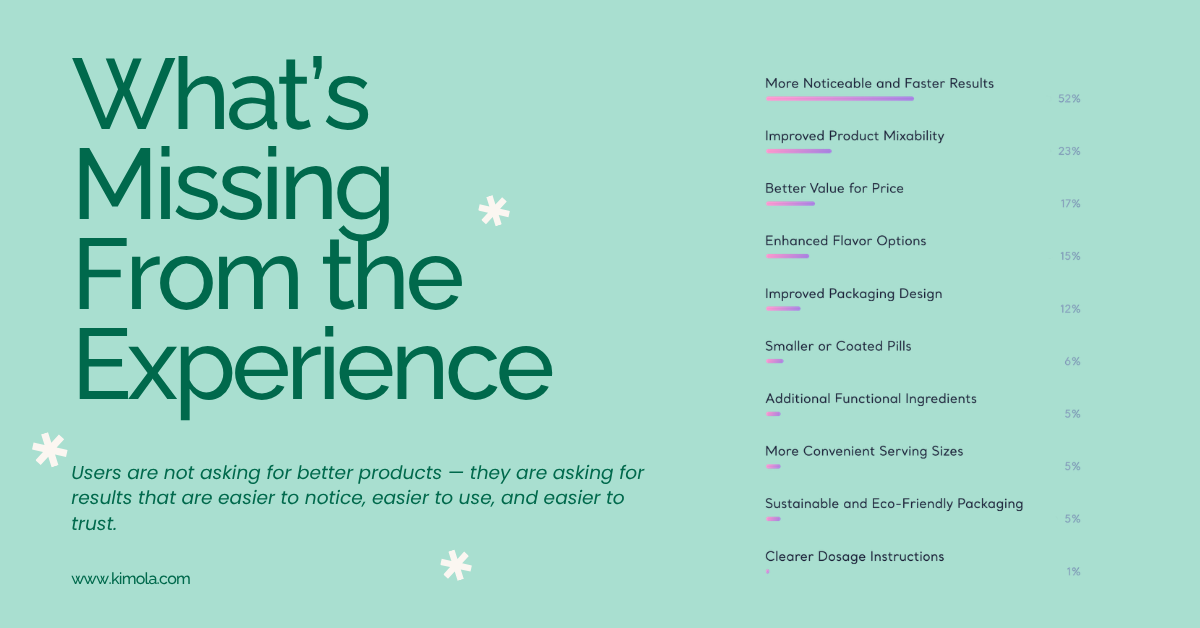
It is not enough for results to exist. They need to be visible early enough, consistent enough, and isolated enough for users to trust them. Without that clarity, even real benefits fail to translate into continued use.
This is where expectation becomes a strategic lever. When outcomes typically require sustained use, positioning cannot rely on immediate transformation. The role of communication shifts from promising results to guiding users on what to expect — and when.
At the same time, continuation depends on how easily the product fits into daily routines. Sensory friction, poor mixability, and inconvenient formats interrupt usage before results can emerge. Reducing this friction is not an optimization — it is a prerequisite for effectiveness.
Clarity in usage becomes equally critical. Without clear guidance on dosage and consumption, negative experiences such as digestive discomfort are often misinterpreted as product failure. This disconnect directly accelerates drop-off.
Trust, in this category, is not built only through outcomes. It is built through consistency — in formulation, in quality, and in how the product presents itself. Small inconsistencies in packaging, quantity, or ingredient transparency can override perceived benefits.
As a result, winning in this category is not about making collagen work better. It is about making its effects easier to recognize, easier to trust, and easier to sustain.
The Pattern Is Not Random, It Becomes Visible at Scale
What looks like scattered feedback at first is not actually random.
A single review might mention taste, another questions effectiveness, and another describes a subtle improvement. On their own, these signals feel disconnected — easy to overlook and easy to dismiss.
But when they are viewed together, they begin to form structure. Patterns start to emerge not just in what users say, but in how they experience the product, how they interpret results, and how they decide to continue or stop.
This is where category understanding changes. It is no longer about reading individual reviews, but about identifying what repeats — where expectations break, where uncertainty builds, and what consistently shapes user behavior.
Reaching that level of clarity requires more than manual analysis. It depends on structured, scalable interpretation of customer feedback.
This is where Kimola comes in. Kimola automatically collects and analyzes customer feedback, turning scattered reviews into structured insights and making patterns immediately visible across themes, sentiment, and behavioral signals.
What matters is not just seeing feedback, but understanding what it collectively reveals. Once those patterns become visible, the category itself becomes easier to understand — and easier to act on.
If you want to explore these patterns yourself, you can start by analyzing your own category with Kimola and see how quickly individual opinions turn into clear, actionable insight.