Why Can't Automatic Pet Feeders Give Confidence?
Oct 25, 2026 - 8 minute read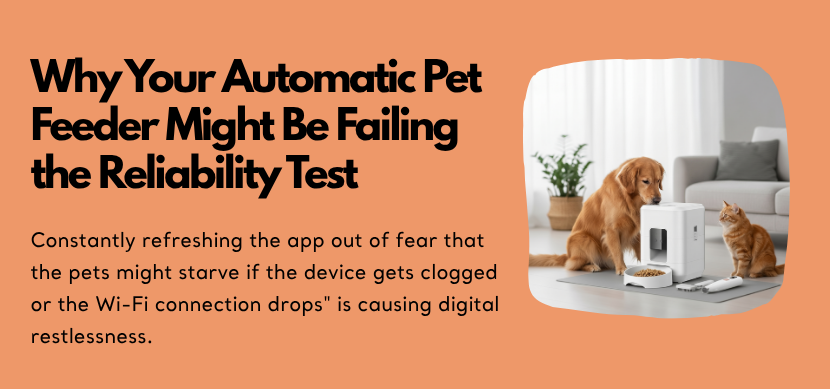
Automatic feeder bowls promise pet owners the freedom of perfectly timed feeding, with control in their hands even when they're away from home. When users buy these devices, not only should a container of food be distributed; it relieves their conscience, their travels or busy working days, "I wonder if he is hungry?" they expect loyalty insurance that frees them from anxiety.
However, in reality, many users describe how this "smart" solution has been replaced by a profound gap in data and evidence when they are not at the device. The uncertainty regarding whether the device distributes food mechanically, along with faulty Wi-Fi notifications and incomprehensible motor error codes like "F02," transforms what should be a liberating feature into a new monitoring obligation that traps the user in front of their phone screen.
This gap between expectations and actual experience is a trust management issue rather than a technological deficiency. Although the device may appear to perform its function on paper, hardware that comes without an adapter, unstable application connections, and malfunctioning mechanisms systematically erode the confidence even of the most tech-savvy users when they need it most.
What Do Users Actually Experience?
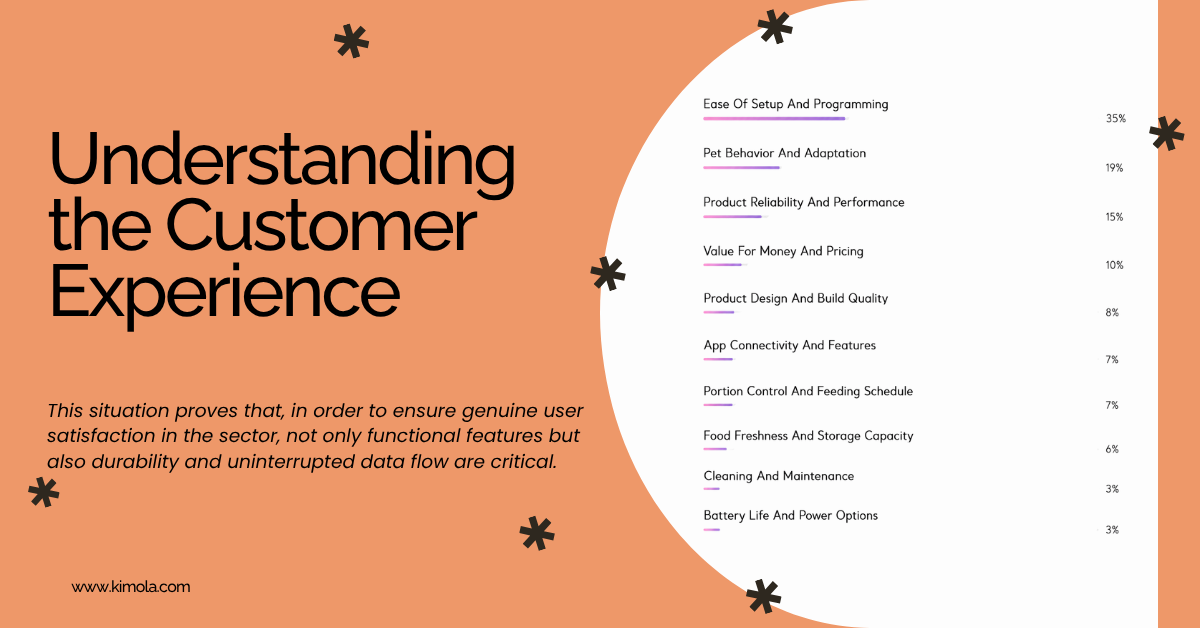
The automatic feeder experience transforms into a hybrid realm of disappointment, where technological promises on paper collide with the realities of the physical world. Although users typically become involved in the process influenced by the initial speed of setup and the portion control feature offered by the mobile application, this initial excitement gives way to deep-seated anxiety about responsibility when the device malfunctions and strays from its routine. In particular, the instability of Wi-Fi connections and the devices' strict reliance on 2.4 GHz networks render the freedom of "remote power supply" an ever-present risk factor that is primed to be disrupted at any moment.
The most frustrating part of this process is the lack of evidence combined with the device's silent operation principle. The user cannot instantly verify whether the motor is actually rotating when they are not at the device, whether the food portion is dropping into the container as a full portion, or whether ununderstandable error codes like "F02" are preventing the current meal from being prepared. Malfunctions in the notification system, instead of liberating the user, condemn them to a new monitoring obligation that constantly forces them to check their camera.
On the hardware side, the expectation of a high-priced technology investment is undermined by poor-quality materials and hidden costs. Due to the absence of an adapter in the box, users are forced to purchase expensive "D"-size batteries, and the inability to remove the non-detachable seals compromises hygiene, significantly reducing the product's lifespan below expectations. Moreover, these designs underestimate the problem-solving abilities of pets; A highly motivated cat manipulating the feeding mechanism by putting a paw into the food dispenser or tipping over the device to access the entire container turns the "safe feeding" promise into a security vulnerability. All these structural issues systematically erode the confidence of even the most technology-friendly users when they need it most.
Who Are the Users?
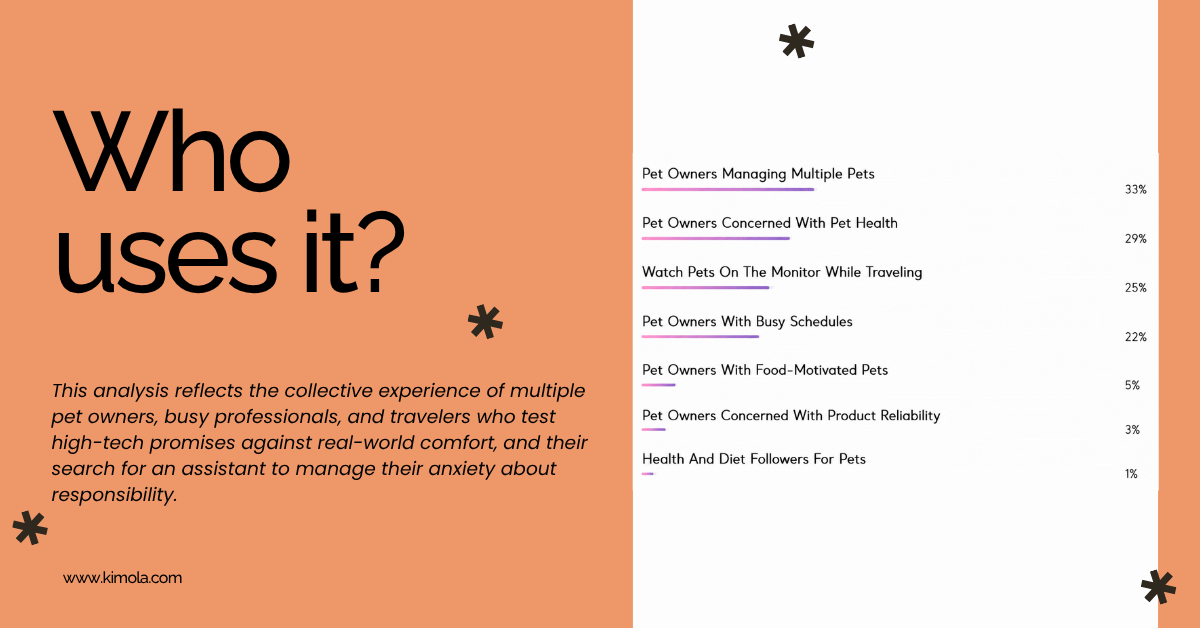
Multi-Pet Households
This group consists of users who require individualized feeding regimens to prevent food competition and theft within the household. They use the device to deter portion theft through features like RFID collars or divider bowls, ensuring each animal adheres to its own diet. Their satisfaction depends on the device's success in ensuring "food safety" and reducing aggressive competition among animals; The biggest source of discomfort is when the device fails to distribute portions evenly among the bowls or when dominant animals manipulate the mechanism to get extra food.
Professionals With a Busy Work Schedule
This segment, which cannot be at home due to irregular working hours or long working shifts, uses the device as a "timing guarantee". Their primary expectation is that the feeding routine will continue with millimetric precision and remote control even when they are physically unable to be present. Although they experience high satisfaction as long as they automate the manual feeding process, a loss of Wi-Fi connection or delayed meal notifications rapidly erode this work-focused group's trust in technology, causing them to view the device as a "burden."
Frequent Travelers
For these frequently traveling users, the device is not just a feeding bowl; it is also a communication center through which they monitor their pet's well-being via integrated cameras. They aim to create a safety net during their physical absence thanks to the device's large storage capacity and backup power options. When the device displays incomprehensible error codes like "F02," when the feeding tube becomes clogged, or when there is uncertainty about the battery status, this remote group experiences significant helplessness and anxiety, negatively impacting the overall experience.
Health-Conscious Caretakers
This segment uses the product specifically for the purpose of controlling the portions of pets with obesity or chronic conditions on a gram-by-gram basis. They expect to provide a medical discipline through the precise portion settings and slow-feed modes offered by the device. When they achieve successful results in terms of precise portioning and dietary compliance, their satisfaction reaches its peak; however, if the mechanism dispenses inconsistent amounts of food or if technical shortcomings in small portion adjustments render the device an illegitimate tool for these health-focused users, it loses its legitimacy.
Strategic Implications: Shifting from Trust to Evidence
Promise Management: Not Automation, but a Support System
The marketing strategy should abandon positioning the device as an autonomous robot that "completely eliminates the owner's presence." Instead, the product should be presented as an "assistant" that stabilizes the nutrition routine and provides data. Instead of promising the user that the device will do everything on its own, it should be emphasized that it is a tool that facilitates manual tracking. This approach sets expectations on a realistic basis by reducing the sense of "betrayal" the user may feel in the event of a mechanical glitch.
Solving the Problem of Invisible Malfunctions with Transparent Data
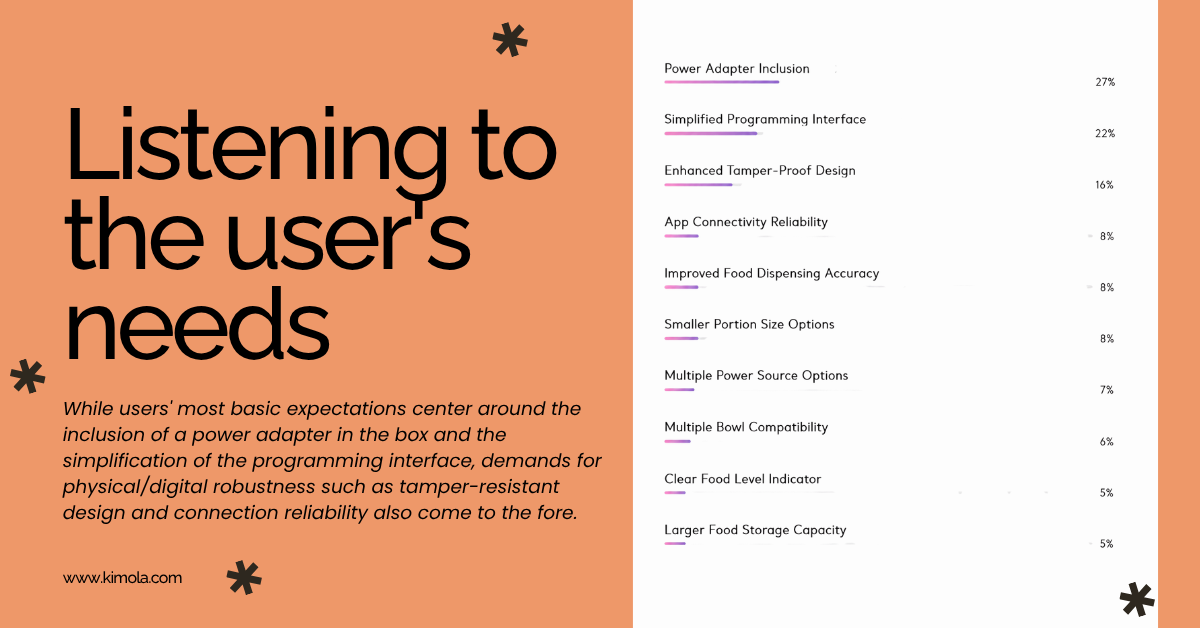
Analyses show that the greatest dissatisfaction stems from a "knowledge gap." The strategy should focus not only on sending out "feedback distributed" notifications, but also on feedback loops that prove the success of the distribution. Instead of technical error codes like "F02" in the application interface, messages that can be acted upon directly, such as "Food path blocked, please check the chamber," should be used. This increases the user's sense of control over the device, preventing it from becoming a "black box."
Transition from "Deficiency" to "Security" in Hardware Perception
The absence of the adapter in the box contents or the cost of batteries should not be framed as a "marketing mistake" but as a "safety layer". The communication language should position the batteries not as the primary power source but as a "lifeline" (backup power) against power outages. The user should be made to feel that they are being offered not just a device, but an uninterrupted energy plan. Additionally, to overcome cleaning challenges, the emphasis should be on "modular design," conveying the message that hygiene is not a mere preference but an integral part of the product's structure.
Being a Behavioral Solution Partner
The product should not be positioned solely as a food dispensing box, but rather as a solution partner that regulates the pet's feeding behaviors (such as rapid eating, waking up early in the morning, and food stealing). Features like RFID or divider containers, especially designed for multi-pet owners, should not be marketed as "add-ons" but as "peace-keeping tools" that end the chaos in the home. This transforms the product from a physical item into a functional component that manages the social dynamics within the household.
Understanding the Experience Beyond the Data
Analyzing a product category not only through its technical specifications but also through the real-life "crash tests" of thousands of users is the only way to truly gauge the market pulse. As we saw in the example of automatic feeder bowls, more than 1,700 reviews show us not only mechanical faults; they also demonstrate how fragile trust is and how users experience anxiety in the "evidence gap." Customer feedback forms the most solid foundation for strategic decisions by filling in the invisible gap between the freedom promised by the product and the burden of control it imposes.
At this point, Kimola automatically transforms thousands of complex customer reviews into in-depth insights and user personas like the ones we presented in this article, by analyzing them within seconds. To transform data into actionable strategies for your brand, not just numbers, you can try Kimola right away and discover the hidden story of your category today.