User Evaluation Alternatives & Competitors: 6 Tools Compared
Oct 27, 2026 - 18 minute read
If you are looking for a User Evaluation alternative, start with the kind of research you need. Outset suits enterprise teams that want AI-moderated video, voice and text interviews at scale. Listen Labs is built for multilingual AI interviews with a large global participant network, and Strella focuses on running quick rounds of AI interviews, including concept and usability studies. If you want AI interviews and usability tests on one platform, Maze covers both. Dovetail fits teams that mainly need to organize and analyze recordings and transcripts they already have. If your question is less about running new interviews and more about understanding what customers already say in surveys, reviews and support tickets, Kimola is built for that and works alongside any of these tools.
User Evaluation is a customer research platform whose main product today is AI-moderated voice interviews. Teams look for an alternative because the product has changed since it was known as a transcript analysis tool, because they need a different interview format, panel or language coverage, or because their real question can be answered from feedback they already have.
This guide is written by the Kimola team. Kimola is our product, so we explain where it fits and where it doesn't, and we describe every other tool based on its public documentation.
What Is User Evaluation?
User Evaluation was first known as an AI tool for transcribing and analyzing research recordings, and its main product is now AI-moderated interviews. An AI moderator runs voice interviews with screened participants from a paid panel or with a team's own users, asks a follow-up question after each answer, and lets researchers listen live and change the next question. In the study report, every claim links to the recording it comes from.
The platform has three products that share one evidence base. Interviews runs the AI-moderated conversations. Swarm uses AI agents that create accounts on a live product and use it over several weeks, with a replay of each session. Analysis lets teams upload calls, PDFs and CSV files and work with them alongside interview transcripts. Interviews and transcripts are available in 40 languages, reports can be exported to PowerPoint, Word, PDF, Markdown and CSV, and the platform offers an API, webhooks and an MCP server.
User Evaluation publishes its pricing. The Free plan includes three free interviews with your own participants, the Pro plan is $49 per month and the Team plan is $199 per month for five seats, with custom pricing on the Scale plan. Each interview is charged separately on every plan: $10 with your own participants, $39 with everyday participants from the panel and $99 with professionals.
Why Teams Look for User Evaluation Alternatives
The most common reason is that the product has changed. Teams that used User Evaluation to transcribe and analyze their own research recordings may now be looking for a tool that is centered on that job rather than on running new interviews.
Teams that want AI-moderated interviews compare options on interview format, participant reach and scale. Some need video or text interviews as well as voice, some need a larger panel or harder-to-reach audiences in specific countries, and some need enterprise security reviews and support for research programs across many teams. The pricing model matters too: per-interview pricing is easy to predict for a single study, while organizations running research continuously may prefer an annual contract.
Some teams need more than interviews, such as prototype tests, card sorting or surveys on the same platform. And sometimes the question behind a new study, such as which problems matter most to customers, can already be answered from survey responses, support tickets and reviews the team has collected.
How We Compared These Tools
We looked at the research methods each tool supports, how it finds participants, the languages it covers, how its analysis connects findings to evidence, and how easy it is to evaluate, including whether pricing is published and whether there is a free plan. All information comes from each company's own website and documentation.
1. Outset
Outset describes itself as a hub for customer understanding, powered by AI-moderated interviews and simulated human data. Compared with User Evaluation, it supports video and text interviews as well as voice, and it is positioned for research teams in larger organizations.
Strengths
Outset runs hundreds of AI-moderated interviews at the same time, and its AI moderator asks follow-up questions to go deeper on each answer. Interviews can be conducted in any language. Teams can recruit participants from more than 85 countries through Outset or share an interview link with their own customers. Results come as summaries, themes, quotes and highlight reels, along with top-line reports and PowerPoint decks. Outset also lists usability testing as a use case and offers an MCP connection for launching studies and analyzing results from other tools.
Limitations
Outset is sold through a sales conversation, and there is no published self-service plan or free tier, so a small team that wants to try a single study may find the buying process heavier than the job requires. Like the other interview tools in this list, it collects new conversations; it is not designed to analyze large volumes of existing feedback such as reviews or support tickets.
Pricing
Pricing is not published and is available on request. Outset's pricing page describes custom plans with add-ons and offers a demo.
Best For
Outset fits research and insights teams in larger organizations that want AI-moderated interviews in several formats, with recruitment across many countries and presentation-ready outputs.
2. Listen Labs
Listen Labs describes its product as customer research conducted, analyzed and summarized by AI. Compared with User Evaluation, it puts more weight on language coverage and access to a very large participant network.
Strengths
The AI moderator runs interviews with follow-up questions around the clock in more than 120 languages. Teams can recruit from a global network of more than 50 million participants, including hard-to-reach audiences, or interview their own contacts. Each finding traces back to a real interview, and learnings stay searchable and reusable across studies. Deliverables range from highlight reels to presentation-ready slides.
Limitations
Listen Labs is evaluated through a demo, without a published self-service plan, so teams that want to compare tools hands-on before talking to sales have fewer options to do that. Its focus is new interview studies rather than the analysis of feedback a team has already collected.
Pricing
Pricing is not published and is available on request through a demo.
Best For
Listen Labs fits teams that run interview studies across many markets and languages and need access to a large participant pool, including audiences that are hard to recruit.
3. Strella
Strella describes itself as an AI-powered customer research platform, with the promise of running 100 customer interviews by the next morning. Compared with User Evaluation, it emphasizes speed and synthesis across customer segments.
Strengths
Strella's AI moderator adjusts its questions in real time based on each participant's answers. Research can be run in more than 46 languages, with participants from a panel of up to 8 million people filtered by your criteria, or with your own customers. Strella synthesizes insights across individual participants and segments, and teams can ask questions about their research and generate highlight reels from it. Concept testing and usability testing are listed as dedicated use cases.
Limitations
Strella does not publish pricing, and its main route to evaluation is a demo, which makes a quick self-service comparison harder. Like the other interview tools here, it is built to collect new conversations rather than to analyze thousands of existing records.
Pricing
Pricing is not published on Strella's website and is available on request.
Best For
Strella fits product and marketing teams that want fast rounds of AI-moderated interviews, for example to test concepts or messaging, and want results compared across customer segments.
4. Maze
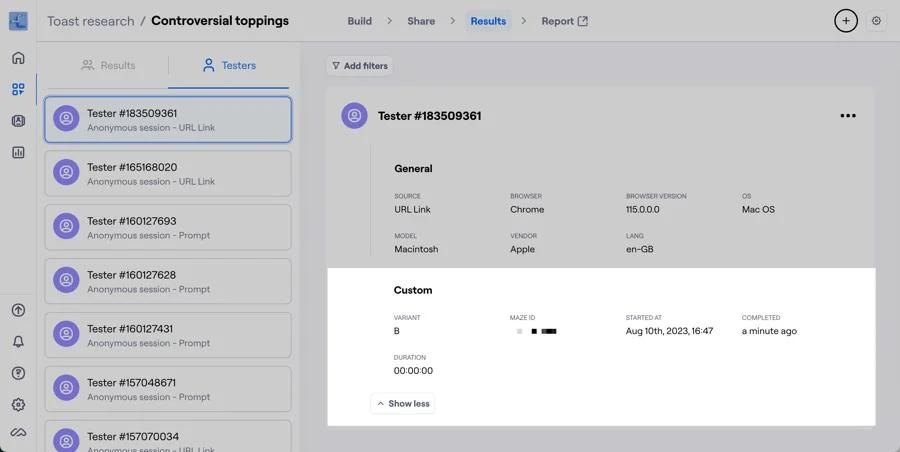
Maze is a user research platform that combines participant recruitment, usability testing and analysis. Compared with User Evaluation, it puts interviews next to task-based tests such as prototype testing, card sorting and tree testing on one platform.
Strengths
Maze supports a wide range of methods: prototype testing with Figma, live website and mobile testing, surveys, card sorting, tree testing, moderated interviews and AI-moderated interviews through its AI Moderator. Teams can recruit from Maze's large participant panel or bring their own users. Automated reports and video clips help turn results into findings that can be shared with stakeholders. For teams that want one tool for both testing and interviewing, this breadth is the main reason to choose Maze.
Limitations
In Maze, the AI Moderator, moderated interviews and live website and mobile testing are part of the Enterprise plan. Between the Free plan and Enterprise there is no self-service paid plan, so a team that needs AI interviews will usually go through a sales conversation and an enterprise contract.
Pricing
Maze offers a Free plan with one study per month and five users, and an Enterprise plan with custom pricing. Details are on Maze's pricing page.
Best For
Maze fits product and design teams that want usability tests and interviews on the same platform and expect research to grow across the organization.
5. Dovetail
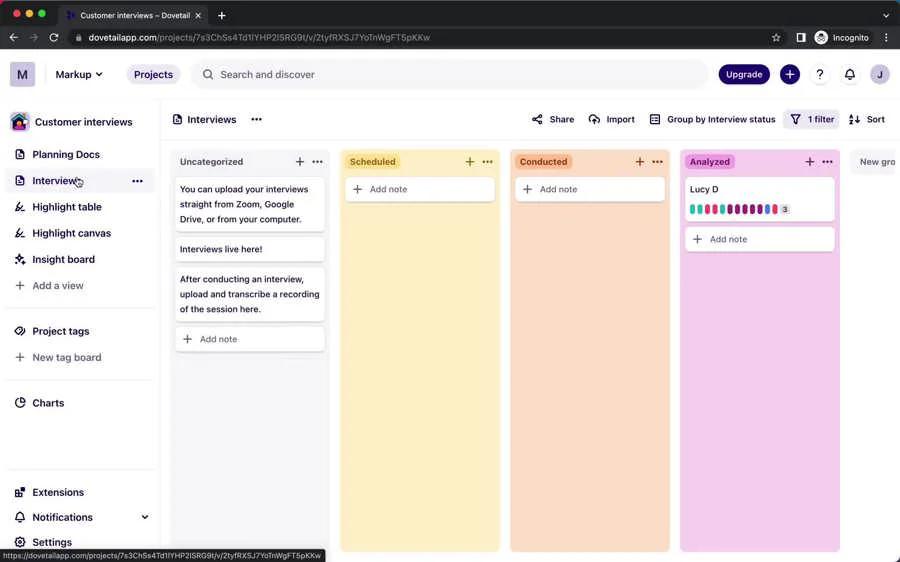
Dovetail is built to organize qualitative research such as interviews and usability tests. Compared with today's User Evaluation, it does not run interviews itself; it focuses on transcribing, analyzing and sharing recordings and feedback a team already has, which makes it close to the job User Evaluation was first known for.
Strengths
Dovetail automatically transcribes calls, interviews and videos, with speaker separation, translation and every line linked to its moment in the recording. It classifies feedback into themes, sentiment and summaries, and Channels sort ongoing feedback into ideas and flag emerging issues. Agents turn findings into actions such as drafting requirements and routing work to Jira or Linear. Dovetail connects to more than 30 sources, including Gong and Salesforce, and offers an API and MCP connectors. For teams that need a shared home for research, this is a mature and widely used option.
Limitations
Dovetail does not recruit participants or moderate interviews, so teams that want AI-moderated interviews will need a separate tool alongside it. Most of its capabilities, including unlimited channels, projects and AI Agents, are part of the Enterprise plan; the Free plan is limited to one channel, one project and one dashboard.
Pricing
Dovetail has a Free plan with no card required and an Enterprise plan with custom pricing, quoted through sales.
Best For
Dovetail fits research and product teams that run their own interviews and calls and need a central place to transcribe, analyze and share what they learn.
6. Kimola
Kimola is an AI platform that turns customer feedback into enterprise-grade market research. It does not run interviews or recruit participants. Instead, it analyzes the feedback a team already has, such as survey responses, support tickets, app reviews and call transcripts, and public reviews it collects from a link. For a User Evaluation user, Kimola is a complement rather than a replacement: it shows which problems matter most across thousands of customers, so the team knows which questions to explore in interviews.
Strengths
Feedback you already have, analyzed at scale. An interview study usually talks to dozens or a few hundred people. The same team often has thousands of open-ended survey answers, support tickets and reviews that are never read in full. Kimola finds themes in the data itself, without predefined categories, and gives every theme mentioned in a comment its own sentiment. Columns in your file, such as plan, country or product version, become part of the analysis, and Kimola analyzes feedback in more than 30 languages within the same analysis. Call center and chat transcripts can be uploaded as text files for conversation analysis.
Competitor reviews from a link. Kimola can collect public reviews when you paste a link to a product or app page on Amazon, Trustpilot, Google Play, the App Store and other platforms, and a browser extension covers more than 30 sources. A team can learn what frustrates users of a competing product without recruiting anyone.
Research questions and tested findings. In Kimola, classifying topics is only the first step. It asks every comment research questions called Dimensions, such as Motivations, Pain Points and Unmet Needs, so a theme like "pricing" is broken down into why customers care and what they expect instead. Kimola then tests combinations of themes, Dimensions, segments and time periods, and only statistically significant differences and trends become Signals. If complaints about onboarding are concentrated among customers on one plan, Kimola surfaces that as a Signal only if the difference is significant. Scores are deterministic, so the same data always produces the same ranking. Action Plans form hypotheses from the analysis, test each one against the feedback and keep only the actions the evidence supports, with every figure and quote checked.
Limitations
Kimola does not conduct interviews, recruit participants, run usability tests or send surveys, and it does not process audio or video recordings directly; call transcripts are uploaded as text. Teams that need new conversations with customers will still need one of the interview tools in this list. Spaces, which keep a growing feedback channel consistently classified over time, and related features such as Funnels, Customers and Tasks are available only on the Enterprise plan. The free Starter plan is limited to 150 queries per month.
Pricing
Every account starts on a free Starter plan with no credit card, paid plans start at $49 per month, and pricing is public on the pricing page. Usage is measured in queries. Smaller teams use Kimola self-service, while larger organizations work with an account manager to set up Spaces and custom models on the same platform.
Best For
Kimola fits research, product and insights teams that want to understand large volumes of customer feedback, from their own surveys, support tickets and reviews or from competitors' public reviews, and use those findings to decide what to explore and build next. For a detailed comparison with a research repository, see Kimola vs Dovetail.
How to Choose the Right User Evaluation Alternative
If you want AI-moderated interviews in video, voice and text for an enterprise research program, Outset is built for that scale. If your studies span many countries and languages and you need a very large participant network, consider Listen Labs. If speed matters most and you want quick interview rounds for concepts or messaging, Strella is a strong fit. If you want interviews and usability tests on one platform, Maze covers both. If you run your own interviews and calls and mainly need to transcribe, analyze and share them, Dovetail is the closer match.
If your question is which problems matter most to customers, or why users of a competing product are unhappy, a new interview study may not be the first step. Kimola analyzes the feedback you already have and public reviews you collect from a link, and many teams use it before or alongside an interview tool: the feedback shows which topics matter and for whom, and the interviews explore them in depth.
Frequently Asked Questions
What happened to User Evaluation's analysis tool?
User Evaluation now centers on AI-moderated interviews. Its Analysis product still lets teams upload calls, PDFs and CSV files into the same evidence base as their interviews. Teams that mainly need to analyze their own recordings often also look at research repositories such as Dovetail.
Is there a free alternative to User Evaluation?
Maze and Dovetail have free plans, with Maze's limited to one study per month and Dovetail's to one project. User Evaluation itself includes three free interviews with your own participants. Kimola's Starter plan is free with no credit card and covers feedback analysis rather than interviews.
Which tools offer AI-moderated interviews?
Outset, Listen Labs and Strella are built around AI-moderated interviews, as is User Evaluation. Maze offers an AI Moderator as part of its Enterprise plan. Dovetail and Kimola do not run interviews; they analyze research and feedback that has already been collected.
Can I understand customers without running new interviews?
Often, yes. Survey responses, support tickets and app or product reviews already describe what customers like, what frustrates them and what they expect, and analyzing them at scale shows which topics are most common and which segments they affect. Kimola does this analysis, including for competitors' public reviews. Interviews remain the right tool when you need to ask new questions or understand a single decision in depth.
Why not just use ChatGPT to analyze interview transcripts or feedback?
General AI assistants are useful for summarizing a small set of transcripts or comments. Classifying thousands of records consistently, testing whether differences between segments are statistically significant, getting the same result from the same data every time and tracing every number back to its source require a different kind of infrastructure. That is the work Kimola is designed for.
Conclusion
User Evaluation alternatives fall into two groups. Outset, Listen Labs, Strella and Maze collect new evidence through AI-moderated interviews and tests, and the right one depends on your formats, markets and scale, while Dovetail organizes and analyzes the research you run yourself. Kimola works from the feedback customers have already given and complements whichever interview tool you choose. If you want to see how Kimola handles your own data, you can start on the free Starter plan.