Why Can't Automatic Pet Feeders Give Confidence?
Oct 30, 2026 - 8 minute read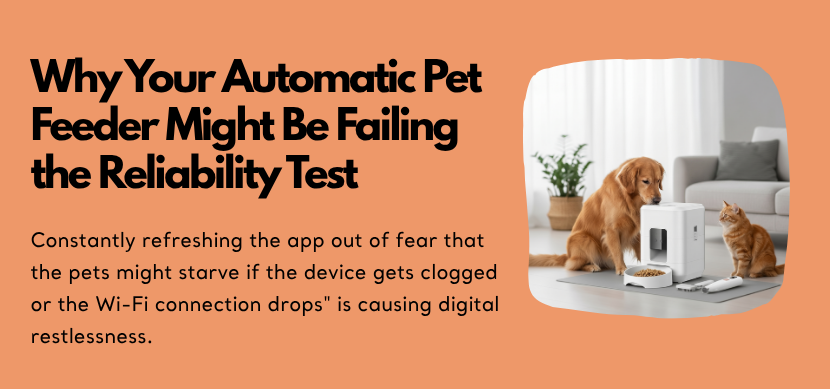
Anyone who lives with a pet knows the small, nagging question that follows them out the door: has he eaten? An automatic feeder promises to answer it for good. Meals arrive on schedule, portions are set from an app, and owners can work late, travel for a weekend or simply sleep in without the guilt. People don't buy a feeder for the food container; they buy it for peace of mind.
That is exactly what many owners say they don't get. Instead of forgetting about feeding time, they find themselves checking their phones: a notification that never arrived, a Wi-Fi connection that dropped, an error code like "F02" that explains nothing. A device bought to remove a worry becomes one more thing to monitor, and the owner is no longer sure whether the pet at home has eaten.
To see where that confidence breaks, we analyzed more than 1,700 pieces of customer feedback about automatic pet feeders in Kimola. The picture is less about technology that doesn't work than about trust that is never earned: devices that may well be doing their job, but can't prove it to the person who isn't there.
What Do Users Actually Experience?
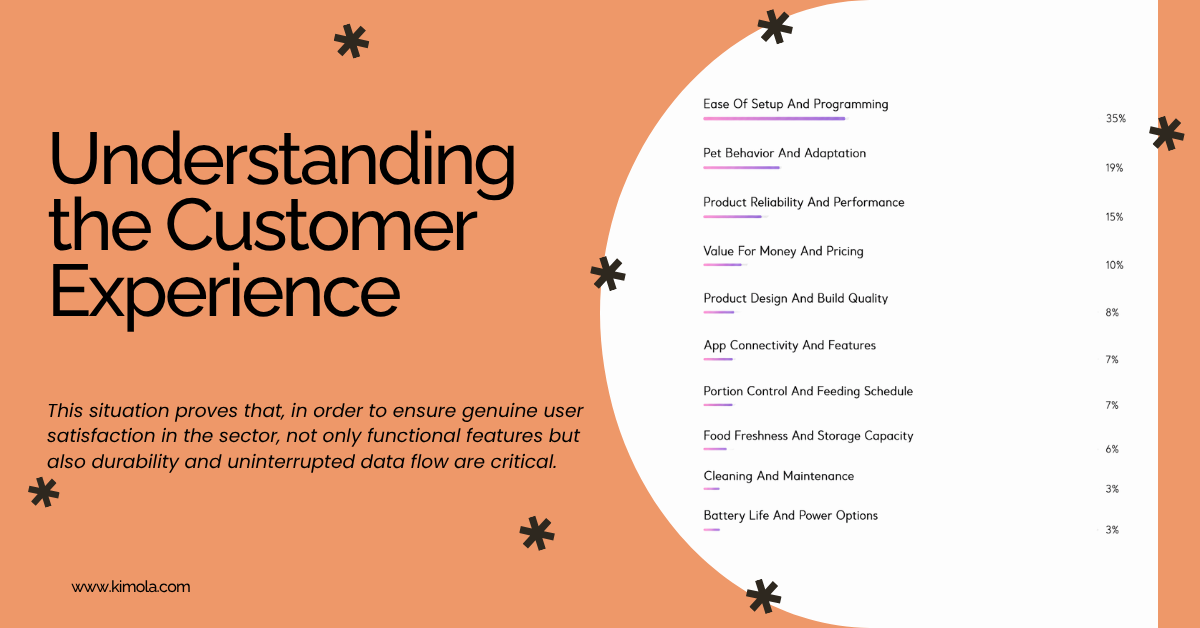
Three things stand out once the feedback is grouped into themes and read alongside the sentiment attached to each one. The first is how quickly early enthusiasm fades. Owners are usually won over by a fast setup and the portion control in the mobile app, but that excitement turns into anxiety the first time the device skips its routine. Unstable Wi-Fi connections, and the fact that many devices only work on 2.4 GHz networks, turn remote control from a convenience into a risk that can fail at any moment.
The second, and the most frustrating, is the lack of evidence. Feeders work silently, so an owner who is away cannot tell whether the motor actually turned, whether a full portion dropped into the bowl or whether an error code like "F02" stopped the meal altogether. When notifications fail as well, the device doesn't free the owner; it sends them back to the camera feed again and again to check.
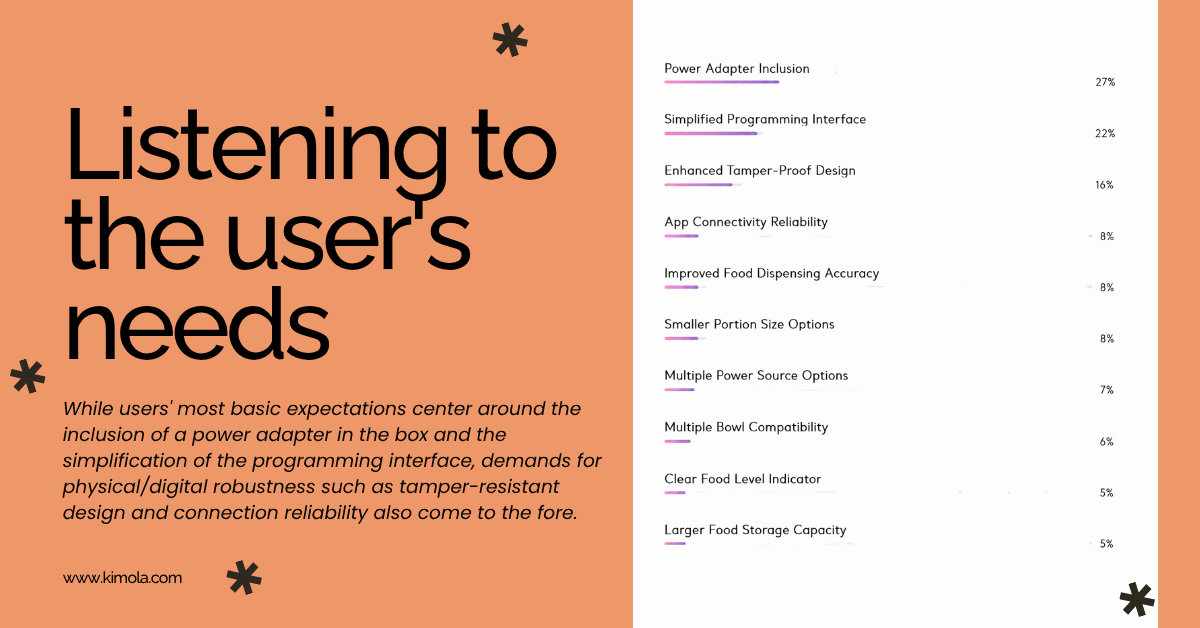
The third is the hardware itself. Owners expect a premium device and find cheap materials and hidden costs instead. Without an adapter in the box, many have to buy D-size batteries, and seals that can't be removed make proper cleaning difficult and shorten the product's life. The designs also underestimate pets: a determined cat that reaches a paw into the dispenser or tips the whole device over to get to the container turns "safe feeding" into a weak point. Taken together, these issues wear down the confidence of even the most tech-friendly owners, precisely when they need the device most.
Who Are the Users?
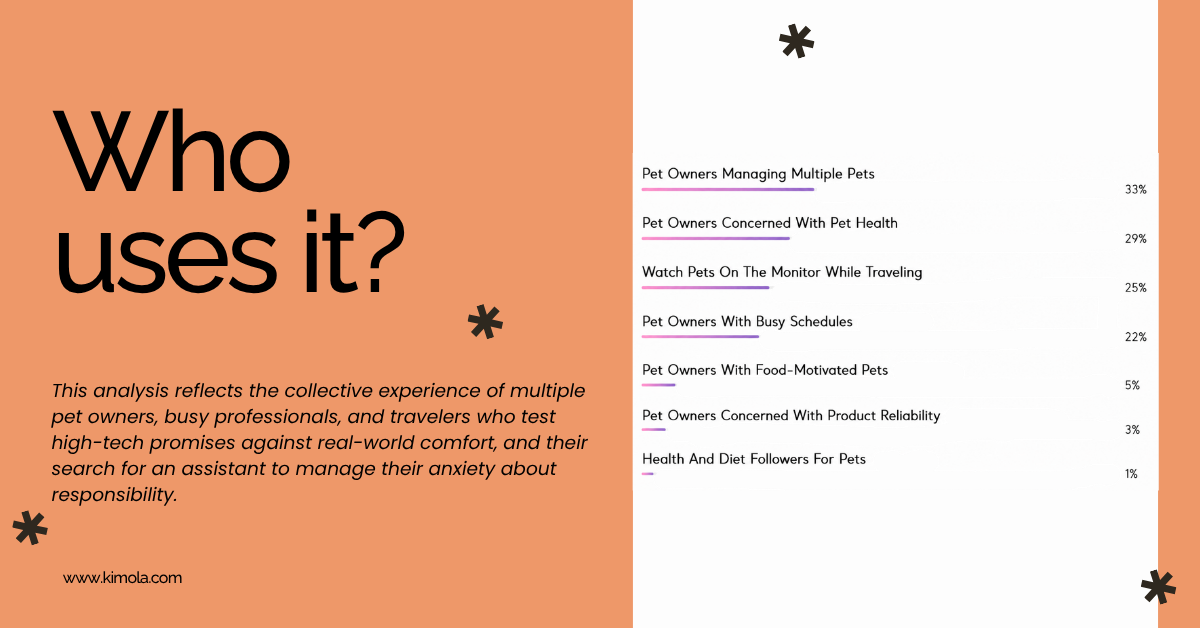
Not every owner buys a feeder for the same reason, and the same failure lands very differently depending on why it was bought. Kimola's Personas dimension groups customers by the needs and priorities they reveal in their own words. Four personas define the category today:
Multi-Pet Households
This group consists of users who require individualized feeding regimens to prevent food competition and theft within the household. They use the device to deter portion theft through features like RFID collars or divider bowls, ensuring each animal adheres to its own diet. Their satisfaction depends on the device's success in ensuring "food safety" and reducing aggressive competition among animals; The biggest source of discomfort is when the device fails to distribute portions evenly among the bowls or when dominant animals manipulate the mechanism to get extra food.
Professionals With a Busy Work Schedule
This segment, unable to be at home because of irregular hours or long shifts, uses the device as a timing guarantee. They expect the feeding routine to run precisely, with remote control, even when they can't be there. They are highly satisfied as long as manual feeding is fully automated, but a lost Wi-Fi connection or a delayed meal notification quickly erodes their trust, and the device starts to feel like a burden rather than a help.
Frequent Travelers
For these frequently traveling users, the device is not just a feeding bowl; it is also a communication center through which they monitor their pet's well-being via integrated cameras. They aim to create a safety net during their physical absence thanks to the device's large storage capacity and backup power options. When the device displays incomprehensible error codes like "F02," when the feeding tube becomes clogged, or when there is uncertainty about the battery status, this remote group experiences significant helplessness and anxiety, negatively impacting the overall experience.
Health-Conscious Caretakers
This segment uses the feeder to control, gram by gram, the portions of pets with obesity or chronic conditions. They rely on precise portion settings and slow-feed modes to bring medical discipline to every meal. When portions are accurate and the diet is followed, their satisfaction is the highest of any group; but if the mechanism dispenses inconsistent amounts, or cannot handle small portions reliably, the device loses its whole purpose for them.
What connects all four groups is that each one hands the feeder a responsibility it cannot see being carried out. For a frequent traveler, a clogged tube means a hungry pet two days away; for a health-conscious caretaker, an inconsistent portion undoes a diet. The higher the stakes of that responsibility, the less a silent failure is forgiven.
Strategic Implications: Shifting from Trust to Evidence
Promise Management: Not Automation, but a Support System
The marketing strategy should abandon positioning the device as an autonomous robot that "completely eliminates the owner's presence." Instead, the product should be presented as an "assistant" that stabilizes the nutrition routine and provides data. Instead of promising the user that the device will do everything on its own, it should be emphasized that it is a tool that facilitates manual tracking. This approach sets expectations on a realistic basis by reducing the sense of "betrayal" the user may feel in the event of a mechanical glitch.
Solving the Problem of Invisible Malfunctions with Transparent Data
The analysis shows that the deepest dissatisfaction stems from a knowledge gap. The strategy should go beyond sending "food dispensed" notifications and build feedback loops that prove the meal was actually delivered. Instead of technical error codes like "F02" in the app, owners should see messages they can act on directly, such as "Food path blocked, please check the chamber." This gives the owner a sense of control over the device and keeps it from becoming a black box.
Transition from "Deficiency" to "Security" in Hardware Perception
The absence of the adapter in the box contents or the cost of batteries should not be framed as a "marketing mistake" but as a "safety layer". The communication language should position the batteries not as the primary power source but as a "lifeline" (backup power) against power outages. The user should be made to feel that they are being offered not just a device, but an uninterrupted energy plan. Additionally, to overcome cleaning challenges, the emphasis should be on "modular design," conveying the message that hygiene is not a mere preference but an integral part of the product's structure.
Being a Behavioral Solution Partner
The product should not be positioned solely as a food dispensing box, but rather as a solution partner that regulates the pet's feeding behaviors (such as rapid eating, waking up early in the morning, and food stealing). Features like RFID or divider containers, especially designed for multi-pet owners, should not be marketed as "add-ons" but as "peace-keeping tools" that end the chaos in the home. This transforms the product from a physical item into a functional component that manages the social dynamics within the household.
Understanding the Experience Beyond the Data
Automatic pet feeders show that a product can fail without breaking. Many of the devices in this study may well have fed the pet on time; what they failed to deliver was the certainty owners paid for. That kind of failure rarely shows up in a defect report. It shows up in customer feedback, in the words owners use to describe checking their phones at work, and it only becomes visible when thousands of comments are read together and structured the same way.
Kimola is an AI platform that turns customer feedback into enterprise-grade market research. It analyzes marketplace feedback, survey responses, support conversations and social discussions the way a research team would, organizing them into themes, sentiment and research Dimensions such as pain points, motivations and personas. If you don't have feedback of your own yet, or want to study a competitor, you can create a report by adding links to product pages on Amazon and other supported platforms, and Kimola collects and analyzes the customer feedback on those pages.
Small and medium-sized businesses can subscribe to one of Kimola's online plans and run studies like this one on their own, whether for a one-off category study or ongoing research. For enterprises, Kimola works as an organization-wide insight hub. Accounts are set up together with a dedicated Account Manager, feedback is classified with the organization's own custom Models, and every team, from research and product to customer experience, works from a common insight language across all of its research and CX programs.
If you build, sell or market pet products or connected devices, create a free account and run the same analysis on your own products and your competitors' to see where your promise and your customers' experience drift apart. If you are planning research across your whole organization, request a demo to see how Kimola works with your own data.