How to Scrape and Analyze Amazon Product Reviews
11 mins read - Created on Dec 18, 2025Amazon product reviews contain rich customer feedback that can be analyzed to identify customer needs, pain points, and underlying motivations. Kimola enables the collection and analysis of these reviews without any technical setup, whether the focus is a single product or a comparative evaluation across multiple listings.
Create a free account or sign in to your existing Kimola account.
Kimola supports both automatic and manual scraping methods. This tutorial explains each method step by step and outlines how the collected data can be analyzed within Kimola. By the end of this guide, you'll be able to choose the right method for your needs and generate reports based on Amazon product reviews.
Let's get started!
Automatically Scrape Amazon Reviews
This method lets you to analyze customer feedback by entering an Amazon product link, without manually scraping reviews or preparing a dataset in advance.
When you enter an Amazon product link, Kimola automatically collects publicly available customer reviews from the product page, builds a dataset in the background, and analyzes the data based on your selected report settings. All steps — from data collection to analysis — are handled automatically.
Here are the steps to create your first report.
Step 1: Get the Amazon Product Link
Open the Amazon product page you want to analyze and copy the URL from the browser’s address bar. Make sure you are on the product page, not a review, category, or seller page.
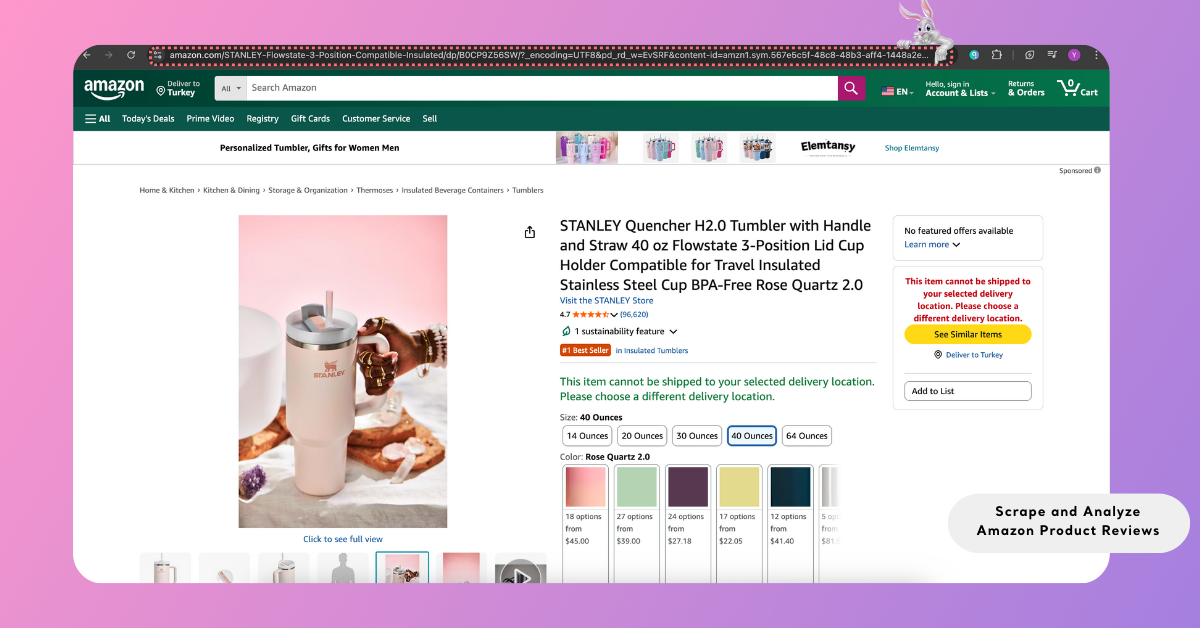
You can collect customer feedback from a single or multiple product links for comparison or grouped analysis. Kimola support both research methods for different business cases.
For a full list of supported platforms to create a report with auto-scraping, see Supported Platforms for Creating Reports from Links including platform-specific details.
Step 2: Enter the Link into Kimola
On the home page of Kimola Dashboard, locate the Create your report area. Enter the link, you copied in the previous step into to bar then hit the Start button.
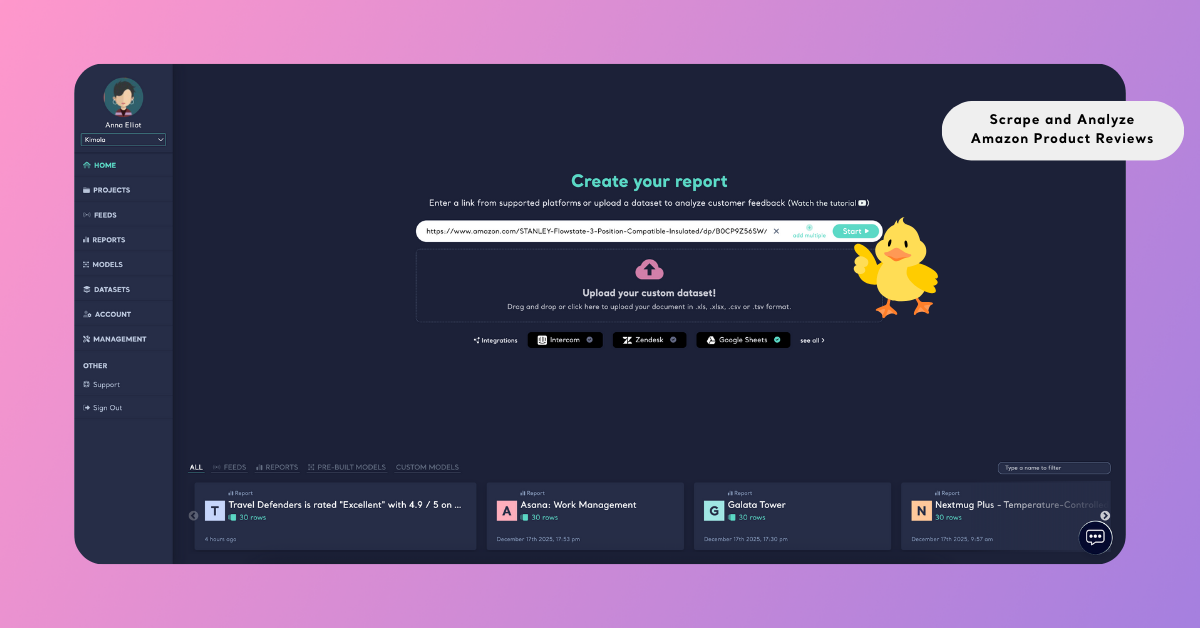
You may need to analyze the customer feedback coming from multiple product link rather than a single one. This allows you to get a broader look into a product or compare different products based on different criteria. In this case, hit the Add Multiple link and enter each Amazon link on a separate line.
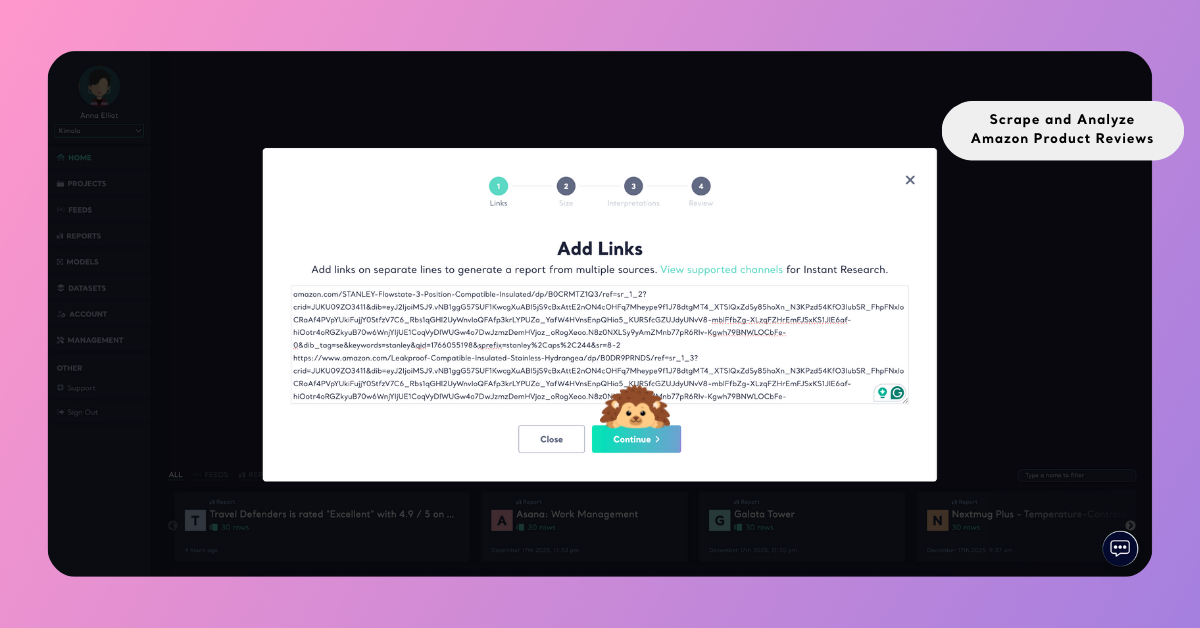
After you enter all the links and hit the Continue button, Kimola automatically validates each URL. If all links are valid, you can proceed to the next step without interruption. If any issues are detected, a validation screen appears, clearly showing:
- Successfully validated links
- Links have errors and need to be fixed or removed
This validation step helps ensure that only supported and accessible Amazon product pages are included in the report, preventing errors during data collection and analysis.
Kimola combines all collected data into a single dataset and generates one report.
Step 3: Select the Report Size
Kimola displays a screen where the total number of reviews to be scraped and analyzed can be defined. The maximum number of reviews available for scraping depends on platform-specific limitations. Using the slider, you can specify the target dataset size that will be used to generate the report.
When multiple product links are included, Kimola distributes the selected report size evenly across all links. If one or more links contain fewer available reviews than required, the remaining quota is automatically fulfilled using reviews from the other links. This ensures that the total dataset size specified for the report is reached whenever sufficient data is available.
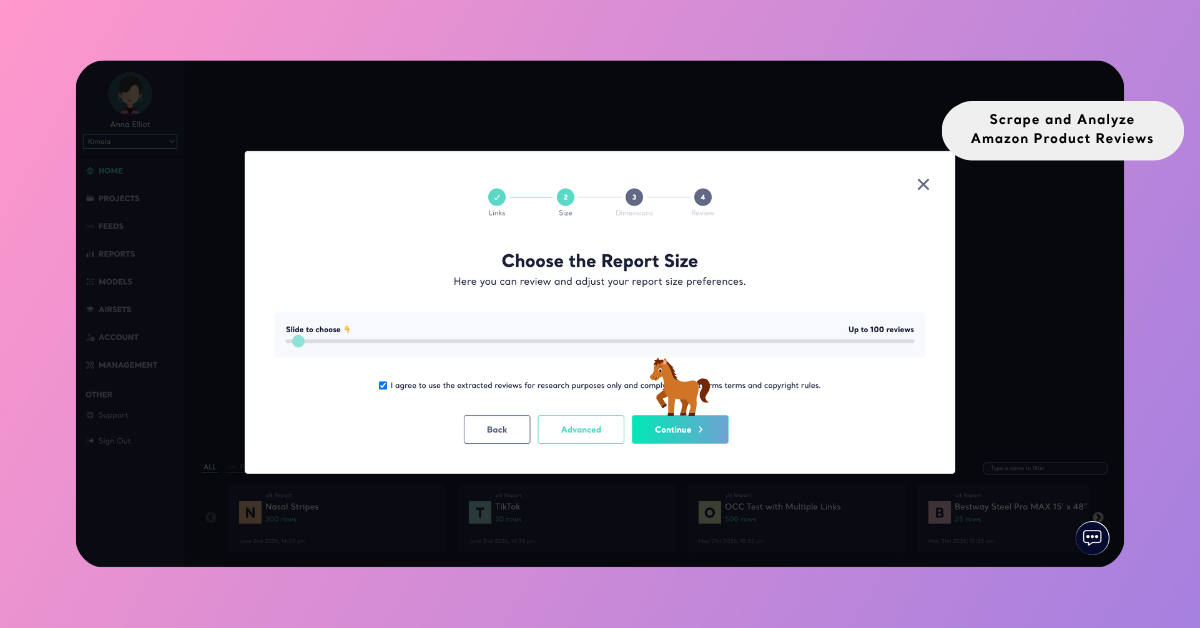
This step allows you to control the overall dataset size and manage the available queries in your plan more efficiently.
After link or links are added and data size is selected, continue with the common report creation steps below.
Leveraging Product Attributes in Amazon Reviews
While auto-scraping Amazon product reviews, Kimola also collects product-specific attributes other than basic fields like review content, rating, url, and date depending on the product category and selected variations.
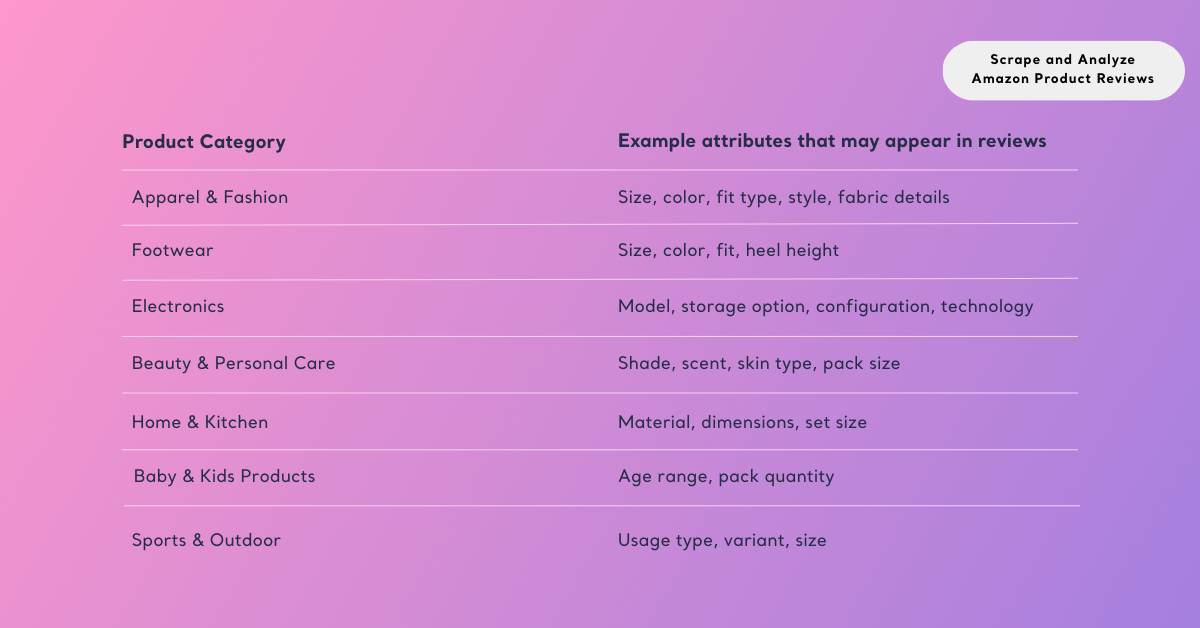
These attributes may vary from product to product and are not limited to a fixed list. If an attribute appears on the Amazon review interface, it is included in the dataset. Below, you can see some of the examples of product-specific attributes collected from Amazon:
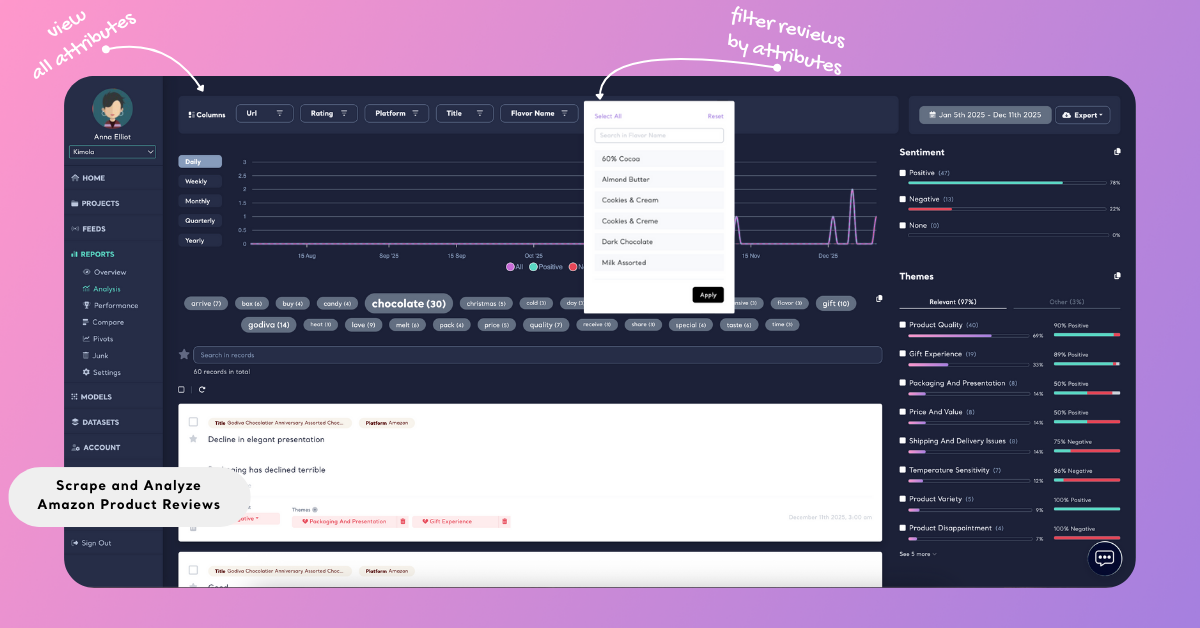
Every time you created a report using the automatic scraping workflow, these attributes appear as filter options at the top of the report. They allow you to narrow the analysis to specific product attributes or compare classifications across different attributes.
Manually Scrape Amazon Reviews
Manual scraping allows you to collect customer feedback directly through a browser extension while browsing Amazon product pages. To support this workflow, Kimola provides its official browser extension, Airset Generator, which captures reviews on supported platforms and stores them as an Airset in your Kimola account.
Before you begin, make sure the Airset Generator is installed and set up on your browser. You are logged into your Kimola account and have connected your API Key. If you haven’t completed setup yet, follow the Set up the Airset Browser Extension guide.
Airsets allow you to store scraped reviews before analysis. This makes them especially useful when working on larger research projects or when collecting data from different products or sources over time. Instead of analyzing everything immediately, you can first collect and organize your data as Airsets, then decide later which dataset to analyze by creating a report.
Unlike automatic scraping, manual scraping through the Airset Generator does not consume queries from your plan. This means that even users on the free plan can collect customer feedback without query-based limitations
Step 1: Open the Amazon Product Page
Go to amazon.com and navigate to the product you want to analyze. Since Airset Generator collects only the reviews that are currently visible in your browser, first open the full review list for the product.
Scroll down to the Customer Reviews section and select See more reviews to load the dedicated reviews page. The resulting URL typically follows a pattern similar to www.amazon.com/product-reviews/<product-id>...
You can pin the Airset Generator next to your browser’s address bar for quick access. While browsing, the extension automatically surfaces the number of available reviews on each page as a small badge.
Step 2: Start Scraping Amazon Product Reviews
Once you are on the Amazon product reviews page, the Airset Generator icon in your browser toolbar displays a small badge showing the number of reviews currently available on the page. This badge appears on the extension icon, which is typically located in the top-right corner of the browser. If the badge is not visible, verify that you are viewing the correct product reviews page.
Select the Airset Generator icon to open the extension. The product name is displayed for confirmation before data collection begins. Click the Generate button to start capturing the reviews currently visible on the page. During the scraping process, the extension may automatically navigate through additional review pages to collect more data. To avoid interruptions, keep the browser tab active and do not close the browser until the process is complete.
Step 3: Complete the Scraping
During scraping, the browser extension attempts to collect the maximum number of available reviews by navigating through multiple review pages. If needed, you can stop the process at any time by selecting the Continuing button.
Whether the process is stopped manually or completes automatically, an Airset is created and displayed in the extension menu alongside your most recent Airsets. If you are logged in to your Kimola account, you can open the Airset directly from the browser extension to review, manage, or analyze the data by creating a report.
The Airset Generator attempts to collect the maximum number of available customer reviews, but platform-specific limitations apply. For example, Amazon typically displays up to 100 reviews per view. Adjusting the review sorting and star-rating filters on the Amazon reviews page allows access to additional subsets of reviews.
Step 4: Create a Report from the Airset
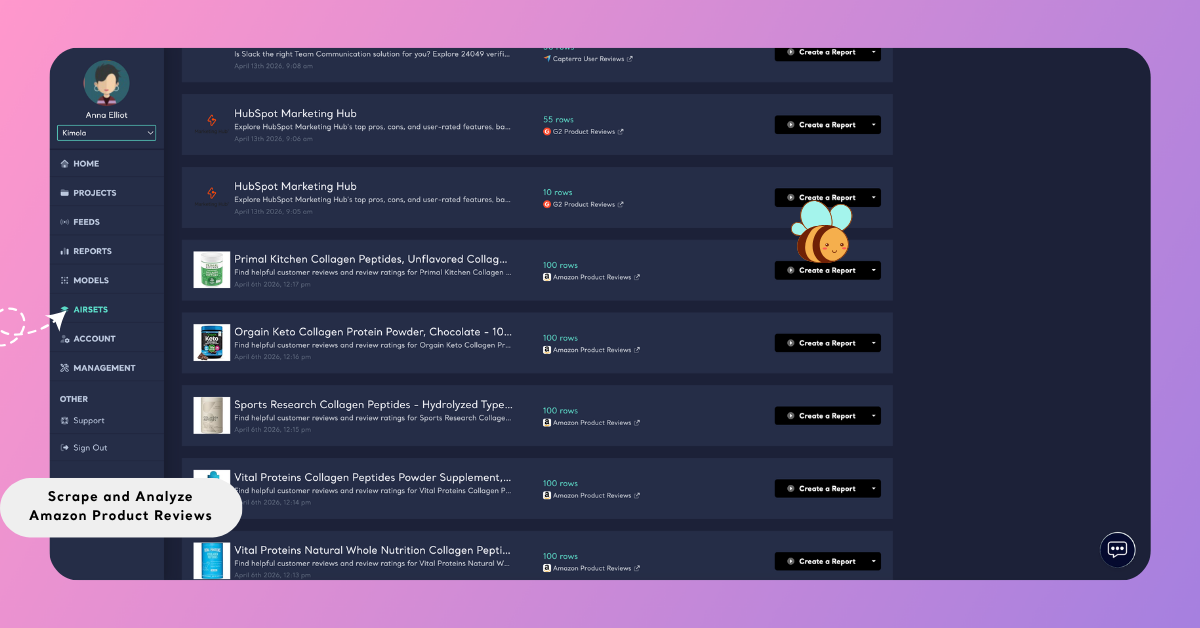
To analyze the customer feedback stored in an Airset, open the Kimola dashboard and navigate to Datasets in the left-hand menu. From there, select Airsets to view the complete list of available datasets.
Locate the relevant Airset and select Create a Report.
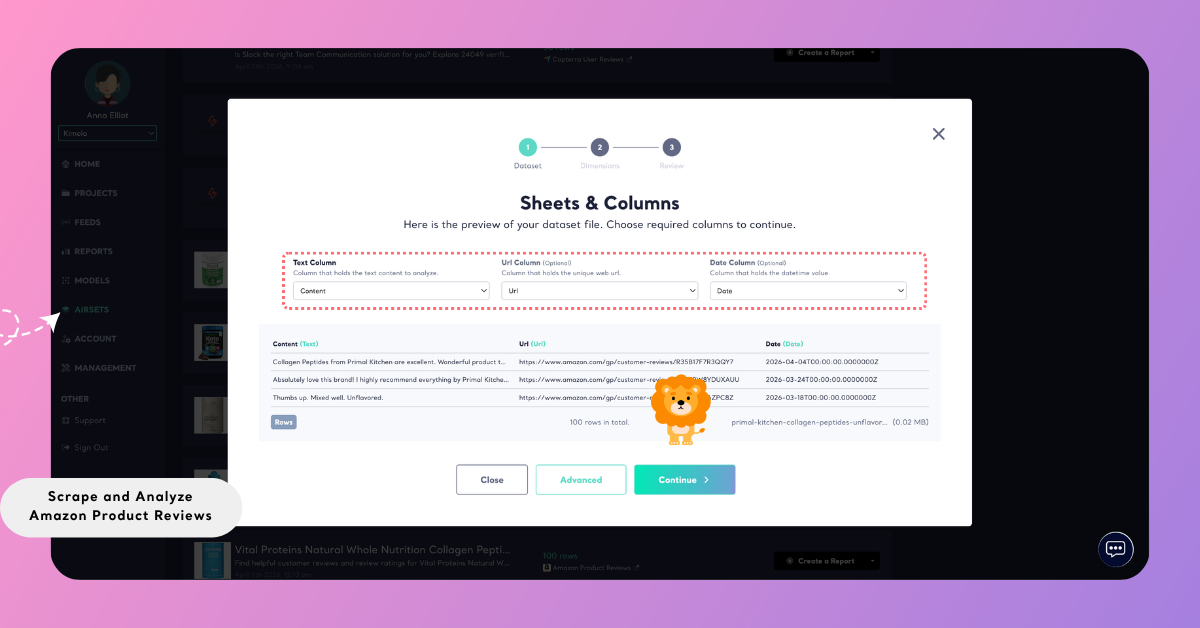
This action initiates Kimola’s standard report creation workflow. Select the column that contains the primary review text, and optionally include date and URL columns if they are available. These selections define the structure of the dataset used for analysis.
Once the column selection is complete, follow the common report creation steps below to continue creating your report.
Analyze Amazon Reviews
Whether Amazon product reviews are collected automatically or manually, they can be systematically analyzed to identify recurring themes, associated sentiment, pain points, usage motivations, and underlying customer needs. This analysis transforms unstructured review text into structured insights that can inform product development, marketing strategy, and broader business decisions.
Kimola uses a unified report generation workflow that is activated across multiple data collection scenarios. In the previous sections, this workflow was initiated for both automatically and manually scraped reviews. In the following steps, the focus shifts to configuring the analysis to ensure that the resulting report aligns with specific research and business objectives.
In addition to one-time analysis, you can automatically track Amazon product reviews by creating a Feed, which provides regular reports and alerts in Kimola.
Choose Dimensions
In addition to standard classifications and aspect-based sentiment results, Kimola allows you to apply higher-level dimensions to the analysis output. This screen enables advanced analyses such as customer personas, pain points, usage motivations, unmet needs, and related interpretive frameworks.
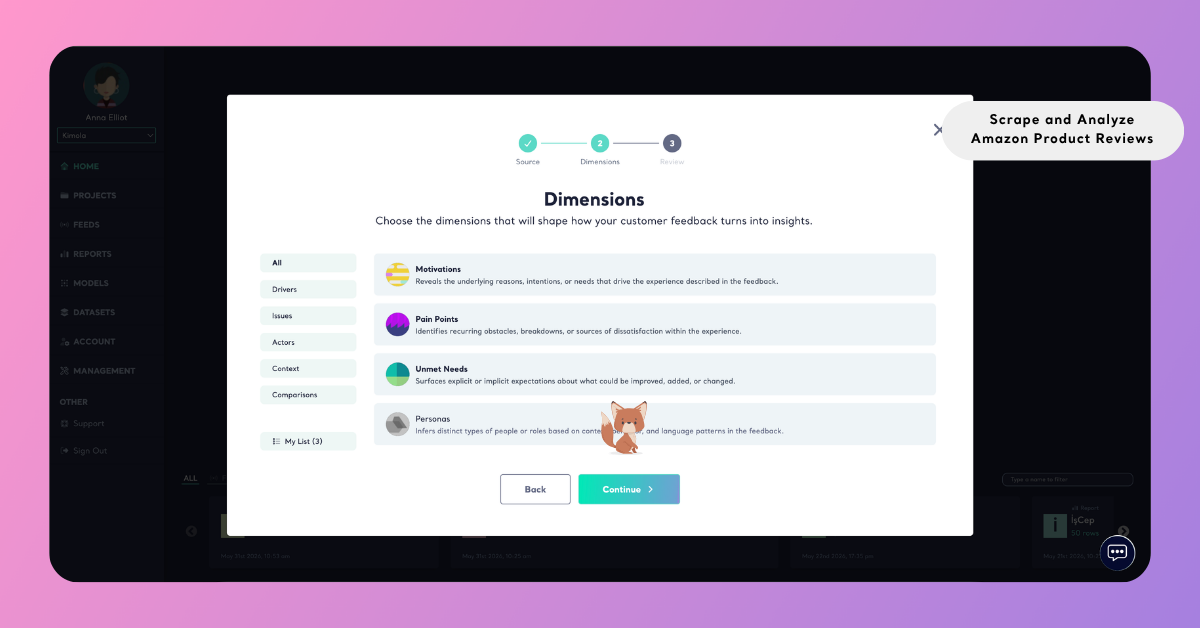
Selected dimensions appear under My List on the left side, allowing you to review and adjust them before creating the report.
Review Report Settings
After the dimension steps, the Review screen appears as the final step before running the analysis.
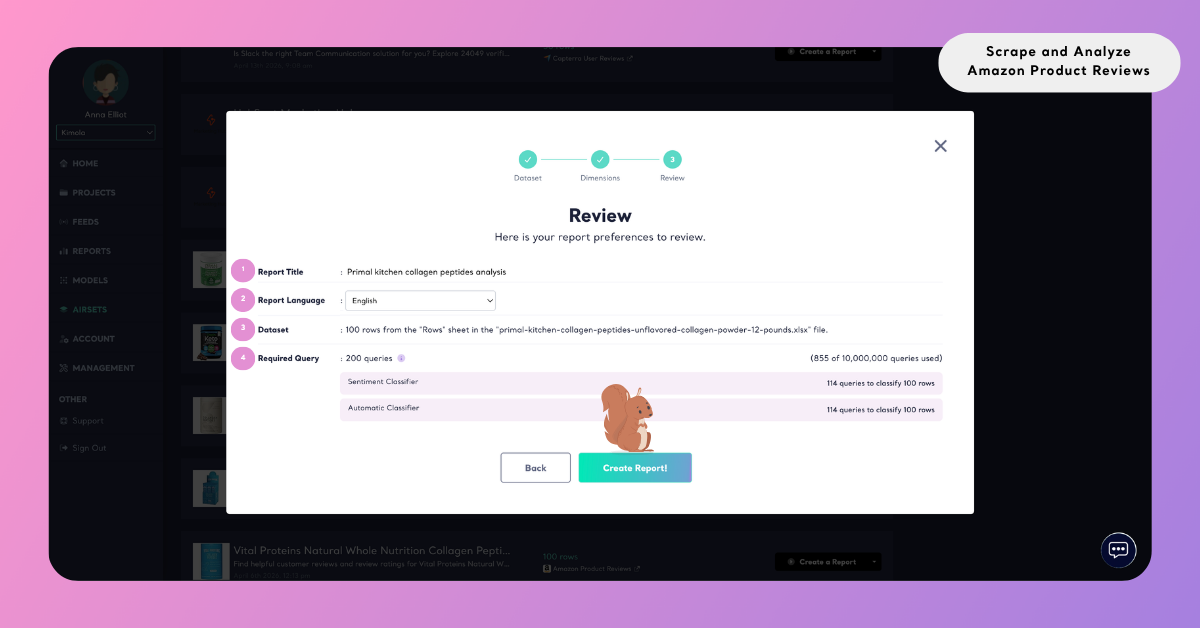
In this screen there are some options to review and modify.
Report Title: Automatically generated from the source (for example, the Amazon product title) when creating a report from a single link. This field cannot be left empty and usually does not require editing.
When creating a report from multiple links or from an Airset, you must enter the report title manually before continuing.
Source / Dataset: Shows the source of the data used to create the report.
- For link-based reports, this field displays the platform detected from the link (for example, Amazon).
- For reports created from an Airset, this field shows the name of the uploaded or generated dataset (the Airset file name).
Report Output: Use the Report Output dropdown to choose the language in which the report results will be generated. This setting controls the language of analysis outputs, including sentiment labels, themes, summaries, and dimension results.
Required Query: The Required Query section shows how many queries will be used to create the report and how they are distributed across analysis steps.
This breakdown may include:
- Scraping queries used to collect data from the selected platform
- Sentiment classification queries applied to each record
- Automatic or custom classifier queries based on the selected dimensions
The total number displayed represents the maximum queries required for this report. This allows you to review plan usage in advance and understand how data volume and selected dimensions impact your quota.
Create the Report
Click Create Report to start the process. Kimola collects the selected data, applies the configured analyses, and generates your report automatically.
Once the report is ready, it appears under the Reports section. From there, you can review the analysis results, organize the report under a Project to keep related work together, or export the outputs for external use.
Reports can be exported in multiple formats to match different workflows:
- Excel for deeper data analysis and custom reporting
- PowerPoint and PDF for presentations and stakeholder sharing
- Email for scheduled or on-demand distribution
This makes it easy to transform Amazon review insights into reusable, shareable outputs that fit directly into your reporting and decision-making processes.
Conclusion
Kimola is built around the idea that meaningful decisions should be informed by real customer voices. Since every research process begins with data, Kimola focuses on making data collection as structured, transparent, and flexible as possible. For this reason, the platform supports both automatic and manual approaches to collecting Amazon product reviews, allowing researchers to choose the method that best fits their scope and constraints.
When using Amazon product reviews, ensure that all data is collected and analyzed strictly for research and internal decision-making purposes. Review content should not be redistributed, republished, or used in ways that violate Amazon’s terms of service or applicable copyright regulations. Users are responsible for ensuring compliance with all platform-specific policies.
If you’re new to Kimola, you can start by trying Kimola’s Amazon Review Analyzer tool. It offers a quick way to analyze Amazon product reviews and helps you get familiar with the workflow before running more advanced analyses.