Understanding the Back to the Future Trilogy Audience: A Deep Dive into
Oct 30, 2026 - 8 minute read
Few films have aged as strangely well as Back to the Future. The first one came out in 1985, the trilogy wrapped up in 1990, and the future it imagined, October 21, 2015, is now more than a decade behind us. We never got the flying cars or the hoverboards. Yet new viewers keep pressing play, old fans keep rewatching, and the DeLorean is still the most famous time machine in cinema.
So what keeps a forty-year-old film about a teenager, an eccentric scientist and a time machine so alive? Is it nostalgia for the 80s, the characters, the clever plot or simply the jokes? Asking fans directly would get you a love letter. Reading what they write on their own, at scale, gets you something more useful: the reasons.
So set the clock, bring the DeLorean up to 88 miles per hour and let’s take a look at the audience.
Methodology
Movie comments are customer feedback too: a viewer telling the world what a film gave them. We collected 1,425 pieces of it from IMDb, the latest 500 for Back to the Future, the latest 500 for Part II and the latest 425 for Part III, and analyzed them in Kimola.
Kimola grouped the feedback into themes and measured the sentiment of each theme separately, so a viewer who loved the humor but found Part II confusing counts on both sides. The Motivations dimension showed what draws people to the trilogy, and the Personas dimension showed who these viewers are.
Roads? Where We're Going, We Don't Need Roads!
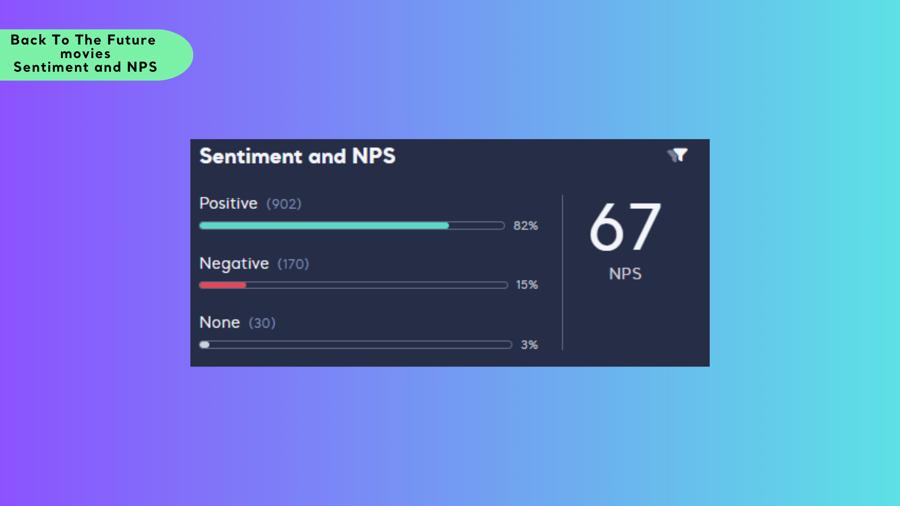
What makes a movie legendary? Box office numbers, or scenes and characters that stay with people for decades? The feedback shows that viewers don’t treat this trilogy as just a film. For them it is a source of nostalgia, an escape and, for some, almost a lifestyle. 82% of the feedback is positive and 15% negative, but the most interesting findings are in the details, and those details explain why the series is still so loved.
Back to the Future not only presents the idea of time travel but also vividly captures the imagination of its era. Its bold futuristic depictions, such as flying cars and self-lacing Nike shoes in 2015, not only captured the spirit of the times but also offered a vision still debated today. Marty McFly's constant appearance in Nike sneakers or the frequent cameos of Pepsi in the films are prime examples of successful brand integration of the time.
All these details turn Back to the Future from a film series into a cultural reference point. It pays homage to science fiction pioneers like Jules Verne while never taking itself too seriously, and that mix of wonder and humor is a big part of why every generation seems to find its way to it.
Viewer Motivations: Why Back to the Future?
Kimola’s Motivations dimension reads each piece of feedback for what draws the viewer to the films. Five motivations stood out, and because a single comment can mention more than one, the percentages add up to more than 100:
Character Development (66%)
Marty McFly’s journey from adolescence to maturity and Doc Brown’s emotional growth are what hold viewers’ attention most. It may have taken Marty a while to realize that being called a chicken isn’t the end of the world, but it’s fantastic character development.
Nostalgia and 80s Culture (60%)
Viewers love how the films capture the spirit of the 80s, and details like the Cafe 80’s scene in Part II are a feast for nostalgic eyes. And no, we haven’t forgotten 1955. The people who remember it firsthand are simply a smaller crowd these days.
Time Travel Concept (59%)
The movie portrays time travel in a fun and creative way. The clock tower serves as one of the most powerful symbols of this concept. Watching the clock tower stand strong through the years, even after witnessing its creation through the DeLorean, surely isn’t just inspiring to me, right?
Humor and Comedy (42%)
Remember when Marty walks into a 1955 diner, asks for a Pepsi Free, and gets told that if he wants a Pepsi, he’s going to have to pay for it? It took me a while to get that joke, but the rest of the audience clearly appreciated the humor: 91% of the feedback on comedy is positive. Lines like “You’re the Doc, Doc!” and “Please excuse the crudity of this model” are just a few examples of the trilogy’s sharp writing.
Cinematic Techniques (32%)
The fire trails left by the DeLorean during time travel, futuristic flying cars, and self-lacing Nike shoes are some of the cinematic elements that captivate audiences.
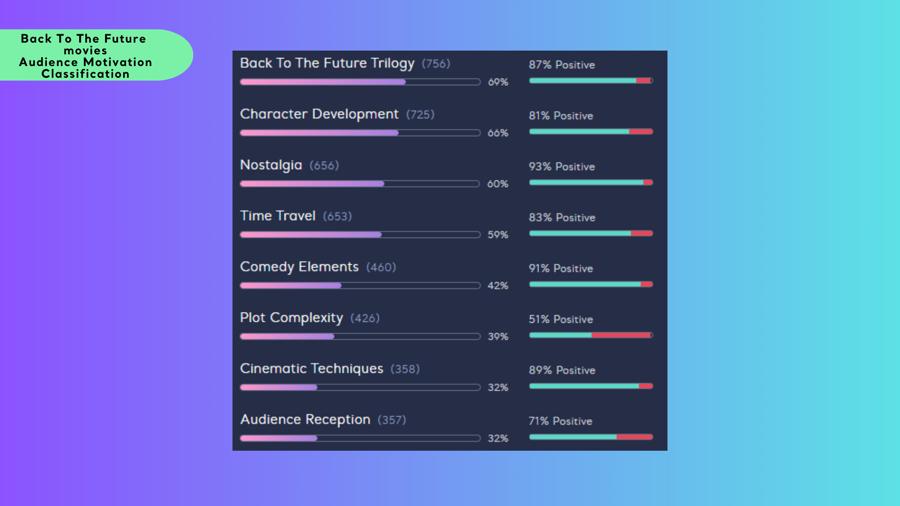
Look at the top three motivations and something stands out. Character development (66%) edges out both nostalgia (60%) and the time travel concept itself (59%). A film that sold itself on a DeLorean is remembered most for the people in it: a teenager learning to keep his temper, and a scientist whose friendship with him viewers care about as much as his inventions.
Audience Profile: Which Personas Love This Movie?
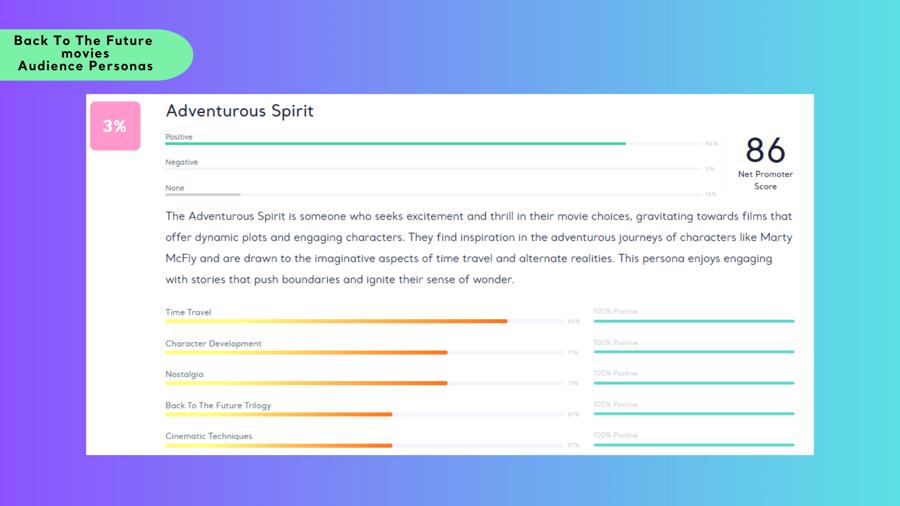
Kimola’s Personas dimension groups viewers by the needs and priorities they reveal in their own words, and eight groups emerged:
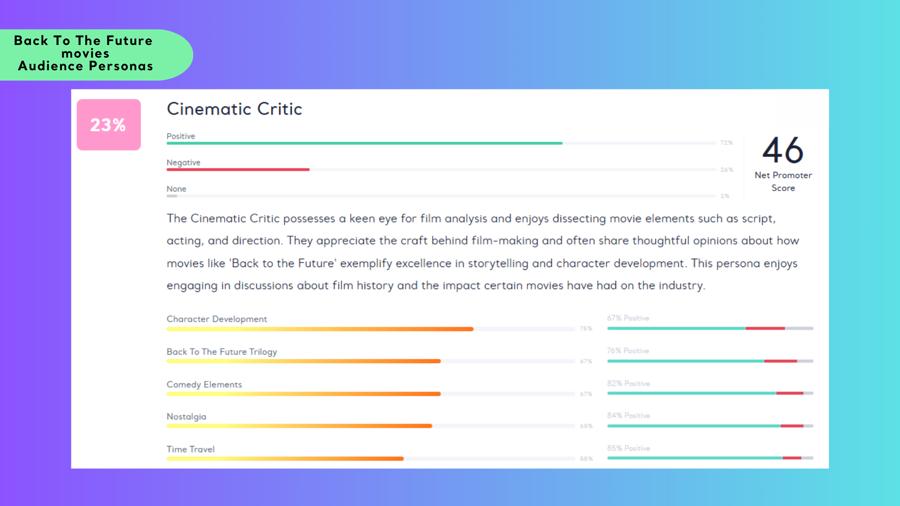
Critical Viewers (23%)
This group examines films in depth, focusing on narrative techniques and consistency. They love debating what makes or breaks a film, using their analytical skills to evaluate pace, character motivation, and storytelling.
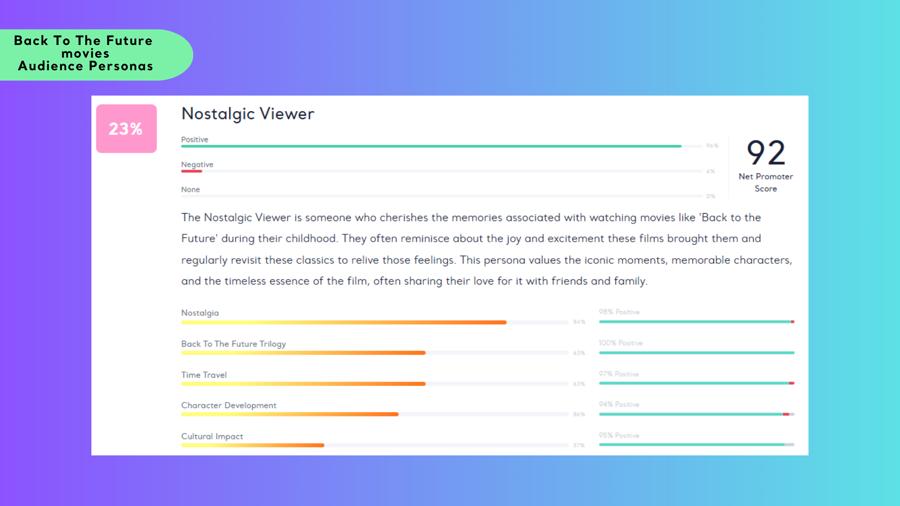
Nostalgic Film Lovers (23%)
Viewers in love with the spirit of the 80s who watch the films with a longing for the past. They frequently revisit beloved films, discuss their cultural impact and often attend film festivals or retrospectives.
Family Entertainer (16%)
The Family Entertainer is a parent or guardian who looks for movies that can be enjoyed together with children. They prioritize films that offer wholesome entertainment and positive messaging while being engaging for both kids and adults. For them, 'Back to the Future' represents a perfect family movie night option, full of adventure and humor that resonates across generations.
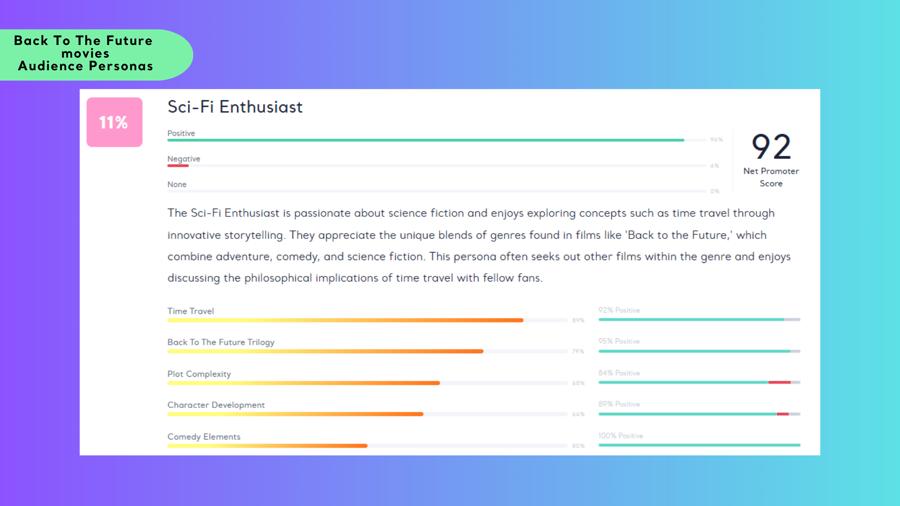
Sci-Fi Enthusiasts (11%)
Viewers fascinated by sci-fi elements like time travel and who love discussing theories. They deeply appreciate films exploring time travel, alternate realities, and futuristic technologies.
Casual Viewer (11%)
The Casual Viewer enjoys watching movies but doesn't dive deep into analysis or discussions. They appreciate the entertainment value of films like 'Back to the Future' and enjoy the light-heartedness and humor present in the story. This persona often watches popular movies during downtime, finding joy in the simple pleasure of a well-made film without the need for critical evaluation.
Pop Culture Buff (7%)
The Pop Culture Buff is fascinated by the influence of films on popular culture and often references iconic moments, quotes, and characters from movies like 'Back to the Future' in conversations. They enjoy exploring how these films have shaped cultural trends and are likely to collect memorabilia or engage with fan communities. This persona thrives on the nostalgia and cultural significance the film embodies.
Curious New Viewers (3%)
Young viewers discovering Back to the Future for the first time and exploring its cultural legacy. They seem to be thoroughly enjoying this discovery.
Cinematography Aficionado (2%)
The Cinematography Aficionado appreciates the artistic elements of filmmaking, focusing on visuals, lighting, and shot composition. They admire how 'Back to the Future' utilizes these elements to enhance storytelling. This persona enjoys analyzing scenes, discussing cinematographic techniques, and sharing insights on how visuals contribute to the overall impact of a film.
Two numbers in this list deserve a second look. The largest group, tied with the nostalgic fans, is the Critical Viewers: this audience loves the trilogy, but it also takes it seriously enough to argue about pacing and plot holes. And Curious New Viewers make up only 3% of the feedback. Back to the Future is still kept alive mostly by people who already love it, which is exactly the kind of signal a studio, a streaming platform or a rights holder would want before planning a re-release.
Did the Future Turn Out as Promised?
Some of the movie’s predictions about the future came true, while others remained purely fictional. Predictions like flying cars, transparent ties, and self-adjusting jackets for 2015 didn't quite materialize. However, self-lacing Nike shoes and widescreen TVs did become reality. Who knows how much longer we’ll have to wait for flying cars?
I hope not too long because the idea of doing flips in the air with my car might not sound as exciting when I’m old!
What the Audience Is Really Saying
Forty years on, Back to the Future is still far more than a sci-fi classic. The feedback shows an audience that comes back for the characters, the 80s and the jokes as much as for the time travel, and that loves the films enough to be critical of them. Their predictions for 2015 may have missed, and lawyers are still very much in business, but their read on what audiences would love turned out to be remarkably accurate.
That is what makes audience feedback so valuable. Box office numbers and star ratings tell you a film worked. Customer feedback, read at scale, tells you why it worked, for whom and what might keep it working for the next generation, which is the kind of understanding market research is supposed to deliver.
Dear Doc, allow us to sign off the way you did in your letter from 1885: your friends in time.
Kimola is an AI platform that turns customer feedback into enterprise-grade market research. It analyzes audience and marketplace feedback, survey responses, support conversations and social discussions the way a research team would, organizing them into themes, sentiment and research Dimensions such as motivations, pain points and personas. If you don’t have feedback of your own yet, or want to study a competitor, you can create a report by adding links to pages on Amazon, Google Play, the App Store and other supported platforms, and Kimola collects and analyzes the customer feedback on those pages.
Small and medium-sized businesses can subscribe to one of Kimola’s online plans and run studies like this one on their own, whether for a one-off study or ongoing research. For enterprises, Kimola works as an organization-wide insight hub. Accounts are set up together with a dedicated Account Manager, feedback is classified with the organization’s own custom Models, and every team, from research and product to customer experience, works from a common insight language.
If you work in film, streaming, gaming or any business where audiences decide what lasts, create a free account and run the same analysis on your own titles and your competitors’. If you are planning research across your whole organization, request a demo to see how Kimola works with your own data.