Understanding Query Usage for Feeds
2 mins read - Updated on Oct 09, 2025In Kimola, Queries are the atomic units that determine how your package usage is calculated. Each query represents a single piece of collected data — whether it’s a detailed news article, a long social media post, or a short e-commerce review.
Understanding how queries are consumed helps you manage your package efficiently and ensure your data collection remains sustainable over time.
How Queries Work in Feeds
Creating a feed itself does not consume any queries. However, once a feed is created and its keywords or links are defined, Kimola immediately begins scanning the internet for matching content.
When the feed is first initialized, the system collects just enough data to generate your first insights. To prevent uncontrolled query usage, the initial data collection is intentionally limited — typically to fewer than 50 records.
Each piece of collected data — regardless of its length — counts as one query from your package. That means a short e-commerce review and a long-form news article both consume one query each.
After the initial batch, Kimola continues to collect new data regularly from your defined sources. Although the platform doesn’t guarantee strict real-time synchronization, it continually retrieves relevant content as it becomes available. Each new piece of content collected also deducts one query from your package balance.
Monitoring Query Usage
You can easily keep track of your query consumption through the Usage menu, located under the Account tab in your Kimola.
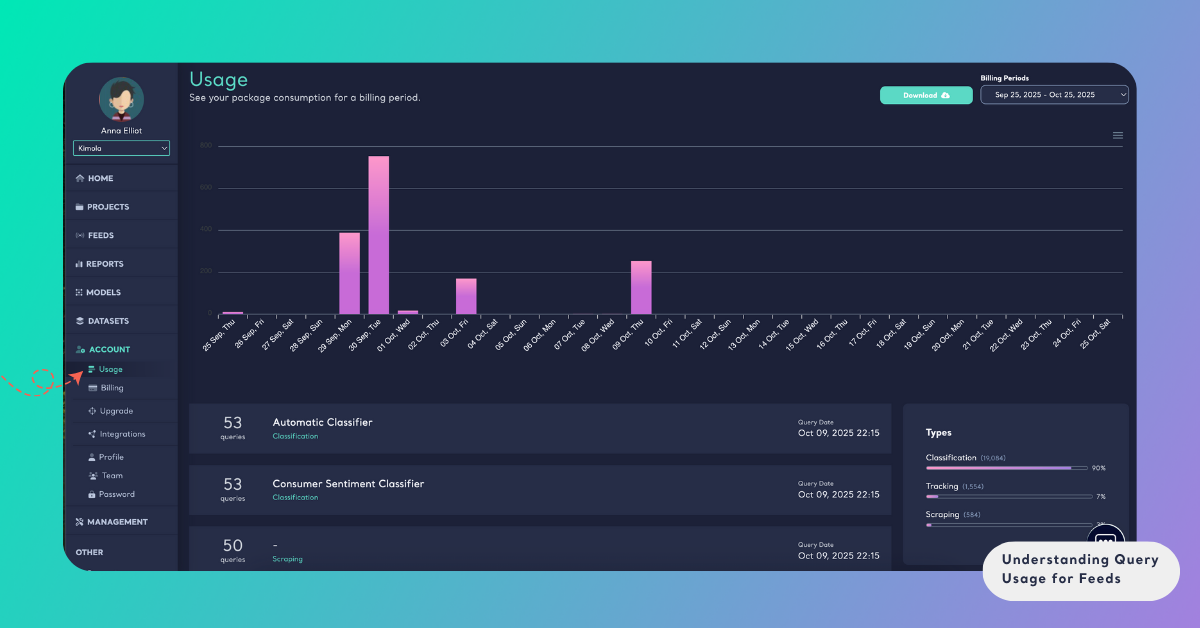
This page gives you a clear breakdown of how your queries are being spent — showing which feeds, actions, or processes consume them — so you can monitor usage in real time and plan your package effectively.